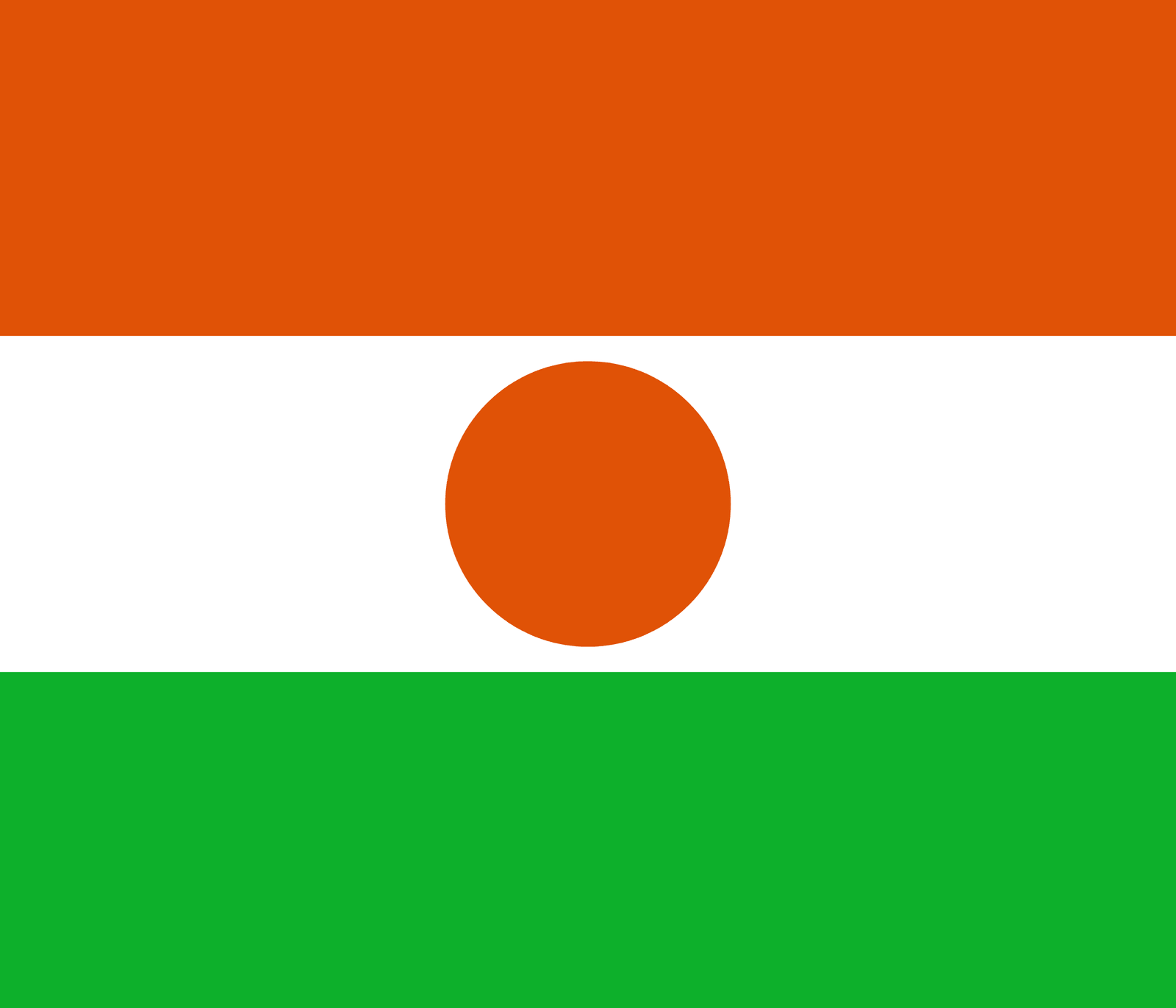
Flag of Niger
| Legal Name | Republic of Niger |
|---|---|
| Flag |
|
| Capital City |
Niamey |
| Total Area | Approximately 1,267,000 km² |
| Land Area | Approximately 1,267,000 km² |
| Water Area | Negligible, mostly seasonal rivers and lakes |
| Population | About 27.5 million |
| Major Cities | Niamey (1.5M), Zinder (350K), Maradi (267K), Agadez (120K), Tahoua (117K) |
| Currency | West African CFA franc (XOF) |
| GDP | Approximately USD 15 billion |
| GDP Per Capita | Approximately USD 550 (nominal) |
About of Niger
Niger is a landlocked country in West Africa, situated at the crossroads of the Sahara Desert and the Sahel region. It shares borders with Libya to the northeast, Chad to the east, Nigeria to the south, Benin and Burkina Faso to the southwest, Mali to the west, and Algeria to the northwest. Niger’s geographic location places it in a region critical for trans-Saharan trade routes, desert ecosystems, and Sahelian climate zones.
The country’s capital, Niamey, is the primary administrative, commercial, and cultural center. Other urban centers like Zinder, Maradi, and Agadez serve as regional hubs for trade, education, and transportation. Niger’s population is predominantly rural, with agriculture forming the backbone of subsistence and local economies.
Niger is internationally recognized as a sovereign state and a member of the African Union, United Nations, and Economic Community of West African States (ECOWAS). Strategically, Niger holds significant importance due to its uranium resources, desert landscapes, and position as a transit country for migration and regional security initiatives.
Etymology
The name “Niger” is derived from the Niger River, which traverses the southwestern part of the country. The river’s name has ancient roots, likely originating from the Latin word niger, meaning “black,” although local interpretations also associate it with the Tuareg and Songhai languages. Over time, the country adopted the name of its principal river as a national identifier, symbolizing the river’s central role in agriculture, transportation, and culture.
History
Prehistoric and Ancient Civilizations
Niger has been inhabited for tens of thousands of years, with evidence of Paleolithic cultures, rock art in the Aïr Mountains, and early pastoralist societies. Archaeological sites reveal sophisticated stone tools, pottery, and early agricultural practices.
Classical and Medieval Periods
From the first millennium CE, Niger became part of trans-Saharan trade networks connecting West Africa to North Africa and the Mediterranean. The region saw the rise of states and empires such as the Kanem-Bornu Empire and Hausa city-states, which facilitated trade in gold, salt, and slaves.
Colonial Rule
In the late 19th century, Niger was colonized by France and incorporated into French West Africa. Colonial administration focused on resource extraction, infrastructure development, and the introduction of European governance models.
Independence Movement
Niger gained independence from France on August 3, 1960, under the leadership of President Hamani Diori. The country established a republican constitution and began the process of building national governance institutions.
Post-Independence Events
Political instability has been recurrent, including military coups in 1974, 1996, and 2010. Despite challenges, Niger has maintained a generally peaceful transition to a multiparty political system, though governance remains influenced by regional conflicts and economic pressures.
Government and Politics
Niger is a semi-presidential republic, with an executive president serving as head of state and a prime minister as head of government. The political system is defined by the 1999 Constitution, which establishes separation of powers, democratic elections, and legal protections for citizens.
Executive Branch: President elected for five-year terms; prime minister appointed by the president.
Legislative Branch: Unicameral National Assembly with members elected for five-year terms.
Judicial Branch: Independent judiciary with a constitutional court overseeing legal and electoral matters.
The country is divided into 8 regions: Agadez, Diffa, Dosso, Maradi, Tahoua, Tillabéri, Zinder, and Niamey (capital district). Niger maintains diplomatic relations with African, European, and Middle Eastern nations and participates in international organizations including the UN, AU, and ECOWAS. Defense is provided by the Nigerien Armed Forces, which address border security, counterterrorism, and regional stability.
Economy
Niger is classified as a developing, low-income economy. Its economic structure relies heavily on agriculture, including millet, sorghum, and livestock, along with uranium mining, which is a critical export commodity. Other sectors include small-scale manufacturing and services, particularly trade and government administration.
Major natural resources include uranium, coal, gold, and oil, while trade partners include France, China, the United States, and neighboring West African states. Economic challenges include climatic variability, desertification, political instability, and high population growth, which place pressure on food security and infrastructure. The country’s economic outlook emphasizes diversification, improved governance, and foreign investment in extractive industries and renewable energy.
Demographics
Niger has a young and rapidly growing population, with an estimated median age of 15 years. Ethnic composition includes:
Hausa (largest group)
Zarma-Songhai
Tuareg
Fulani (Peul)
Kanuri
Languages spoken include French (official), Hausa, Zarma, and various indigenous tongues. The dominant religion is Islam (primarily Sunni), shaping social norms and cultural practices. Approximately 16% of the population lives in urban areas, with the remainder in rural settings. Population growth is high, driven by fertility rates exceeding 6 children per woman.
Culture and Society
Nigerien culture is rich in oral traditions, music, and festivals. Cultural heritage includes the Tuareg music, Hausa storytelling, and traditional crafts such as weaving, leatherwork, and pottery. Social norms emphasize community cohesion, family structures, and hospitality. Major public holidays include Independence Day (August 3), religious festivals like Eid al-Fitr, and local cultural celebrations.
Sports include soccer, traditional wrestling, and camel racing in desert regions. Education is provided through a system of primary, secondary, and tertiary institutions, though literacy rates are low, particularly in rural areas.
Education and Healthcare
The education system in Niger follows a formal curriculum from primary to tertiary levels, with some vocational training opportunities. Literacy rates are estimated at 35–40%, reflecting challenges in access and resources. Higher education is concentrated in Niamey.
Healthcare is provided through a combination of public hospitals, regional clinics, and international aid programs. Public health challenges include malaria, malnutrition, and limited access to clean water, while vaccination campaigns and NGO initiatives have improved child health outcomes.
Geography and Climate
Niger is dominated by the Sahara Desert in the north, Sahelian plains in central regions, and scattered river valleys along the Niger River in the southwest. Physical features include the Aïr Mountains, Air Massif, and seasonal wadis. Niger’s climate is mostly arid to semi-arid, with a short rainy season from June to September and prolonged dry periods.
Natural hazards include droughts, desertification, and occasional locust plagues. Environmental concerns center on water scarcity, soil degradation, and climate change impacts.
Flora and Fauna
Niger has limited biodiversity due to arid conditions, but includes:
Native plants: Acacia trees, desert grasses, and Sahelian shrubs.
Wildlife: Sahelian antelope, desert foxes, cheetahs, and migratory birds.
Conservation efforts: W National Park and Aïr and Ténéré Natural Reserves protect desert ecosystems and threatened species.
Map of Niger
National Flag: Orange, white, and green horizontal stripes with an orange star in the center.
Coat of Arms: Shield with crossed swords, a sun, and millet and sorghum motifs representing agriculture.
National Anthem: La Nigérienne
National Animals/Plants: African lion, dama gazelle, and millet.
National Flag (Detailed Section)
The flag features three horizontal bands: orange (top), white (middle), green (bottom). The orange star in the center symbolizes independence, unity, and hope. The orange represents the Sahara and northern regions, white stands for purity, and green symbolizes fertility in the Niger River valley.
The flag has been in use since 1959, shortly before independence, and is flown on government buildings, schools, and public holidays.
Realted Flags
Flag flying days
| Date | Flag Position | Occasion / Reason |
|---|---|---|
| August 3 | Full-mast | Independence Day |
| May 1 | Full-mast | Labor Day |
| December 18 | Full-mast | Republic Day |
| National Mourning | Half-mast | Death of national leaders or significant tragedy |