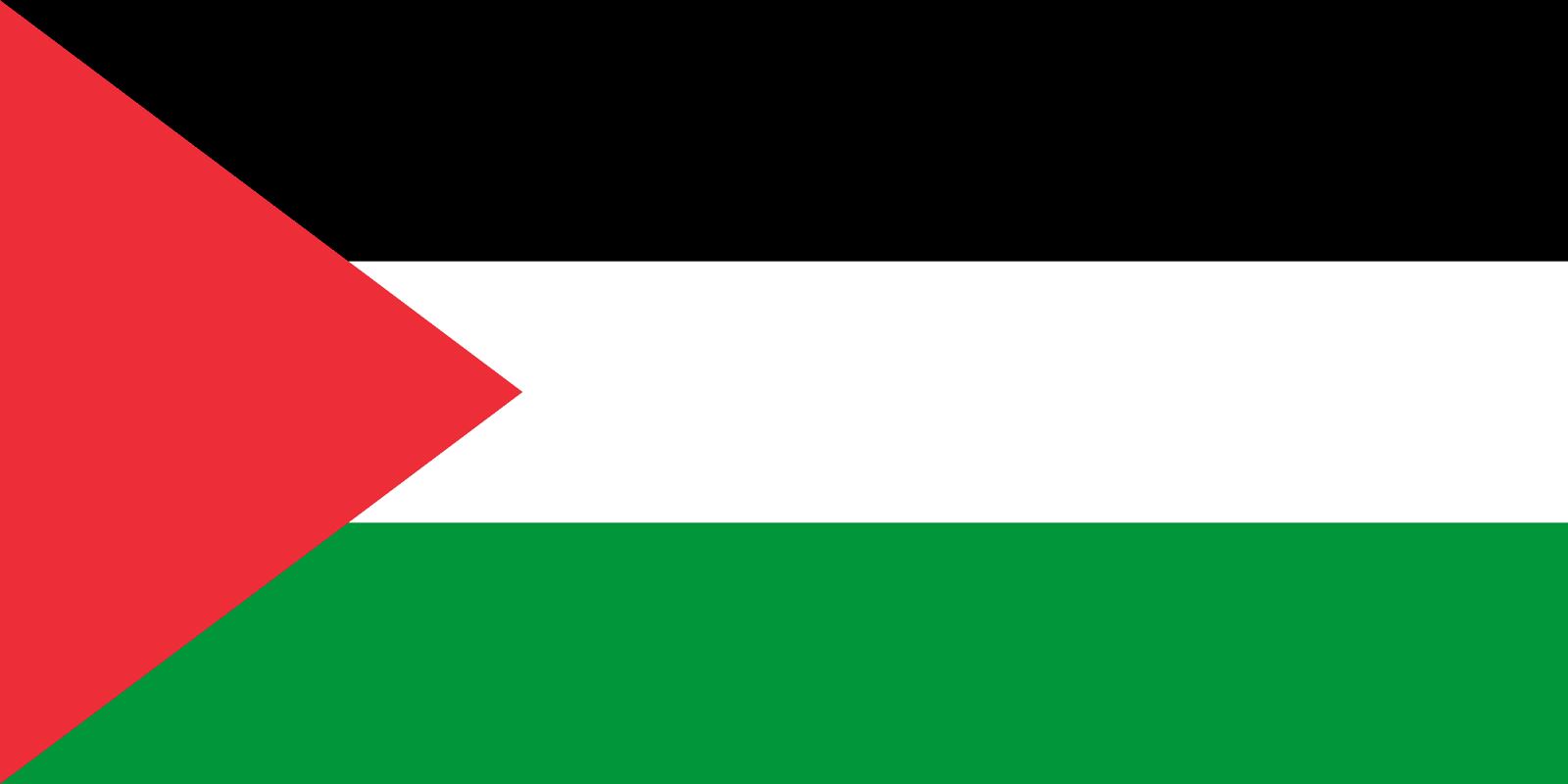
Flag of Palestine
| Legal Name | State of Palestine |
|---|---|
| Flag |
|
| Capital City |
Ramallah (administrative), East Jerusalem (claimed) |
| Total Area | 6,020 km² |
| Land Area | 6,020 km² |
| Water Area | 0 km² (no major inland water bodies under full control) |
| Population | Approximately 5.5 million |
| Major Cities | Gaza City (~590,000), Hebron (~215,000), Nablus (~155,000), Ramallah (~120,000) |
| Currency | Israeli Shekel (ILS), Jordanian Dinar (JOD) in some areas |
| GDP | USD 16 billion |
| GDP Per Capita | USD 6,300 (PPP) |
About of Palestine
Palestine is a Middle Eastern territory located on the eastern coast of the Mediterranean Sea. It encompasses the West Bank and the Gaza Strip, with a diverse landscape including mountainous regions, coastal plains, and valleys. The territory is landlocked in the West Bank and has a Mediterranean coastline in Gaza, providing it with strategic access to trade routes and maritime resources.
Palestine shares borders with Israel and Jordan, with Egypt bordering the Gaza Strip. The administrative capital is Ramallah, while East Jerusalem is claimed as the national capital. Gaza City is the largest urban center, densely populated and economically significant. Despite limited international recognition, Palestine maintains observer status at the United Nations and is a member of various international organizations, highlighting its geopolitical relevance in regional stability, Middle Eastern politics, and the Israeli-Palestinian conflict.
Etymology
The name “Palestine” derives from the Latin “Palaestina”, which itself originates from the Greek “Philistia”, referring to the ancient Philistines who inhabited the southern coastal regions. Historically, the name has been used to describe the territory corresponding to modern-day Israel, the West Bank, and Gaza. Over centuries, it has evolved into the modern political designation of Palestinian territories.
History
Prehistoric and Ancient Civilizations
The region of Palestine has been inhabited for tens of thousands of years, with Neolithic settlements, agricultural development, and early trade networks. Ancient Canaanites, Philistines, and Israelites established early city-states and kingdoms.
Classical and Medieval Periods
The area experienced successive empires, including the Egyptians, Assyrians, Babylonians, Persians, Greeks, and Romans, culminating in the Roman province of Judea. The Byzantine Empire controlled Palestine until the Islamic Caliphates established rule in the 7th century. Later periods saw Crusader states and Ottoman rule beginning in the 16th century.
Colonial and Mandate Periods
Following World War I, Palestine became a British Mandate, formalized by the League of Nations in 1920. The mandate era was marked by growing tensions between Arab and Jewish populations, particularly regarding immigration and land ownership.
Independence Movements
The State of Israel was established in 1948, resulting in the displacement of large numbers of Palestinians (Nakba). Subsequent Arab-Israeli conflicts, including wars in 1967 and 1973, led to Israeli occupation of the West Bank and Gaza. The Palestine Liberation Organization (PLO) emerged as a leading entity advocating for Palestinian self-determination.
Key Post-Independence Events
The Oslo Accords (1993-1995) established limited self-governance under the Palestinian Authority in parts of the West Bank and Gaza. Efforts at peace have been intermittent, with continued territorial disputes, settlement expansion, and periodic conflicts in Gaza.
Modern Political Developments
Palestine continues to pursue international recognition, achieving non-member observer state status at the UN in 2012. Political divisions between Fatah in the West Bank and Hamas in Gaza have complicated governance and diplomacy.
Government and Politics
Palestine operates under a semi-presidential system:
Executive: President (currently Mahmoud Abbas) serves as head of state; Prime Minister leads the Palestinian Authority government.
Legislative: Unicameral Palestinian Legislative Council (PLC), though operations are limited due to political division.
Judiciary: Independent system including Supreme Judicial Council and Sharia courts for personal status matters.
Administrative Divisions: West Bank governorates (11) and Gaza Strip.
Foreign Relations: Limited recognition; maintains diplomatic missions in many countries; engages with UN, Arab League, and Organization of Islamic Cooperation.
Defense: No formal military; internal security managed by Palestinian Security Forces; Hamas maintains armed wing in Gaza.
Economy
Palestine’s economy is developing and constrained by political instability and territorial fragmentation:
Major Industries: Construction, small-scale manufacturing, textiles, and services.
Agriculture: Olives, citrus fruits, vegetables, and livestock.
Trade: Heavy reliance on Israel for imports and exports.
Natural Resources: Limited; small phosphate deposits, arable land.
Economic Challenges: Restricted movement, dependence on foreign aid, limited infrastructure, and conflict-related disruption.
Future Outlook: Economic resilience depends on political solutions, foreign investment, and infrastructure development.
Demographics
Population Composition: Predominantly Arab Palestinians.
Languages: Arabic (official), English widely used in administration and education.
Religions: Islam (majority), Christianity (minority).
Urban vs Rural: Urban population concentrated in cities like Gaza City, Hebron, and Ramallah (~75%).
Population Growth: Relatively high growth rates; young demographic profile with median age below 25.
Culture and Society
Palestinian culture reflects deep-rooted Arab traditions:
Arts & Literature: Rich oral traditions, poetry, calligraphy, and modern literature.
Music & Dance: Dabke (folk dance), traditional songs, and contemporary fusion.
Cuisine: Olive oil, flatbreads, hummus, falafel, and maqlooba.
Social Norms: Family-oriented, hospitality-centered, strong community bonds.
Festivals: Eid al-Fitr, Eid al-Adha, Christmas for Christian minority, cultural heritage festivals.
Sports: Football is the most popular; basketball and traditional games are also played.
Education and Healthcare
Education: Public and private schooling; compulsory primary education; universities include Birzeit University and Al-Quds University.
Literacy Rate: Approximately 96%.
Healthcare: Mix of public and NGO facilities; challenges include access, infrastructure, and conflict-related healthcare needs.
Public Health Achievements: Improved vaccination coverage, maternal health, and chronic disease management programs.
Geography and Climate
Physical Geography: Mountainous West Bank, coastal Gaza Strip, Jordan Valley, Dead Sea basin.
Climate Zones: Mediterranean with hot, dry summers and mild, rainy winters.
Natural Hazards: Earthquakes, flash floods, and water scarcity.
Environmental Concerns: Water shortages, land degradation, urban pollution, and deforestation.
Flora and Fauna
Biodiversity: Limited but diverse in Mediterranean and desert ecosystems.
Native Plants: Olive trees, carob, wild herbs, and date palms.
Wildlife: Hyenas, foxes, gazelles, migratory birds, and Mediterranean reptiles.
Conservation Efforts: Protected areas include Wadi Qelt, Ain al-Hilweh wetlands, and regional nature reserves.
Map of Palestine
Flag: Horizontal black, white, and green stripes with a red triangle on the hoist side.
Coat of Arms: Features olive branches, Palestinian map outline, and national emblem.
National Anthem: Fida’i
National Animals / Plants: Palestinian dove (symbolic), olive tree (heritage and economy).
National Flag (Detailed Section)
Design and Layout: Tri-color horizontal stripes of black, white, and green; red triangle on hoist side.
Historical Development: Inspired by the Arab Revolt flag (1916); officially adopted in 1964 by the PLO.
Symbolism:
Black: Past oppression
White: Peace
Green: Land and hope
Red Triangle: Struggle for independence and sacrifice
Flag Protocol: Flown at official buildings, schools, international events, and diplomatic missions.
Usage: Represents Palestinian identity, unity, and aspiration for statehood.
Flag flying days
| Date | Flag Position | Occasion / Reason |
|---|---|---|
| November 15 | Full-mast | Palestinian Independence Day (Declaration of 1988) |
| May 5 | Full-mast | Nakba Day (Commemoration of 1948 displacement) |
| National Mourning | Half-mast | Death of national leaders or national tragedies |
| Other Cultural Festivals | Full-mast | Local and cultural heritage events |