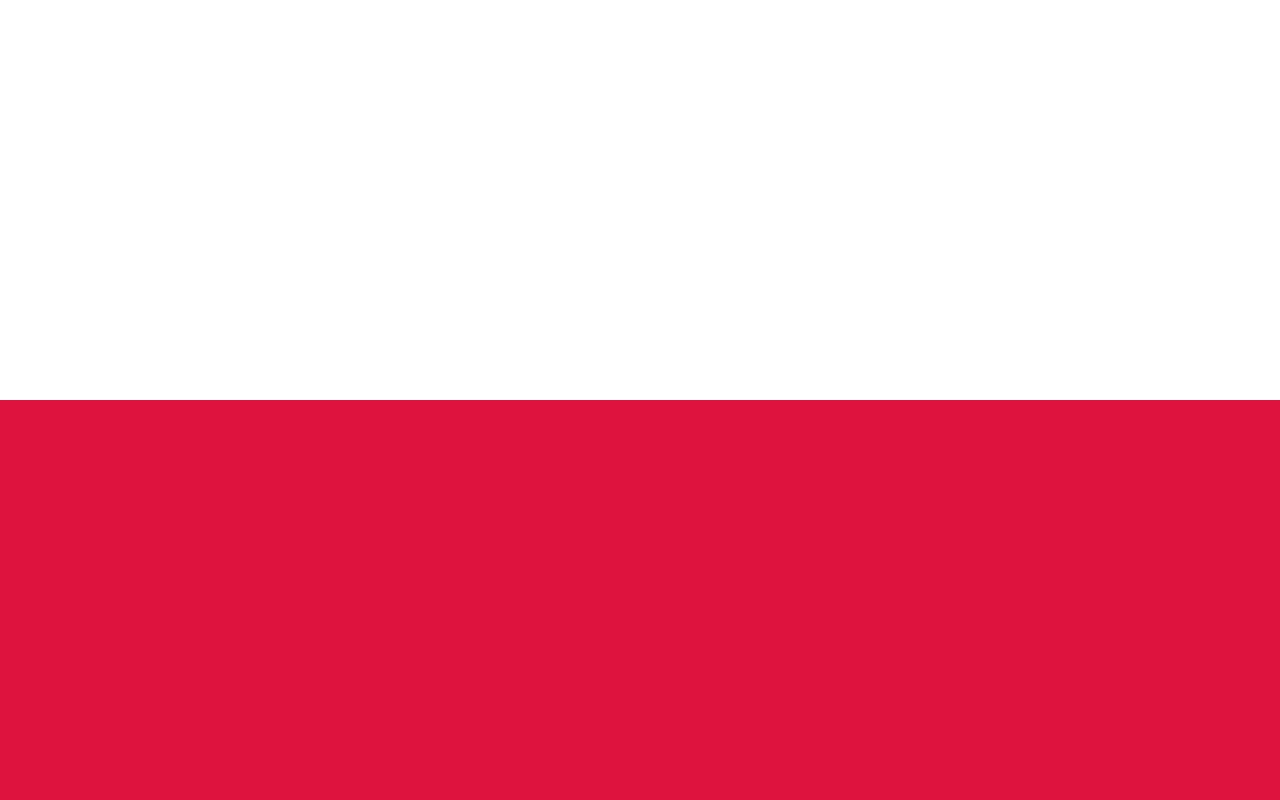
Flag of Poland
| Legal Name | Republic of Poland |
|---|---|
| Flag |
|
| Capital City |
Warsaw |
| Total Area | 312,696 |
| Land Area | 304,255 |
| Water Area | 8,441 |
| Population | Approximately 37.6 million |
| Major Cities | Warsaw (~1.8M), Kraków (~780,000), Łódź (~670,000), Wrocław (~640,000), Poznań (~540,000), Gdańsk (~470,000) |
| Currency | Polish złoty (PLN) |
| GDP | USD 820 billion |
| GDP Per Capita | USD 50,000 (PPP, approx.) |
About of Poland
Poland is a Central European country strategically located between Western and Eastern Europe, forming a historical and cultural bridge between the two regions. It lies on the North European Plain, with access to the Baltic Sea along its northern coast. Poland shares land borders with Germany to the west, Czechia and Slovakia to the south, Ukraine and Belarus to the east, and Lithuania and Russia’s Kaliningrad Oblast to the northeast.
The capital city, Warsaw, is the political, economic, and cultural heart of the country, while other major urban centers such as Kraków, Wrocław, Gdańsk, and Poznań play key roles in industry, education, and tourism. Poland has a largely ethnically homogeneous population compared to many European states, shaped by the profound demographic changes of the 20th century. Internationally, Poland is a sovereign, fully recognized state, and an active member of the European Union, NATO, the United Nations, and the Schengen Area.
Poland’s geopolitical importance stems from its location on NATO’s eastern flank, its growing economic influence in Central Europe, and its historical experience as a frontline state between major powers. It plays a key role in regional security, European energy transit, and political coordination within the EU.
Etymology
The name “Poland” derives from the Polans (Polanie), a West Slavic tribe that settled in the region around the Warta River in the early medieval period. The Polish name Polska reflects this tribal origin. Linguistically, the root pole means “field” or “plain,” referring to the open landscapes inhabited by early Slavic communities. Over time, the tribal name came to represent the broader territory and eventually the unified state.
History
Prehistoric and Ancient Civilizations
Human settlement in present-day Poland dates back to the Paleolithic era, with archaeological evidence of early hunter-gatherer societies. During the Bronze and Iron Ages, the region was inhabited by various Indo-European and later Slavic groups, engaging in agriculture, trade, and metallurgy.
Classical and Medieval Periods
Although never fully incorporated into the Roman Empire, Poland maintained trade contacts with Roman provinces. By the 9th and 10th centuries, Slavic tribes consolidated under the Piast dynasty. In 966, Duke Mieszko I adopted Christianity, marking the birth of the Polish state and its integration into European civilization.
Kingdom and Commonwealth
Poland became a kingdom in 1025 and later formed the Polish–Lithuanian Commonwealth in 1569, one of Europe’s largest and most populous states. The Commonwealth was notable for its early parliamentary system and religious tolerance. Internal weaknesses and external pressures led to its decline.
Partitions and Loss of Statehood
Between 1772 and 1795, Poland was partitioned by Russia, Prussia, and Austria, disappearing from the map of Europe for 123 years. Despite this, Polish culture and identity survived through uprisings, literature, and education.
Independence and World War II
Poland regained independence in 1918 after World War I. In 1939, it was invaded by Nazi Germany and the Soviet Union, triggering World War II. The country suffered immense human and material losses, including the Holocaust and widespread destruction.
Communist Era and Democratic Transition
After 1945, Poland became a socialist state within the Soviet sphere. The Solidarity movement in the 1980s played a crucial role in ending communist rule. In 1989, Poland transitioned peacefully to democracy.
Modern Developments
Since joining NATO (1999) and the European Union (2004), Poland has experienced strong economic growth and increasing regional influence. Contemporary politics feature debates over judicial reform, media freedom, and relations within the EU.
Government and Politics
Poland is a unitary parliamentary republic governed under the 1997 Constitution.
Executive Branch: President (head of state) elected by popular vote; Prime Minister (head of government) leads the Council of Ministers
Legislative Branch: Bicameral parliament consisting of the Sejm (lower house) and Senate
Judicial Branch: Independent courts, with the Supreme Court and Constitutional Tribunal at the highest level
Administrative Divisions: 16 voivodeships (provinces)
Foreign Relations: Active in the EU, NATO, UN, OSCE, and regional Central European initiatives
Defense: Professional armed forces with growing defense expenditure and strong NATO integration
Economy
Poland is classified as a developed, high-income economy and is one of the largest economies in Central Europe.
Key sectors include manufacturing, automotive production, machinery, electronics, food processing, information technology, and business services. Agriculture remains important, particularly grain, potatoes, dairy, and meat production. Poland is rich in coal, copper, silver, and salt, though energy diversification is a national priority.
Germany is Poland’s largest trading partner, followed by other EU states. Major exports include vehicles, machinery, electronics, furniture, and food products. Economic challenges include demographic decline, energy transition, and balancing rapid growth with environmental sustainability. Long-term prospects remain positive due to strong domestic demand, EU investment, and industrial modernization.
Demographics
Poland’s population is predominantly ethnic Polish, with small minorities including Germans, Ukrainians, Belarusians, and Lithuanians. Polish is the official and dominant language.
The majority of citizens identify as Roman Catholic, though religious practice has been gradually declining. About 60% of the population lives in urban areas, with major cities driving economic and cultural life. Poland faces low birth rates and an aging population, partially offset by immigration from neighboring countries.
Culture and Society
Polish culture reflects a blend of Slavic roots, Christian traditions, and European intellectual heritage. National identity is strongly shaped by historical struggles for independence.
Poland has a rich legacy in literature, music, and science, with figures such as Adam Mickiewicz, Frédéric Chopin, Marie Curie, and Czesław Miłosz. Traditional cuisine includes pierogi, bigos, żurek, and rye bread, emphasizing hearty flavors.
Public holidays and festivals often have religious or historical significance, such as Constitution Day (May 3) and Independence Day (November 11). Football is the most popular sport, alongside volleyball, athletics, and winter sports.
Education and Healthcare
Education is free and compulsory until the age of 18. Poland has a strong higher education system, with well-regarded universities in Warsaw, Kraków, and Wrocław. Literacy rates exceed 99%.
Healthcare is provided through a publicly funded universal system, complemented by private services. Key challenges include hospital funding, workforce shortages, and managing chronic diseases, though health outcomes continue to improve.
Geography and Climate
Poland’s geography is dominated by lowlands and plains, with the Carpathian and Sudeten Mountains in the south and sandy Baltic coasts in the north. Major rivers include the Vistula and Oder.
The country has a temperate climate, with cold winters and warm summers. Natural hazards are relatively limited but include floods, storms, and occasional droughts. Environmental priorities focus on air quality, water management, and reducing coal dependence.
Flora and Fauna
Poland hosts diverse ecosystems, including forests, wetlands, and mountain habitats. Native species include oak, beech, pine, and birch trees. Wildlife features European bison, wolves, lynx, deer, and numerous bird species.
Protected areas include Białowieża Forest, one of Europe’s last primeval forests, and several national parks dedicated to biodiversity conservation.
Map of Poland
National Flag: White and red horizontal bicolor
Coat of Arms: White Eagle crowned in gold on a red shield
National Anthem: Mazurek Dąbrowskiego
National Animals / Monuments: White eagle, Wawel Castle, Warsaw Old Town
National Flag (Detailed Section)
The Polish flag consists of two horizontal stripes, white on top and red on the bottom. Its origins date back to medieval heraldry associated with the Piast dynasty.
White symbolizes peace, purity, and the white eagle, while red represents courage, valor, and the blood shed for independence. The flag is used on public buildings, during national celebrations, and in international representation. Strict protocol governs its display, including respectful handling and proper positioning.
Realted Flags
Flag flying days
| Date | Flag Position | Occasion / Reason |
|---|
| May 2 | Full-mast | Polish Flag Day |
| May 3 | Full-mast | Constitution Day |
| November 11 | Full-mast | Independence Day |
| National Mourning Days | Half-mast | Official periods of mourning |