Flag of Singapore
| Legal Name | Republic of Singapore |
|---|---|
| Flag |
|
| Capital City |
Singapore |
| Total Area | Approximately 734 km² |
| Land Area | Approximately 728 km² |
| Water Area | Approximately 6 km² |
| Population | Approximately 5.9 million |
| Major Cities | Singapore (entire city-state functions as a single metropolitan area) |
| Currency | Singapore Dollar (SGD) |
| GDP | Approximately USD 500 billion |
| GDP Per Capita | Approximately USD 85,000 (PPP) |
About of Singapore
Singapore is a sovereign island city-state located in Southeast Asia, situated at the southern tip of the Malay Peninsula. It lies along one of the world’s busiest maritime routes, connecting the Indian Ocean with the South China Sea. Despite its small geographic size, Singapore holds outsized global influence due to its economic strength, strategic location, and political stability.
The country has no land borders but shares maritime boundaries with Malaysia to the north and Indonesia to the south. The capital city, Singapore, also serves as the country’s largest and only city, functioning as a highly integrated metropolitan area with advanced infrastructure and urban planning.
Singapore’s population is highly diverse, reflecting centuries of migration and trade. It is a multicultural society with a mix of Asian ethnic groups and a significant expatriate community. The country is internationally recognized as a global financial hub, major shipping center, and leader in governance efficiency.
Strategically, Singapore occupies a critical geopolitical position in Asia. It plays a key role in global trade, regional diplomacy, and security cooperation, serving as a bridge between East and West while maintaining a policy of neutrality and active international engagement.
Etymology
The name “Singapore” is derived from the Sanskrit words simha (lion) and pura (city), meaning “Lion City.” According to legend, a Sumatran prince encountered a lion-like creature upon arriving on the island and named the settlement accordingly.
Historically, the island was known by various names, including Temasek, meaning “Sea Town” in Old Javanese. Over time, the name Singapore became dominant, particularly during the colonial and modern periods, symbolizing strength, courage, and sovereignty.
History
Archaeological evidence suggests that Singapore was inhabited as early as the 2nd century CE, serving as a trading post within regional maritime networks. During the medieval period, it was part of various Malay and regional empires, including Srivijaya and the Majapahit sphere of influence.
In 1819, Singapore was established as a British trading post, rapidly developing into a major colonial port. It later became part of the British Straits Settlements and grew into a multicultural commercial center.
During World War II, Singapore was occupied by Japan, a period that deeply shaped its political consciousness. After the war, the island returned to British control before gaining self-governance.
Singapore briefly joined the Federation of Malaysia in 1963 but separated in 1965 to become an independent republic. Since independence, it has transformed from a developing port city into a highly industrialized and globally connected nation through strong governance, economic planning, and social cohesion.
Government and Politics
Singapore operates as a parliamentary republic with a strong central government. The political system is based on a written constitution that establishes the framework for governance, civil rights, and the separation of powers.
Executive authority lies with the Cabinet, led by the Prime Minister, while the President serves as head of state with custodial and ceremonial responsibilities. Legislative power is vested in a unicameral parliament, elected through regular general elections.
The judiciary is independent and highly regarded for efficiency and integrity. Singapore is administratively divided into districts and planning areas for governance and urban management.
In foreign affairs, Singapore maintains an active and pragmatic diplomatic posture. It is a member of the United Nations, ASEAN, the Commonwealth, and numerous international organizations. National defense is based on a strong military and compulsory national service, ensuring deterrence and regional stability.
Economy
Singapore has a highly developed, high-income economy characterized by openness, innovation, and strong institutions. It is one of the world’s leading financial centers and consistently ranks among the most competitive economies globally.
Major economic sectors include finance, trade, logistics, electronics manufacturing, biotechnology, and digital services. The services sector dominates the economy, while manufacturing remains technologically advanced and export-oriented.
Agriculture plays a negligible role due to limited land, and the country lacks significant natural resources. Instead, Singapore relies on human capital, technology, and global trade networks.
Its primary trading partners include major economies in Asia, Europe, and North America. Economic challenges include population aging, global economic volatility, and the need to sustain innovation-driven growth in a competitive global environment.
Demographics
Singapore’s population is ethnically diverse, with Chinese, Malay, Indian, and other communities forming the core demographic groups. This diversity is central to national identity and social policy.
Four official languages are recognized: English, Mandarin Chinese, Malay, and Tamil. English serves as the main working and administrative language. Religions practiced include Buddhism, Christianity, Islam, Hinduism, and Taoism, alongside a significant secular population.
The country is fully urbanized, with nearly the entire population living in urban environments. Population growth is driven largely by migration, as birth rates remain low.
Culture and Society
Singapore’s culture reflects a blend of Asian traditions and modern global influences. Multiculturalism is a foundational principle, reinforced through education, housing policy, and public life.
The arts thrive through festivals, museums, and performance spaces showcasing music, theater, literature, and visual arts. Singaporean cuisine is internationally renowned, featuring a fusion of Chinese, Malay, Indian, and Peranakan flavors.
Social norms emphasize discipline, respect for law, community harmony, and meritocracy. Major festivals include Chinese New Year, Hari Raya Aidilfitri, Deepavali, and Christmas. Sports and recreation are actively promoted, with football, swimming, and athletics being popular.
Education and Healthcare
Singapore’s education system is highly structured and internationally recognized for excellence. Compulsory education is supported by a strong emphasis on science, mathematics, and bilingualism, alongside world-class universities and research institutions.
The healthcare system combines public and private services, supported by mandatory savings and insurance schemes. Healthcare outcomes are among the best globally, with long life expectancy and low infant mortality, though challenges include managing chronic diseases and an aging population.
Geography and Climate
Singapore consists of one main island and several smaller islets. The terrain is mostly flat with gently rolling hills, reclaimed land, and an extensive coastline.
The country has an equatorial climate, characterized by high humidity, consistent temperatures, and abundant rainfall throughout the year. Natural hazards are minimal, though heavy rainfall can cause localized flooding.
Environmental sustainability is a national priority, with policies focused on green urban planning, water security, and climate resilience.
Flora and Fauna
Despite urbanization, Singapore maintains notable biodiversity through protected areas and green spaces. Native vegetation includes tropical rainforest species, mangroves, and coastal flora.
Wildlife includes monkeys, otters, reptiles, birds, and diverse marine species. Conservation efforts are centered on nature reserves, urban parks, and marine protection zones.
Map of Singapore
Singapore’s national symbols emphasize unity, progress, and multicultural harmony. The flag, coat of arms, and anthem reflect shared values and aspirations.
The Merlion, a mythical creature with a lion’s head and a fish’s body, serves as an iconic national monument, symbolizing the country’s origins and maritime heritage.
National Flag (Detailed Section)
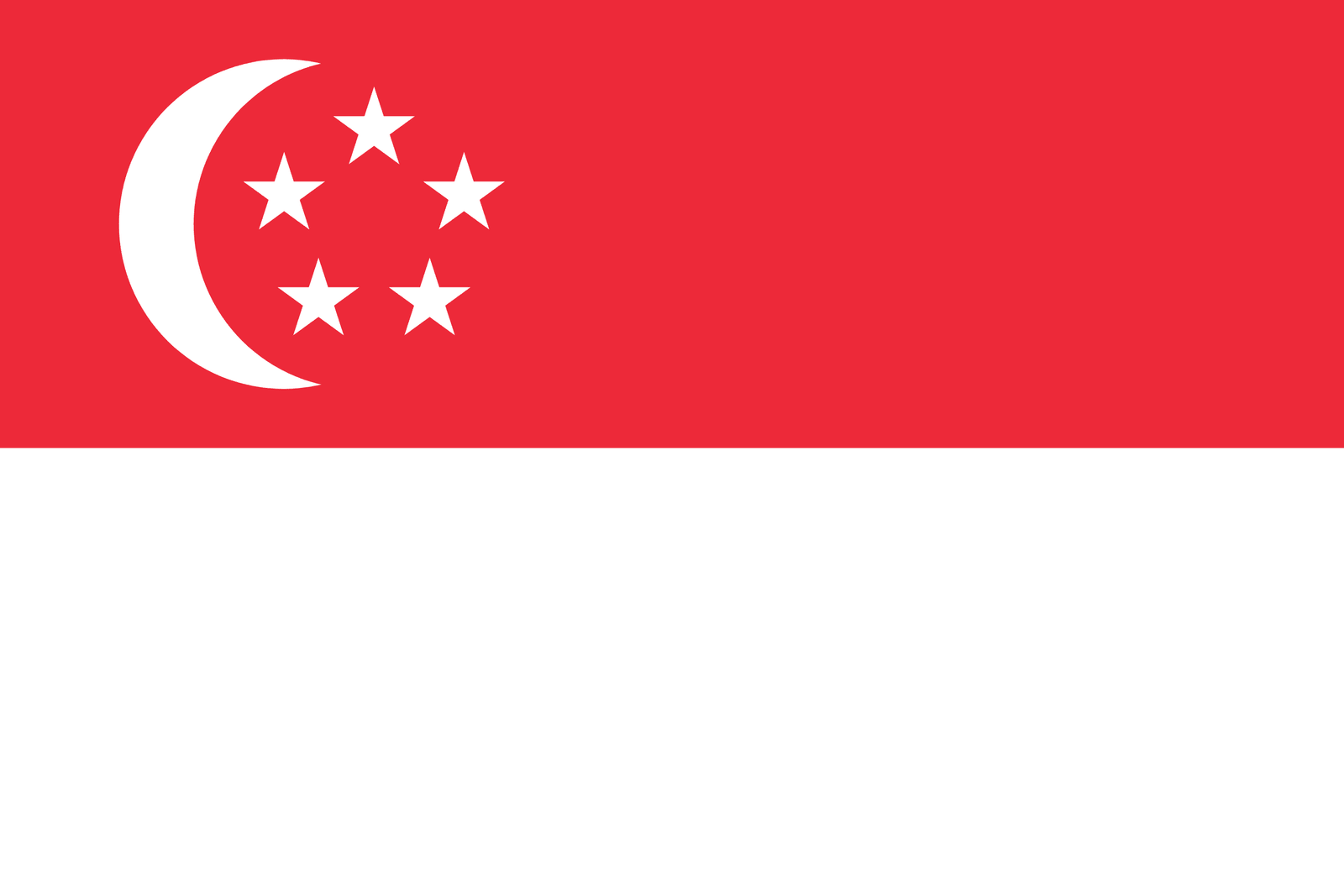
The national flag of Singapore features two horizontal bands of red and white. In the upper hoist corner is a white crescent moon accompanied by five white stars arranged in a circle.
Red symbolizes universal brotherhood and equality, while white represents purity and virtue. The crescent moon signifies a young nation on the rise, and the five stars represent democracy, peace, progress, justice, and equality.
The flag was officially adopted in 1959 and is governed by strict regulations regarding display, usage, and respect.
Realted Flags


Flag flying days
| Date | Flag Position | Occasion or Reason |
|---|---|---|
| February 15 | Full-mast | Total Defence Day |
| May 1 | Full-mast | Labour Day |
| August 9 | Full-mast | National Day |
| As Declared | Half-mast | National mourning or remembrance |