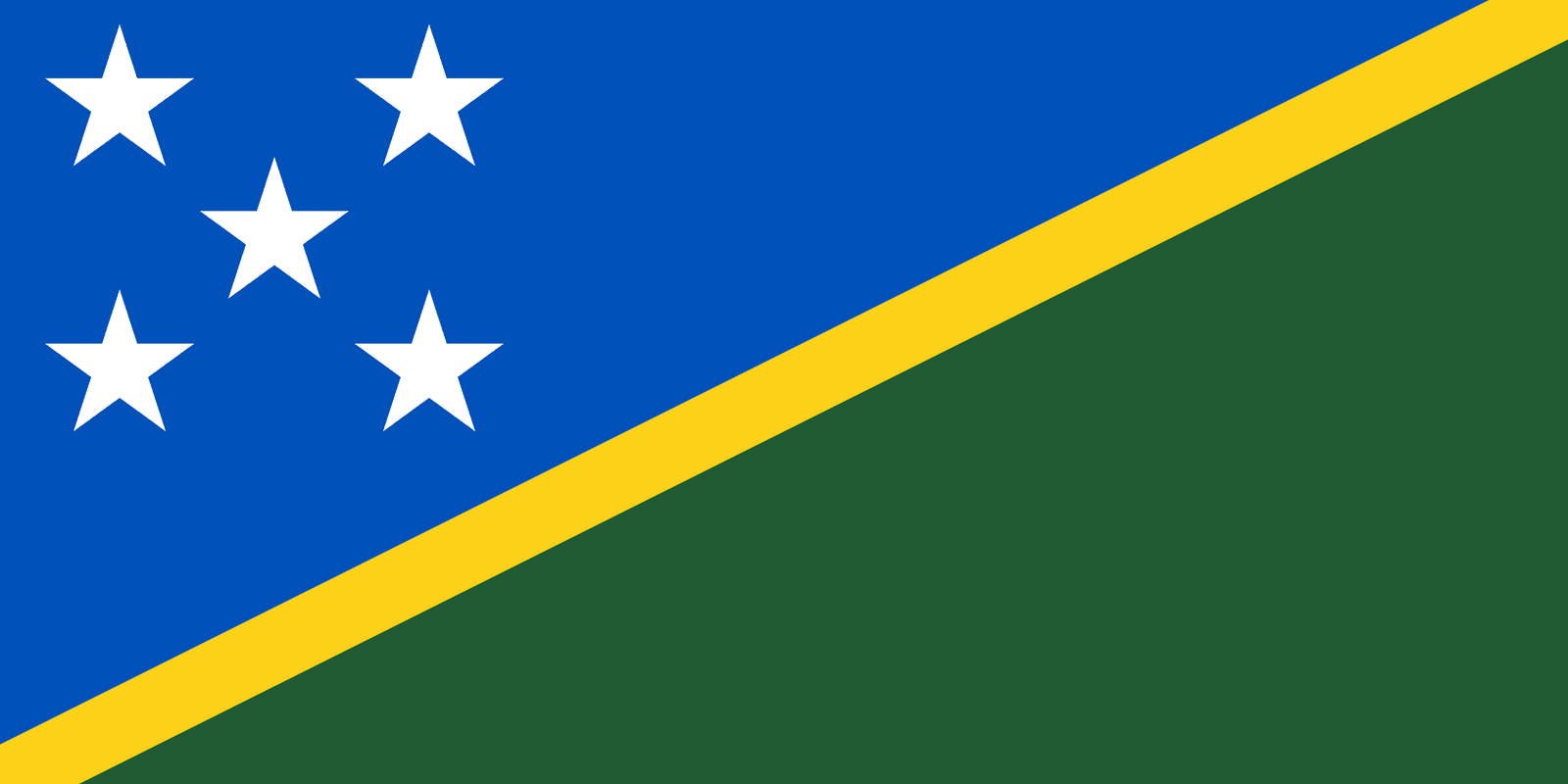
Flag of Solomon Islands
| Legal Name | Solomon Islands |
|---|---|
| Flag |
|
| Capital City |
Honiara |
| Total Area | 28,896 km² |
| Land Area | Approximately 27,986 km² |
| Water Area | Approximately 910 km² |
| Population | Approximately 740,000 |
| Major Cities | Honiara (≈ 85,000), Auki (≈ 8,000), Gizo (≈ 7,000), Buala (≈ 4,000), Kirakira (≈ 3,000) |
| Currency | Solomon Islands Dollar (SBD) |
| GDP | Approximately USD 1.7 billion |
| GDP Per Capita | Approximately USD 2,300 (PPP) |
About of Solomon Islands
The Solomon Islands is an island nation located in the southwestern Pacific Ocean, east of Papua New Guinea and northeast of Australia. It lies within the region of Melanesia and consists of a vast archipelago of more than 900 islands, many of which are volcanic in origin. The country occupies a strategically significant maritime position between the Pacific Ocean and the Coral Sea.
The nation shares no land borders with other countries, but its maritime boundaries are with Papua New Guinea to the west, Australia to the southwest, and Vanuatu to the southeast. Its capital and largest city, Honiara, is situated on the northern coast of Guadalcanal Island and serves as the political, economic, and cultural center of the country.
Demographically, the Solomon Islands is characterized by a young and rapidly growing population, predominantly of Melanesian descent, with smaller Polynesian and Micronesian communities. The population is largely rural, with many communities living in traditional villages and relying on subsistence agriculture and fishing.
The Solomon Islands is an internationally recognized sovereign state and a member of the United Nations, the Commonwealth of Nations, and several regional Pacific organizations. Its strategic importance lies in its location along key Pacific maritime routes and its role in regional security, environmental conservation, and geopolitical competition in the Pacific.
Etymology
The name “Solomon Islands” originates from Spanish exploration in the 16th century. In 1568, Spanish explorer Álvaro de Mendaña named the islands after the biblical King Solomon, inspired by legends of great wealth and gold associated with the ancient king.
The name reflects European perceptions and myths rather than indigenous nomenclature. Over time, “Solomon Islands” became the standardized geographic and political name under colonial administration and was retained after independence, evolving into a symbol of national identity despite its foreign origin.
History
Archaeological evidence indicates that the Solomon Islands were first settled around 30,000 years ago by Papuan-speaking peoples, followed later by Austronesian migrants. These early communities developed complex societies based on fishing, agriculture, and inter-island trade.
Prior to European contact, the islands were home to numerous independent tribal groups with distinct languages and cultural practices. Social organization was based on kinship, customary law, and local leadership structures.
European exploration began in the 16th century, but sustained colonial interest did not emerge until the late 19th century. In 1893, the islands became a British protectorate known as the British Solomon Islands. Colonial rule introduced Christianity, plantation agriculture, and centralized administration.
During World War II, the Solomon Islands were the site of intense fighting between Allied and Japanese forces, most notably the Battle of Guadalcanal. The war had a lasting impact on infrastructure, population movement, and political awareness.
The Solomon Islands gained internal self-government in 1976 and full independence from the United Kingdom on July 7, 1978. Post-independence history has included periods of political instability, particularly ethnic tensions in the late 1990s and early 2000s, which led to regional intervention to restore order.
In recent decades, the country has focused on democratic consolidation, economic development, and strengthening institutions while navigating regional and global geopolitical dynamics.
Government and Politics
The Solomon Islands is a constitutional monarchy with a parliamentary democratic system. The British monarch is the ceremonial head of state, represented locally by a Governor-General, while executive power is exercised by an elected Prime Minister and Cabinet.
The constitution provides the legal framework for governance, human rights, and the separation of powers. The executive branch is led by the Prime Minister, who is elected by members of the National Parliament. Legislative authority rests with a unicameral parliament composed of elected representatives.
The judiciary is independent and includes local courts and a High Court, with provisions for appeals to higher regional courts. Customary law plays an important role in local governance alongside statutory law.
Administratively, the country is divided into provinces and a capital territory. In foreign relations, the Solomon Islands maintains diplomatic ties with a range of countries and is an active participant in regional organizations such as the Pacific Islands Forum. Defense is limited in scale, with security primarily managed by police forces and regional partnerships.
Economy
The Solomon Islands is classified as a developing economy with a strong reliance on natural resources. Economic activity is concentrated in agriculture, forestry, fishing, and mining, with limited industrial diversification.
Agriculture remains the backbone of livelihoods, with key products including coconuts, cocoa, palm oil, and root crops. Forestry and logging have historically been major export earners, though concerns over sustainability have prompted efforts toward regulation and diversification.
The services sector, including government, trade, and tourism, is growing but remains constrained by infrastructure and geographic dispersion. Manufacturing is limited, primarily involving small-scale processing of agricultural and marine products.
Major exports include timber, fish, palm oil, and agricultural commodities, while key trade partners are countries in the Asia-Pacific region. Economic challenges include vulnerability to external shocks, climate change, limited infrastructure, and a narrow export base. Future prospects focus on sustainable resource management, tourism development, and human capital investment.
Demographics
The population of the Solomon Islands is predominantly Melanesian, with small Polynesian, Micronesian, and minority communities. Ethnic diversity is accompanied by remarkable linguistic diversity, with over 70 indigenous languages spoken alongside English, the official language.
Christianity is the dominant religion, practiced by the majority of the population, with various denominations represented. Traditional beliefs and customs continue to influence social life, particularly in rural areas.
Most of the population lives in rural settings, with urbanization gradually increasing around Honiara and provincial centers. Population growth remains relatively high, driven by a young age structure and high fertility rates.
Culture and Society
The culture of the Solomon Islands is deeply rooted in community life, customary traditions, and respect for elders and ancestral practices. National identity is shaped by island heritage, shared history, and cultural diversity.
Arts and cultural expression include traditional music, dance, wood carving, shell jewelry, and storytelling. Cuisine is based on locally sourced ingredients such as fish, taro, cassava, coconut, and tropical fruits.
Social norms emphasize communal responsibility, hospitality, and respect for customary authority. Public holidays and festivals often combine Christian observances with traditional celebrations. Sports such as football, rugby, and traditional canoe racing are widely enjoyed.
Education and Healthcare
The education system includes primary, secondary, and tertiary levels, with increasing emphasis on access and quality. Literacy rates have improved over time, though disparities remain between urban and rural areas. Higher education is provided through national and regional institutions.
Healthcare services are delivered through a mix of public hospitals, clinics, and community health centers. While significant progress has been made in maternal and child health, challenges persist due to geographic isolation, limited resources, and emerging non-communicable diseases.
Geography and Climate
The Solomon Islands features rugged mountainous terrain, fertile volcanic soils, dense tropical forests, and extensive coastlines. Rivers are generally short but vital for local communities.
The climate is tropical, with high humidity and temperatures throughout the year. There are distinct wet and dry seasons influenced by monsoon patterns. The country is prone to natural hazards such as earthquakes, tsunamis, cyclones, and volcanic activity.
Environmental concerns include deforestation, coastal erosion, and the impacts of climate change, particularly sea-level rise affecting low-lying islands.
Flora and Fauna
The Solomon Islands is a biodiversity hotspot, home to numerous endemic plant and animal species. Tropical rainforests support a wide range of flora, including hardwood trees, palms, and medicinal plants.
Wildlife includes unique bird species, reptiles, marine life, and coral reef ecosystems. Conservation efforts are focused on protecting forests, marine habitats, and endangered species through national parks and community-based initiatives.
Map of Solomon Islands
National symbols reflect the country’s identity and heritage. The national flag represents unity, land, sea, and the provinces. The coat of arms incorporates traditional and natural elements, while the national anthem emphasizes freedom and gratitude.
Other symbols include culturally significant plants, marine life, and historical landmarks that embody the nation’s values and history.
National Flag (Detailed Section)
The flag of the Solomon Islands features a diagonal yellow stripe dividing the field into a blue upper section and a green lower section, with five white stars arranged in an “X” pattern in the blue field.
Adopted at independence in 1978, the flag symbolizes the sea (blue), the land and agriculture (green), and the sun and unity of the people (yellow). The stars represent the original provinces of the country.
Flag protocol emphasizes respectful display on national occasions, government buildings, and international events, in accordance with national law and custom.
Flag flying days
| Date | Flag Position | Occasion or Reason |
|---|---|---|
| January 1 | Full-mast | New Year’s Day |
| July 7 | Full-mast | Independence Day |
| First Monday in August | Full-mast | National Day of Thanksgiving |
| December 25 | Full-mast | Christmas Day |
| As Declared | Half-mast | National mourning or remembrance |