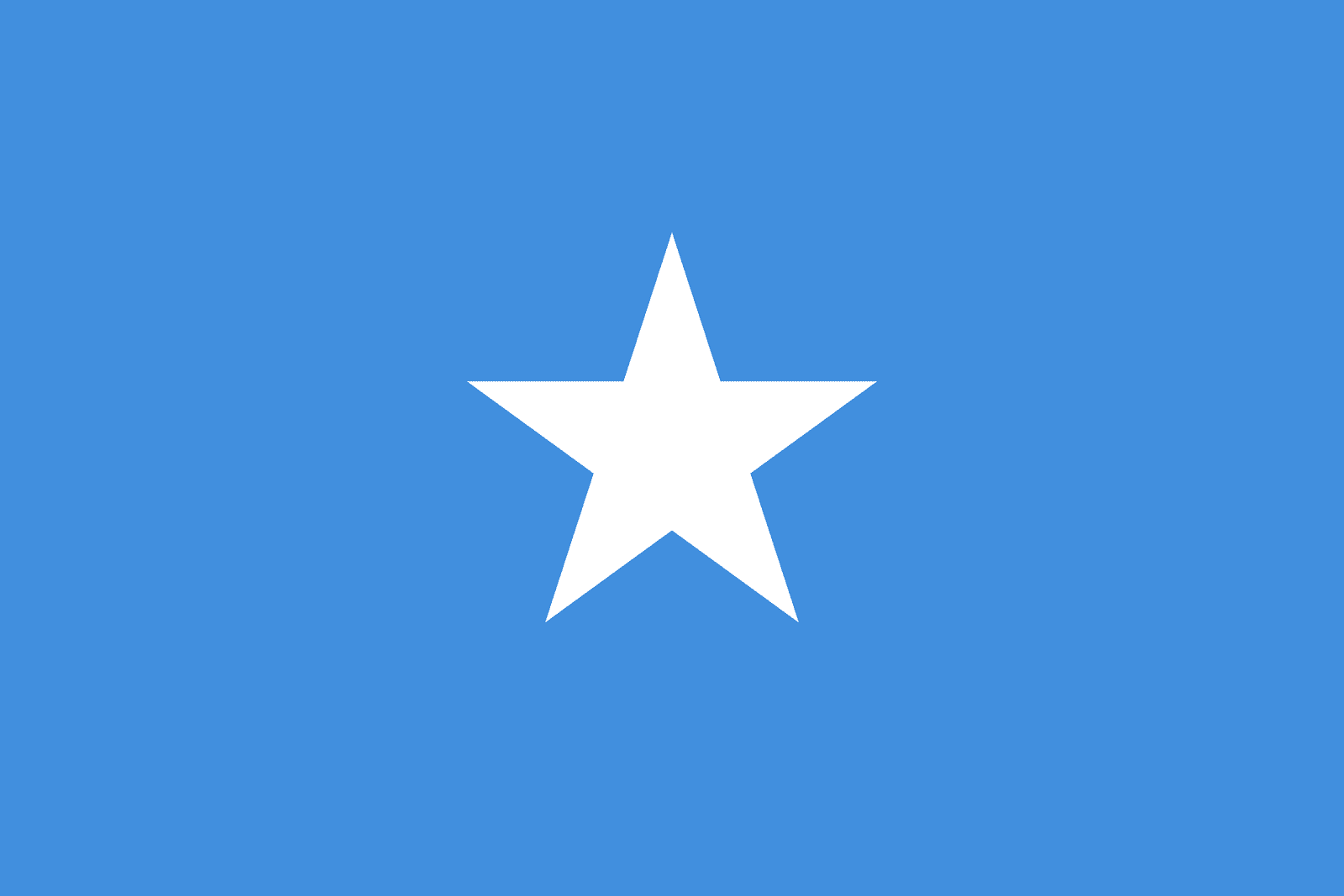
Flag of Somalia
| Legal Name | Federal Republic of Somalia |
|---|---|
| Flag |
|
| Capital City |
Mogadishu |
| Total Area | 637,657 km² |
| Land Area | 627,337 km² |
| Water Area | 10,320 km² |
| Population | Approximately 19.9 million |
| Major Cities | Mogadishu (2.8 million), Hargeisa (1.2 million), Bosaso (700,000), Kismayo (500,000) |
| Currency | Somali Shilling (SOS) |
| GDP | USD 7.5 billion |
| GDP Per Capita | USD 1,065 (PPP) |
About of Somalia
Somalia is strategically located in the Horn of Africa, bordering Ethiopia, Djibouti, and Kenya, with extensive coastlines along the Gulf of Aden and the Indian Ocean. Its position provides a critical maritime gateway for international shipping through the Bab-el-Mandeb Strait, connecting the Red Sea to the Indian Ocean.
The capital and largest city, Mogadishu, serves as the political, economic, and cultural hub. Other major urban centers include Hargeisa in the self-declared Republic of Somaliland, Bosaso in Puntland, and Kismayo in Jubaland. Somalia has a predominantly young population and is characterized by a rich nomadic heritage and pastoral economy, alongside emerging urban markets.
Internationally, Somalia is recognized as a sovereign state and a member of the African Union, United Nations, and Arab League. Its geopolitical importance is underscored by its location along key shipping routes and its role in regional security issues, including anti-piracy efforts and counterterrorism.
Etymology
The name “Somalia” derives from the Somali people, the region’s dominant ethnic group. Linguistically, it is linked to the Somali word “Soomaali”, historically associated with pastoralist clans and their social and cultural identity. The term reflects both the ethnic composition and the geographic continuity of Somali-inhabited lands.
History
Somalia’s history stretches back thousands of years, with evidence of ancient civilizations along the coast and interior, engaging in trade with the Arabian Peninsula, India, and Egypt. By the classical period, the region formed part of the ancient Land of Punt, renowned for frankincense and myrrh.
In the medieval period, Somali sultanates such as the Sultanate of Mogadishu and the Adal Sultanate emerged, controlling trade networks and fostering Islamic culture. During the 19th century, European powers, particularly Britain and Italy, established colonial territories: British Somaliland in the north and Italian Somaliland in the south.
Somalia gained independence in 1960, uniting the two territories into the Somali Republic. The post-independence period was marked by a civilian government followed by military rule under Siad Barre (1969–1991). The collapse of central authority led to civil war, fragmentation, and humanitarian crises. Since the early 2000s, federal institutions have gradually been restored, with ongoing stabilization efforts, including the Federal Government of Somalia, established in 2012.
Government and Politics
Somalia is a federal parliamentary republic with a complex political structure reflecting regional autonomy:
Executive: President (head of state) and Prime Minister (head of government)
Legislature: Bicameral Federal Parliament consisting of the Upper House (Senate) and House of the People
Judiciary: Federal Supreme Court and regional courts
The nation comprises six federal member states, including Puntland and Jubaland. Somalia engages actively with international partners for security, development, and diplomatic relations. The Somali National Army and regional forces collaborate to counter terrorism, piracy, and insurgent activity, while international peacekeeping supports stability.
Economy
Somalia’s economy is classified as developing and largely informal, with pastoralism, agriculture, and fishing forming the backbone. Livestock exports, remittances from the Somali diaspora, telecommunications, and emerging small-scale manufacturing drive growth. Natural resources include uranium, iron ore, tin, and potential offshore oil and gas reserves.
Trade partners include Gulf States, Kenya, Ethiopia, and European countries. Economic challenges include infrastructure deficits, political instability, and vulnerability to droughts and conflict. Development efforts focus on enhancing governance, trade integration, and private sector growth.
Demographics
Somalia has a youthful and rapidly growing population. Ethnic composition is predominantly Somali, with minority Bantu, Arab, and other communities. Somali and Arabic are official languages, with English and Italian used in some administrative contexts. The majority of the population practices Islam (Sunni). Urbanization is increasing, but a significant portion remains rural and pastoralist. Population growth is high, driven by fertility rates and improving health indicators.
Culture and Society
Somali culture emphasizes clan identity, nomadic traditions, oral poetry, and Islamic values. National identity is shaped by shared language, religion, and heritage. Arts include poetry, storytelling, and traditional music. Cuisine features staple foods such as rice, goat meat, and sorghum.
Social norms reflect community cohesion, respect for elders, and Islamic ethics. Key public holidays include Independence Day (July 1) and Eid al-Fitr. Football, traditional sports, and camel racing are popular recreational activities.
Education and Healthcare
Education includes primary, secondary, and limited tertiary institutions, often disrupted by conflict. Literacy rates are gradually improving through government and NGO initiatives. Healthcare is a mix of public and private services, facing challenges such as communicable diseases, maternal health, and access in rural areas. Efforts focus on rebuilding infrastructure and expanding public health programs.
Geography and Climate
Somalia features a semi-arid to arid landscape, with plateaus, plains, and mountain ranges in the north. Major rivers include the Jubba and Shabelle. Its coastline along the Indian Ocean and Gulf of Aden stretches over 3,000 km. Somalia has a hot climate with seasonal monsoons, periodic droughts, and occasional cyclones. Environmental concerns include desertification, deforestation, and water scarcity.
Flora and Fauna
Somalia hosts diverse ecosystems, including savannas, coastal mangroves, and semi-deserts. Indigenous plants include acacia, frankincense, and myrrh trees. Wildlife includes antelope species, hyenas, lions, leopards, and a rich variety of marine life. Conservation efforts are emerging but remain limited due to security and governance challenges.
Map of Somalia
National Flag: Light blue with a central white star
Coat of Arms: Golden shield supported by leopards, with a white star and crossed spears
National Anthem: Qolobaa Calankeed
National Animals/Plants: Leopard, African lion, frankincense tree
National Flag (Detailed Section)
The flag was adopted in 1954 for the Trust Territory and retained at independence in 1960. The light blue symbolizes the United Nations, which helped Somalia achieve independence, while the white star represents the unity of the Somali people across the Horn of Africa. The flag is flown at government buildings, national events, and international representations, with protocols emphasizing respect and proper display.
Flag flying days
| Date | Flag Position | Occasion or Reason |
|---|---|---|
| July 1 | Full-mast | Independence Day |
| October 21 | Full-mast | Somali National Army Day |
| As Declared | Half-mast | National mourning or remembrance |