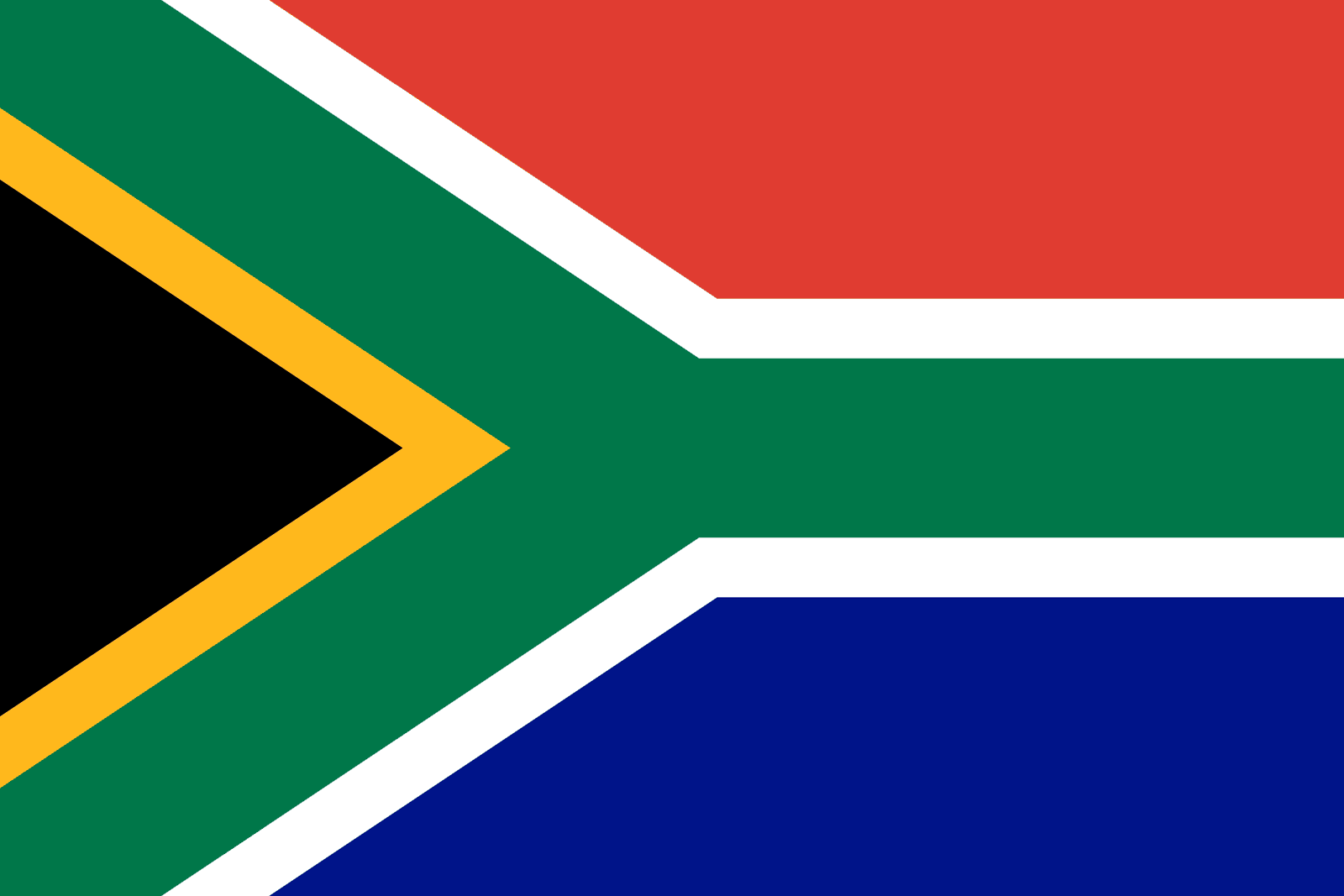
Flag of South Africa
| Legal Name | Republic of South Africa |
|---|---|
| Flag |
|
| Capital City |
Pretoria (administrative), Bloemfontein (judicial), Cape Town (legislative) |
| Total Area | 1,221,037 km² |
| Land Area | 1,213,090 km² |
| Water Area | 7,947 km² |
| Population | Approximately 60.1 million |
| Major Cities | Johannesburg (5.7 million), Cape Town (4 million), Durban (3.7 million), Pretoria (2.5 million), Port Elizabeth (1.2 million) |
| Currency | South African Rand (ZAR) |
| GDP | USD 419 billion |
| GDP Per Capita | USD 14,000 (PPP) |
About of South Africa
South Africa is located at the southern tip of the African continent, bordered by Namibia, Botswana, Zimbabwe, Mozambique, Eswatini, and Lesotho, with extensive coastlines along both the Atlantic and Indian Oceans. Its geographic positioning makes it a critical maritime gateway connecting the Atlantic and Indian Oceans, facilitating trade and international shipping routes.
The nation’s political and administrative functions are divided among three capitals: Pretoria hosts the executive, Cape Town the legislative, and Bloemfontein the judicial branch. Johannesburg, as the largest urban center, is the economic powerhouse, driving industries from mining to finance. South Africa is known for its demographic diversity, encompassing multiple ethnicities, languages, and religions, contributing to its rich cultural tapestry.
Internationally, South Africa is recognized as a major regional power and a member of the African Union, BRICS, the United Nations, and the Commonwealth of Nations. Its strategic significance arises from its mineral wealth, industrial base, and influence in African politics, trade, and peacekeeping.
Etymology
The name “South Africa” is derived from its location at the southernmost part of the African continent. Historically, the term evolved as European settlers distinguished the region from other parts of Africa. Indigenous names such as “Mzanzi” in Xhosa and Zulu reflect local linguistic heritage, often meaning “south” or “land at the south.”
History
South Africa’s history spans millions of years, with archaeological evidence of early hominid activity, including the famous Homo sapiens fossils at sites like Sterkfontein and Swartkrans. Prehistoric societies were primarily hunter-gatherers, evolving into Bantu-speaking communities during the Iron Age.
The region experienced significant colonial encounters starting in the 17th century when Dutch settlers (Boers) established Cape Colony, later contested by the British. This period saw the displacement of indigenous communities and the introduction of slavery, agriculture, and European legal systems.
The discovery of diamonds and gold in the 19th century transformed the economy and intensified European colonization, leading to conflicts such as the Anglo-Boer Wars (1880–1881, 1899–1902). South Africa became a union under British dominion in 1910 and later a republic in 1961, continuing racial segregation through apartheid from 1948 until its dismantling in 1994.
Post-apartheid, South Africa transitioned to a democratic system with universal suffrage, culminating in the election of Nelson Mandela as the first Black president. Since then, the nation has pursued social reforms, economic development, and regional diplomacy.
Government and Politics
South Africa operates as a constitutional democracy with a three-tier system: national, provincial, and local government. Its Constitution, widely regarded as one of the most progressive globally, enshrines human rights, rule of law, and separation of powers.
Executive: President (head of state and government) elected by the National Assembly
Legislature: Bicameral Parliament with the National Assembly and National Council of Provinces
Judiciary: Independent, led by the Constitutional Court and Supreme Court of Appeal
The country is divided into nine provinces, each with its own legislature. South Africa maintains active foreign relations, balancing regional leadership in Africa with strategic ties to major global powers. The South African National Defence Force ensures national security and contributes to international peacekeeping.
Economy
South Africa is classified as an upper-middle-income emerging economy with a diverse industrial base. Key sectors include mining (gold, platinum, diamonds), manufacturing, finance, tourism, and agriculture. Its extensive mineral resources underpin both domestic growth and exports.
The nation faces economic challenges such as unemployment, inequality, and energy insecurity but benefits from a sophisticated financial system, robust infrastructure, and trade networks spanning Asia, Europe, and Africa. Strategic initiatives aim to diversify the economy, promote innovation, and integrate with global markets.
Demographics
The population is composed of various ethnic groups: Black South Africans (approximately 80%), Coloured (mixed race), White, and Indian/Asian communities. The country recognizes eleven official languages, including Zulu, Xhosa, Afrikaans, and English. Christianity is the dominant religion, with indigenous beliefs, Hinduism, and Islam also practiced. Urbanization is high, with major cities accounting for a significant portion of the population. Population growth has stabilized, with life expectancy and fertility rates reflecting modern demographic transitions.
Culture and Society
South Africa’s culture reflects a blend of indigenous traditions, European influences, and Asian heritage. National identity is reinforced by the legacy of apartheid struggle, reconciliation, and multiculturalism. Music, dance, literature, and visual arts are highly vibrant, with global recognition for jazz, kwaito, and literary works.
Public holidays include Freedom Day, Heritage Day, and Human Rights Day. Sports such as rugby, cricket, and football play a major role in national identity and recreation. Social norms emphasize family, community, and respect for cultural diversity.
Education and Healthcare
The education system spans primary, secondary, and tertiary levels, with a literacy rate exceeding 95% among youth. Universities such as the University of Cape Town and the University of Witwatersrand are internationally renowned.
Healthcare combines public and private systems, with ongoing efforts to address communicable diseases such as HIV/AIDS, tuberculosis, and malaria. Access to healthcare has improved, though disparities persist between urban and rural populations.
Geography and Climate
South Africa features varied landscapes, including the Drakensberg Mountains, the Highveld plateau, Kalahari Desert edges, and extensive coastlines along the Atlantic and Indian Oceans. Major rivers include the Orange and Limpopo. The climate ranges from Mediterranean in the southwest to subtropical in the northeast, with semi-arid regions in the interior. Natural hazards include droughts, occasional floods, and wildfires. Environmental concerns involve biodiversity loss, pollution, and water scarcity.
Flora and Fauna
South Africa is a biodiversity hotspot with endemic plant species such as fynbos and protea. Wildlife includes lions, elephants, rhinos, leopards, and cheetahs. National parks like Kruger, Table Mountain, and Addo Elephant Park protect ecosystems, supporting ecotourism and conservation initiatives.
Map of South Africa
National Flag: Y-shaped design symbolizing unity, peace, and diversity
Coat of Arms: Features secretary bird, protea, and motto “!ke e: /xarra //ke” (ǀXam language meaning “Diverse people unite”)
National Anthem: Combination of “Nkosi Sikelel’ iAfrika” and “Die Stem van Suid-Afrika”
National Animals/Plants: Springbok (antelope), Blue Crane (bird), King Protea (flower)
National Flag (Detailed Section)
The South African flag, adopted in 1994, reflects post-apartheid unity. The Y-shape symbolizes the convergence of diverse communities into one nation. Colors represent historical and cultural elements: black, green, and yellow from the African National Congress; red, white, and blue from colonial and Boer heritage.
Flag protocol dictates prominent display on government buildings, national events, and official ceremonies. Misuse is prohibited under law to uphold respect and national pride.
Flag flying days
| Date | Flag Position | Occasion or Reason |
|---|
| April 27 | Full-mast | Freedom Day |
| June 16 | Full-mast | Youth Day |
| September 24 | Full-mast | Heritage Day |
| As Declared | Half-mast | National mourning or remembrance |