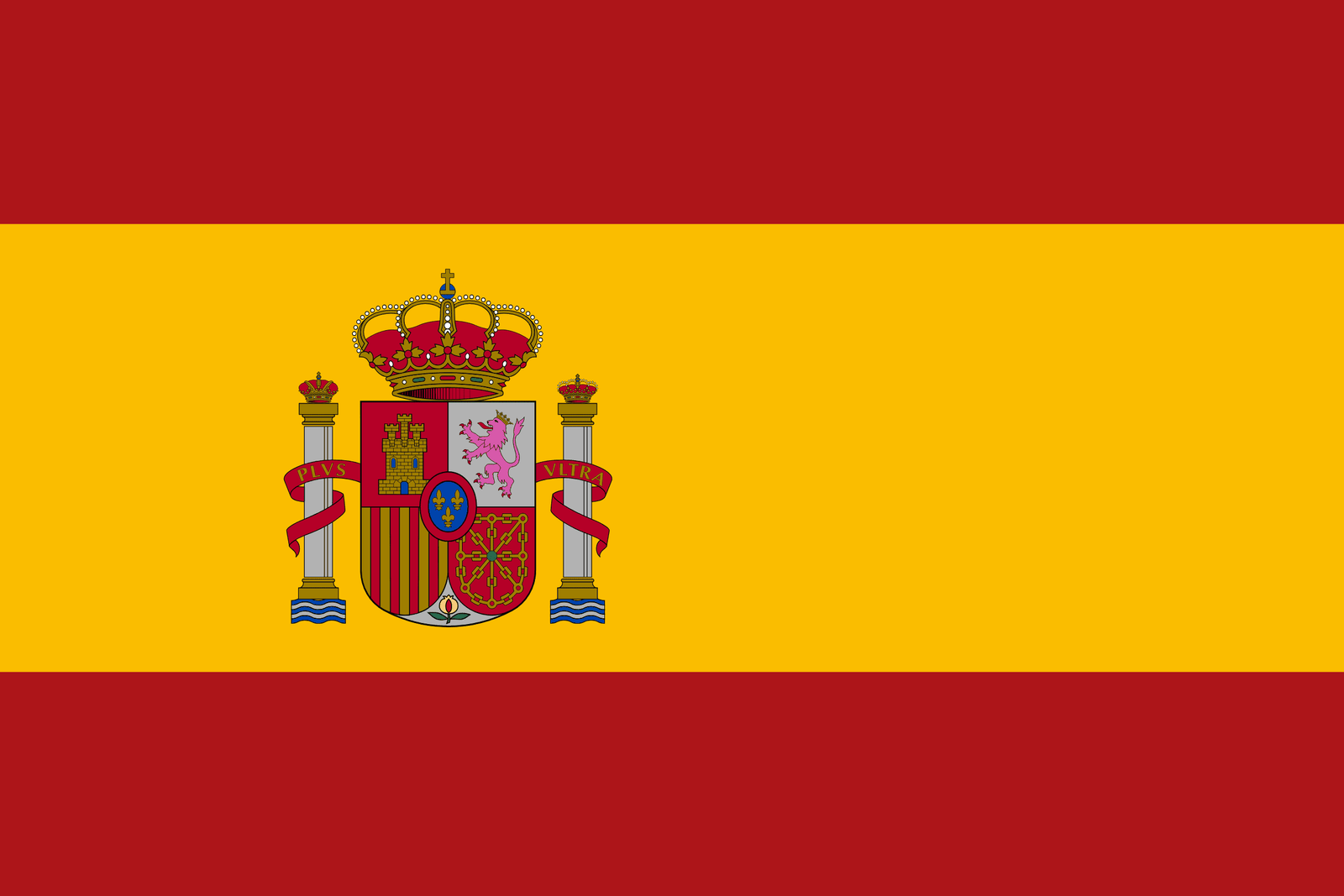
Flag of Spain
| Legal Name | Kingdom of Spain |
|---|---|
| Flag |
|
| Capital City |
Madrid |
| Total Area | 505,990 km² |
| Land Area | 498,511 km² |
| Water Area | 7,479 km² |
| Population | Approximately 47 million |
| Major Cities | Madrid (6.7 million metro), Barcelona (5.6 million metro), Valencia (1.6 million), Seville (1.5 million), Zaragoza (0.7 million) |
| Currency | Euro (EUR) |
| GDP | USD 1.6 trillion |
| GDP Per Capita | USD 40,500 (PPP) |
About of Spain
Spain is a European country located on the Iberian Peninsula, sharing land borders with Portugal to the west, France and Andorra to the northeast, and Gibraltar to the south. It also has extensive coastlines along the Atlantic Ocean and the Mediterranean Sea. Its strategic location has historically made it a bridge between Europe, Africa, and the Americas.
Madrid, the capital and largest city, functions as the political, economic, and cultural hub of the country. Other major urban centers include Barcelona, Valencia, Seville, and Zaragoza, all contributing to Spain’s diverse economic and cultural landscape. Spain’s population exhibits a predominantly Iberian ethnic composition, with recognized regional minorities such as Catalans, Basques, and Galicians.
Spain is internationally recognized as a sovereign state, a member of the European Union, NATO, United Nations, and other global organizations. Its geopolitical importance stems from its position controlling access to the Mediterranean, Atlantic maritime routes, and proximity to North Africa, influencing trade, security, and cultural exchange.
Etymology
The name “Spain” derives from the ancient Roman term Hispania, which itself likely comes from the Phoenician word i-spn-ya, meaning “land of rabbits” or “edge of the west.” Over centuries, “Hispania” evolved linguistically into “España,” the modern Spanish name. The term has endured through Roman, Visigothic, and Moorish periods, reflecting Spain’s long and layered historical identity.
History
Prehistoric and Ancient Civilizations
Archaeological evidence shows human presence in the Iberian Peninsula dating back hundreds of thousands of years. Iberians, Celts, and Tartessians developed early settlements, metallurgy, and trade networks. The Phoenicians, Greeks, and Carthaginians established colonies along the coasts.
Classical and Medieval Periods
Rome conquered the Iberian Peninsula in the 2nd century BCE, integrating it as Hispania. Roman infrastructure, law, and culture profoundly influenced local populations. Following the fall of the Roman Empire, Visigoths established kingdoms that persisted until the Islamic conquest in 711 CE. Al-Andalus, the Muslim-ruled territories, flourished as centers of learning, trade, and culture.
Major Empires and Dynasties
The Reconquista gradually reclaimed the peninsula for Christian kingdoms, culminating in the unification under Ferdinand and Isabella in 1492. Spain’s global maritime empire expanded in the Americas, Asia, and Africa, establishing one of the largest colonial networks in history.
Colonial Rule and Global Influence
Spanish colonies in the Americas generated immense wealth and influence, making Spain a dominant European power from the 16th to 17th centuries. The Spanish Inquisition, Habsburg rule, and conflicts such as the Spanish Armada shaped both domestic and international policies.
Independence Movements and Modern History
Internal decline, Napoleonic invasions, and colonial independence movements in Latin America weakened Spain by the 19th century. Spain lost its remaining overseas colonies, including Cuba and the Philippines, in 1898. The 20th century included the Spanish Civil War (1936–1939), Francisco Franco’s dictatorship, and the transition to democracy after 1975.
Modern Political Developments
Spain is now a parliamentary constitutional monarchy under King Felipe VI. Since joining the European Union in 1986, Spain has undergone significant economic modernization, democratization, and integration into international affairs.
Government and Politics
Spain is a parliamentary constitutional monarchy with a decentralized political system.
Executive: Headed by the King (ceremonial) and the Prime Minister (government head).
Legislature: Bicameral Parliament (Cortes Generales) composed of the Congress of Deputies and Senate.
Judiciary: Independent system with the Supreme Court as the highest body.
Spain is divided into 17 autonomous communities and two autonomous cities, each with varying degrees of legislative and administrative powers. It maintains active foreign relations through the EU, NATO, UN, and bilateral ties. Spain’s armed forces include the Army, Navy, and Air Force, focused on defense, peacekeeping, and international cooperation.
Economy
Spain is a developed, high-income country with a diversified economy. Services dominate, particularly tourism, finance, and retail. Agriculture produces olives, wine, citrus, and vegetables, while manufacturing includes automobiles, machinery, textiles, and chemicals. Spain has natural resources such as coal, iron ore, and uranium.
Key trade partners include Germany, France, Italy, the United Kingdom, and the United States. Spain faces challenges such as unemployment, fiscal deficits, and regional economic disparities. Future growth depends on technological innovation, renewable energy, and sustainable tourism development.
Demographics
Spain’s population is predominantly Iberian, with recognized regional identities:
Ethnic Groups: Castilian, Catalan, Basque, Galician, Andalusian, and minority groups of African, Romani, and Latin American descent.
Languages: Spanish (Castilian, official nationwide), Catalan, Basque, Galician, and others in autonomous regions.
Religions: Roman Catholic (~68%), other Christian denominations, Islam, Judaism, and non-religious.
Urban vs Rural: About 80% urbanized, with major metropolitan centers in Madrid, Barcelona, and Valencia.
Population Growth: Moderate, with aging population and immigration contributing to demographic changes.
Culture and Society
Spain has a rich cultural heritage blending Roman, Visigothic, Islamic, and European influences. National identity emphasizes language, regional diversity, art, and historical legacy. Flamenco music, bullfighting (cultural tradition), and festivals such as La Tomatina and Running of the Bulls are globally recognized.
Cuisine includes paella, tapas, jamón ibérico, and wines. Literature boasts contributions from Cervantes and contemporary authors. Social norms emphasize family, communal gatherings, and religious traditions. Sports, especially football, basketball, and cycling, are integral to national life.
Education and Healthcare
Education is compulsory until age 16, with free primary and secondary education and numerous universities, including the University of Salamanca and University of Barcelona. Literacy rates exceed 98%.
Healthcare is universal and publicly funded, with high-quality hospitals and advanced medical services. Public health achievements include low infant mortality, high life expectancy, and strong vaccination programs.
Geography and Climate
Spain’s terrain includes the Pyrenees in the north, central Meseta plateau, coastal plains, and the Sierra Nevada mountains. Major rivers include the Ebro, Tagus, and Guadalquivir. Spain has a Mediterranean climate along the coast, oceanic climate in the north, and semi-arid conditions in the southeast. Natural hazards include wildfires, droughts, and occasional floods. Environmental concerns focus on deforestation, desertification, and marine pollution.
Flora and Fauna
Spain hosts diverse ecosystems, from Mediterranean forests to alpine zones. Native plants include cork oak, olive trees, and lavender. Wildlife includes Iberian lynx, brown bears, wolves, and migratory bird species. Protected areas such as Doñana National Park and Picos de Europa safeguard biodiversity and natural heritage.
Map of Spain
National Flag: Red and yellow horizontal stripes with the coat of arms.
Coat of Arms: Features castles, lions, the Pillars of Hercules, and royal crown.
National Anthem: La Marcha Real (Royal March).
National Animals/Plants: Bull, Iberian lynx, and olive tree.
National Flag (Detailed Section)
The Spanish flag consists of red-yellow-red horizontal stripes, with the yellow stripe double the height of each red stripe. The coat of arms represents the historical kingdoms of Castile, León, Aragon, Navarre, and Granada, along with the Pillars of Hercules symbolizing maritime power. The flag is flown on public buildings, national holidays, and international events.
Realted Flags
Flag flying days
| Date | Flag Position | Occasion or Reason |
|---|---|---|
| October 12 | Full-mast | National Day (Fiesta Nacional de España) |
| June 6 | Full-mast | Constitution Day |
| December 6 | Full-mast | Spanish Constitution commemoration |
| As Declared | Half-mast | Mourning, death of monarch or national tragedy |