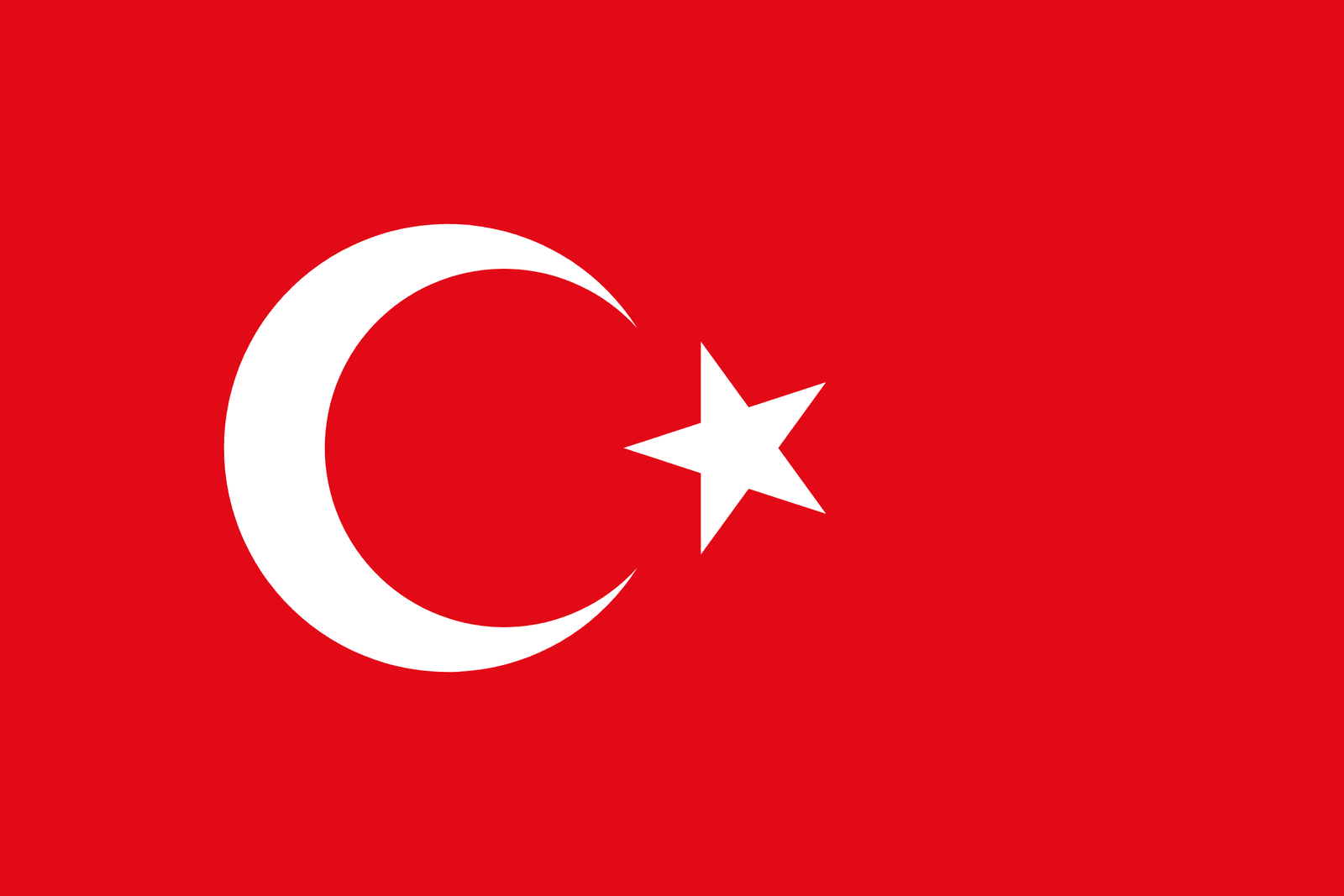
Flag of Türkiye
| Legal Name | Republic of Türkiye |
|---|---|
| Flag |
|
| Capital City |
Ankara |
| Total Area | 783,562 km² |
| Land Area | 769,632 km² |
| Water Area | 13,930 km² |
| Population | Approximately 85 million |
| Major Cities | Istanbul (15.7 million metro), Ankara (5.8 million), İzmir (4.5 million), Bursa (3.2 million), Antalya (2.7 million), Adana (2.3 million) |
| Currency | Turkish Lira (TRY) |
| GDP | Approximately USD 1.1 trillion |
| GDP Per Capita | Approximately USD 12,900 (nominal) |
About of Türkiye
Türkiye is a transcontinental nation strategically located at the junction of Europe and Asia. The majority of its landmass lies in Anatolia (Asia Minor), while a smaller portion, Eastern Thrace, is situated in southeastern Europe. This geographic position has historically made Türkiye a bridge between continents, cultures, and civilizations, shaping its role as a hub of trade, migration, and diplomacy.
The country shares land borders with Greece and Bulgaria to the northwest; Georgia to the northeast; Armenia, Azerbaijan’s Nakhchivan exclave, and Iran to the east; and Iraq and Syria to the south. Türkiye is surrounded by three major bodies of water: the Black Sea to the north, the Aegean Sea to the west, and the Mediterranean Sea to the south. The Bosphorus and Dardanelles straits, which connect these seas, are among the world’s most strategically important waterways.
Ankara serves as the political capital and administrative center, while Istanbul is the largest city and economic powerhouse. Türkiye’s population is predominantly urban, with large metropolitan areas driving industry, finance, and culture. Internationally, Türkiye is a recognized sovereign state and a significant regional power, playing a central role in Eurasian geopolitics, energy transit, regional security, and global trade routes.
Etymology
The name “Türkiye” originates from the word “Türk,” referring to the Turkic peoples, combined with the suffix “-iye,” meaning “land of” or “belonging to.” The term can be interpreted as “the land of the Turks.” The word “Türk” has roots in ancient Turkic languages and historically conveyed meanings associated with strength, unity, and identity. Over time, the name evolved through medieval and Ottoman usage and was formally adopted as the country’s official name with the founding of the republic in 1923. In recent years, Türkiye has emphasized the international use of this native spelling and pronunciation.
History
Prehistoric and Ancient Civilizations
Anatolia is one of the oldest continuously inhabited regions in the world. Archaeological sites such as Göbekli Tepe and Çatalhöyük provide evidence of advanced Neolithic societies. In antiquity, the region was home to powerful civilizations including the Hittites, Phrygians, Lydians, and Urartians, alongside Greek colonies along the Aegean coast.
Classical and Medieval Periods
Following the conquests of Alexander the Great, Anatolia became part of the Hellenistic world and later the Roman Empire. Constantinople, founded in 330 CE, emerged as the capital of the Eastern Roman (Byzantine) Empire and a major center of politics, religion, and learning. From the 11th century onward, Seljuk Turks migrated into Anatolia, gradually establishing Turkish political dominance.
Empires and Dynasties
The Ottoman Empire arose in the late 13th century and expanded into one of history’s most powerful empires, spanning Southeast Europe, the Middle East, and North Africa. The capture of Constantinople in 1453 marked a turning point, establishing Istanbul as the imperial capital. For centuries, the Ottoman state played a decisive role in regional and global affairs.
Decline, Independence, and the Republic
By the 19th century, internal challenges and external pressures weakened the empire. After defeat in World War I, the Ottoman state collapsed. The Turkish War of Independence, led by Mustafa Kemal Atatürk, resulted in the establishment of the Republic of Türkiye in 1923, ending centuries of imperial rule.
Modern Political Developments
The republic introduced sweeping reforms in governance, law, education, and society, promoting secularism and modernization. Throughout the 20th and 21st centuries, Türkiye experienced political pluralism, military interventions, economic transformation, and constitutional change. Recent decades have seen a shift toward a presidential system and an assertive foreign policy.
Government and Politics
Türkiye is a presidential republic with a centralized political structure. The President serves as both head of state and head of government, holding executive authority. The Grand National Assembly of Türkiye is the unicameral legislative body responsible for enacting laws and overseeing government actions. The judiciary is constitutionally independent and includes the Constitutional Court, Court of Cassation, and Council of State.
Administratively, Türkiye is divided into 81 provinces, each governed by centrally appointed officials. In foreign relations, Türkiye is an active participant in international affairs and is a member of organizations such as the United Nations, NATO, the Council of Europe, the G20, and the Organization of Turkic States. Its military is among the largest and most capable in the region, playing a significant role in national defense and international security missions.
Economy
Türkiye is classified as an emerging market economy with a broad and diversified economic base. Manufacturing is a major pillar, encompassing automotive production, machinery, electronics, textiles, and defense industries. Agriculture remains significant, with Türkiye ranking among the world’s leading producers of wheat, fruits, vegetables, olives, and hazelnuts.
The service sector, including tourism, transportation, finance, and retail, contributes the largest share of GDP. Türkiye possesses notable natural resources such as boron, coal, and various minerals, though it depends heavily on imported energy. Major trade partners include the European Union, Middle Eastern countries, and Asian markets. Economic challenges include inflation, currency volatility, and external debt, while future growth strategies emphasize exports, technological innovation, and infrastructure development.
Demographics
Türkiye has a predominantly urban population with a relatively young demographic profile. Ethnically, the population is largely Turkish, alongside Kurdish communities and smaller minority groups. Turkish is the official language, while Kurdish and other regional languages are widely spoken. The majority of the population identifies as Muslim, primarily Sunni, with smaller religious minorities.
Urbanization has accelerated over recent decades, driven by internal migration to major cities. Population growth has slowed, reflecting changing family structures, education levels, and economic conditions.
Culture and Society
Türkiye’s culture reflects a rich blend of Central Asian, Middle Eastern, Mediterranean, and European influences. Strong family ties, hospitality, and respect for tradition are central social values. Turkish arts include music, dance, calligraphy, ceramics, and carpet weaving, alongside a dynamic contemporary cultural scene.
Turkish cuisine is internationally celebrated, known for its regional diversity and dishes such as kebabs, mezes, breads, and desserts. National and religious holidays commemorate independence, republican values, and cultural heritage. Football is the most popular sport, complemented by basketball, volleyball, and traditional wrestling.
Education and Healthcare
The education system consists of compulsory primary and secondary education, followed by a large higher education sector with public and private universities. Literacy rates are high, and access to education has expanded significantly across the country.
Healthcare operates under a universal coverage model combining public and private providers. Reforms over the past two decades have improved access and quality, though challenges remain related to regional disparities, urban population pressures, and public health management.
Geography and Climate
Türkiye’s physical geography is highly diverse, featuring coastal plains, fertile river valleys, high plateaus, and rugged mountain ranges. Major rivers such as the Tigris and Euphrates originate in eastern Anatolia. The country’s extensive coastline supports trade, tourism, and fishing.
Climate conditions vary widely, ranging from Mediterranean along the southern and western coasts to continental in central Anatolia and oceanic along the Black Sea. Türkiye is prone to earthquakes due to active fault lines, making seismic activity a major natural hazard. Environmental concerns include deforestation, air pollution, water management, and urban expansion.
Flora and Fauna
Türkiye is one of the most biologically diverse countries in its region, with a wide range of ecosystems including forests, wetlands, steppes, and alpine zones. It is home to numerous endemic plant species and a rich variety of wildlife, such as bears, wolves, lynx, deer, and many migratory bird species. National parks and protected areas play an important role in conservation and sustainable tourism.
Map of Türkiye
The national flag is a red field with a white crescent and star, symbolizing independence and historical continuity. The national anthem is İstiklâl Marşı (Independence March). National symbols also include the tulip, long associated with Turkish culture, and significant monuments such as Anıtkabir, the mausoleum of Mustafa Kemal Atatürk.
National Flag (Detailed Section)
The flag of Türkiye consists of a red background with a white crescent moon and a five-pointed star positioned slightly left of center. The design evolved from Ottoman-era banners and was standardized following the establishment of the republic. Red symbolizes the sacrifice of those who defended the nation, while the crescent and star represent sovereignty, heritage, and national unity. The flag is displayed on public buildings, during national ceremonies, and on official holidays, with strict protocols governing respectful usage.
Flag flying days
| Date | Flag Position | Occasion or Reason |
|---|
| April 23 | Full-mast | National Sovereignty and Children’s Day |
| May 19 | Full-mast | Commemoration of Atatürk, Youth and Sports Day |
| August 30 | Full-mast | Victory Day |
| October 29 | Full-mast | Republic Day |
| As Declared | Half-mast | National mourning or remembrance |