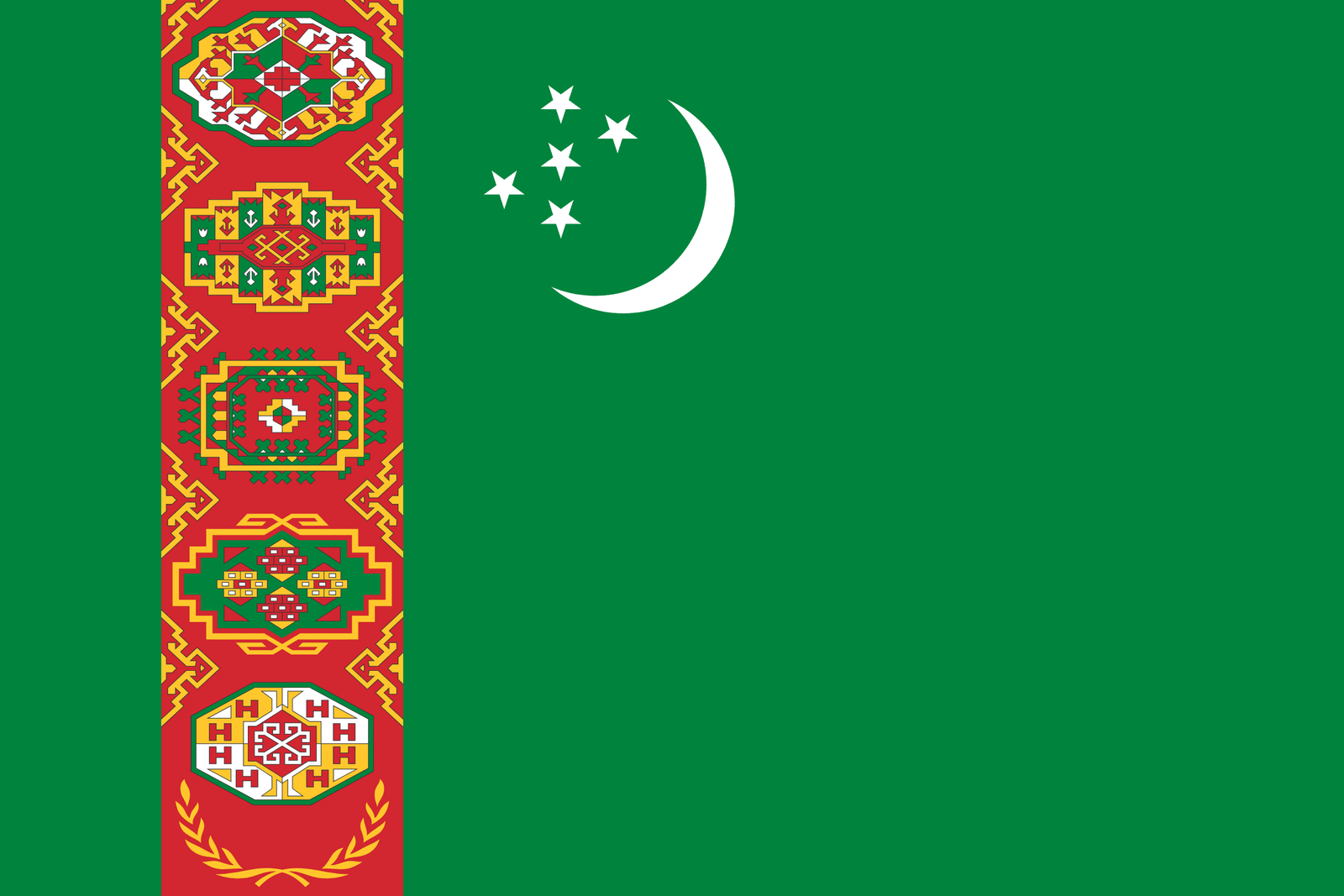
Flag of Turkmenistan
| Legal Name | Turkmenistan |
|---|---|
| Flag |
|
| Capital City |
Ashgabat |
| Total Area | 491,210 km² |
| Land Area | Approximately 469,930 km² |
| Water Area | Approximately 21,280 km² |
| Population | Approximately 6.3 million |
| Major Cities | Ashgabat (1.0 million), Türkmenabat (300,000), Daşoguz (280,000), Mary (200,000), Balkanabat (150,000) |
| Currency | Turkmenistan Manat (TMT) |
| GDP | Approximately USD 45–50 billion |
| GDP Per Capita | Approximately USD 7,000 (nominal) |
About of Turkmenistan
Turkmenistan is a Central Asian nation located between the Caspian Sea and the vast deserts of inner Asia. It occupies a strategic position at the crossroads of Europe, the Middle East, and Asia, bridging historic trade routes that once formed part of the Silk Road. The country is dominated by arid landscapes, particularly the Karakum Desert, which covers most of its territory.
Turkmenistan shares land borders with Kazakhstan to the northwest, Uzbekistan to the north and east, Afghanistan to the southeast, and Iran to the south. It also has a long western coastline along the Caspian Sea, which provides maritime access and significant energy potential. Ashgabat, the capital and largest city, is the political, cultural, and economic center, known for its distinctive white marble architecture.
Internationally, Turkmenistan is recognized as a sovereign state and is notable for its policy of permanent neutrality, formally acknowledged by the United Nations. Its geopolitical importance stems from its vast natural gas reserves, strategic energy transit potential, and location near key regional markets in Eurasia.
Etymology
The name “Turkmenistan” derives from “Turkmen,” referring to the Turkic ethnic group native to the region, and the Persian suffix “-stan,” meaning “land” or “place.” The term can be interpreted as “the land of the Turkmen people.” Historically, the name evolved through medieval Islamic and Turkic usage, becoming formalized during the Soviet era and retained after independence.
History
Prehistoric and Ancient Civilizations
Human settlement in present-day Turkmenistan dates back thousands of years. Ancient civilizations flourished in oasis regions such as Merv, one of the oldest continuously inhabited cities in Central Asia. Early societies practiced irrigation agriculture and trade.
Classical and Medieval Periods
The region was influenced by major empires, including the Achaemenid Persians, Alexander the Great’s empire, and later the Parthian and Sassanian states. During the Islamic Golden Age, cities like Merv became major centers of learning, culture, and commerce along the Silk Road.
Turkic and Mongol Eras
From the 10th century onward, Turkic tribes migrated into the area, shaping the ethnic and linguistic foundations of modern Turkmen society. The Mongol invasions in the 13th century brought devastation but also integrated the region into broader Eurasian networks.
Russian and Soviet Rule
In the late 19th century, the Russian Empire incorporated the territory, later becoming the Turkmen Soviet Socialist Republic within the USSR. Soviet rule introduced industrialization, collectivized agriculture, and centralized governance.
Independence and Modern Era
Turkmenistan declared independence in 1991 following the dissolution of the Soviet Union. The post-independence period has been marked by strong presidential rule, a centrally managed economy, and an emphasis on national identity and neutrality in foreign affairs.
Government and Politics
Turkmenistan is a presidential republic with a highly centralized political system. The Constitution establishes the president as both head of state and government, wielding significant executive authority. Legislative power is exercised by a unicameral parliament, while the judiciary operates under constitutional and civil law principles.
Administratively, the country is divided into five regions (welaýatlar) and one independent city, Ashgabat. Turkmenistan maintains a policy of permanent neutrality, shaping its foreign relations and limiting participation in military alliances. The armed forces focus on territorial defense and internal security.
Economy
Turkmenistan is classified as a developing, resource-rich economy. It possesses some of the world’s largest reserves of natural gas, which form the backbone of national income and exports. Energy production and related infrastructure dominate industrial activity.
Agriculture employs a significant portion of the population, with cotton and wheat as major crops, supported by extensive irrigation. Manufacturing remains limited, while services are largely state-driven. Key trade partners include China, Russia, Iran, and regional neighbors. Economic challenges include heavy reliance on hydrocarbons, limited diversification, and vulnerability to global energy price fluctuations. Future prospects center on energy export expansion, infrastructure development, and gradual economic diversification.
Demographics
The population of Turkmenistan is predominantly ethnic Turkmen, with minorities including Uzbeks, Russians, and Kazakhs. Turkmen is the official language, while Russian is widely understood in urban areas. Islam is the dominant religion, practiced mainly in its Sunni form, with small Christian minorities.
Urbanization has increased in recent decades, particularly around Ashgabat, though a substantial portion of the population remains rural. Population growth is moderate, influenced by demographic trends and migration.
Culture and Society
Turkmen culture is deeply rooted in nomadic traditions, tribal identity, and hospitality. Family and clan ties play a central role in social organization. Traditional arts include carpet weaving, which is internationally renowned, as well as music, poetry, and equestrian sports.
Cuisine features dishes based on meat, rice, bread, and dairy products. National holidays emphasize independence, neutrality, and cultural heritage. Education, respect for elders, and social conformity are important cultural values.
Education and Healthcare
Education in Turkmenistan is state-controlled and compulsory at the primary and secondary levels. Literacy rates are high, reflecting Soviet-era educational foundations. Higher education is provided through national universities and specialized institutes.
Healthcare is largely publicly funded, with services concentrated in urban areas. Public health priorities include maternal care, infectious disease control, and management of non-communicable diseases, though access and quality vary regionally.
Geography and Climate
Turkmenistan’s geography is dominated by the Karakum Desert, interspersed with oases and river valleys such as the Amu Darya basin. The western region features Caspian Sea coastlines, while the south includes foothills of the Kopet Dag mountains.
The climate is sharply continental, characterized by extremely hot summers, cold winters, and low annual rainfall. Natural hazards include droughts, earthquakes, and desertification. Environmental concerns focus on water management, land degradation, and the impacts of large-scale irrigation.
Flora and Fauna
Despite its arid environment, Turkmenistan supports unique desert and semi-desert ecosystems. Native vegetation includes saxaul trees, shrubs, and drought-resistant grasses. Wildlife features species such as gazelles, wild sheep, foxes, and numerous reptiles.
The country maintains nature reserves and national parks aimed at conserving biodiversity and protecting endangered species, particularly in desert and wetland habitats.
Map of Turkmenistan
National symbols emphasize Turkmen heritage, independence, and neutrality. The flag, coat of arms, and anthem incorporate traditional motifs, Islamic symbolism, and references to unity and sovereignty. The Akhal-Teke horse, famed for its endurance and beauty, is a prominent national symbol.
National Flag (Detailed Section)
The national flag of Turkmenistan features a green background symbolizing Islam and life, with a vertical red stripe bearing five traditional carpet guls representing the country’s major tribes. A white crescent moon and five stars signify a bright future and the nation’s regions. Adopted after independence, the flag reflects cultural continuity and national pride. It is flown on government buildings, during official ceremonies, and on national holidays according to formal protocol.
Flag flying days
| Date | Flag Position | Occasion or Reason |
|---|
| January 1 | Full-mast | New Year’s Day |
| March 21 | Full-mast | Nowruz (Spring Festival) |
| May 18 | Full-mast | Constitution and State Flag Day |
| September 27 | Full-mast | Independence Day |
| December 12 | Full-mast | Neutrality Day |
| As Declared | Half-mast | National mourning or remembrance |