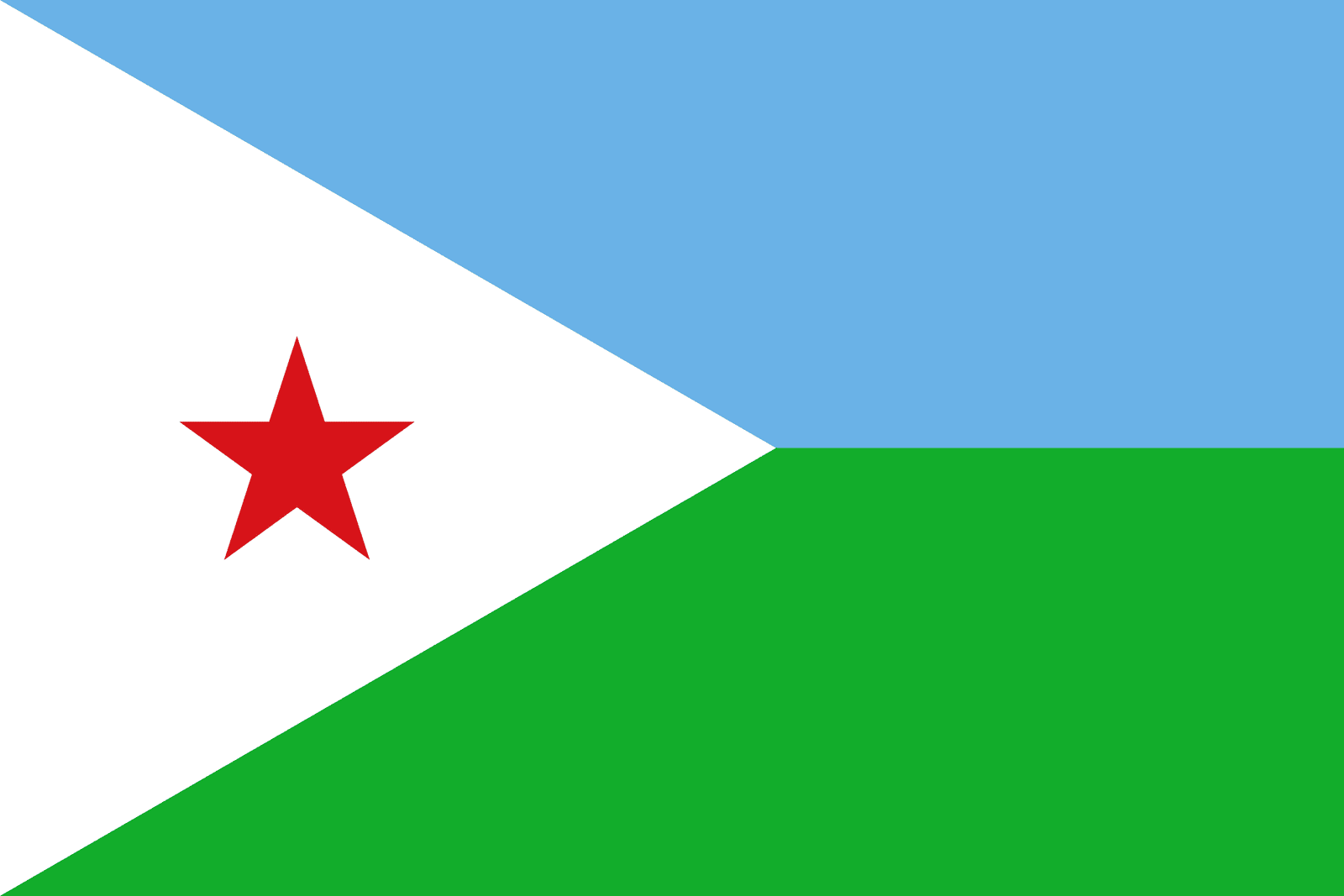
Flag of Djibouti
| Legal Name | Republic of Djibouti |
|---|---|
| Flag |
|
| Capital City |
Djibouti City |
| Total Area | ~23,200 |
| Land Area | ~23,180 |
| Water Area | ~20 |
| Population | ~1.1 million |
| Major Cities | Djibouti City (~600,000), Ali Sabieh (~40,000), Tadjoura (~35,000), Obock (~20,000), Dikhil (~15,000) |
| Currency | Djiboutian Franc (DJF) |
| GDP | ~USD 4.0 billion |
| GDP Per Capita | ~USD 3,600 (nominal) |
About of Djibouti
Djibouti is a small but strategically significant country located in the Horn of Africa, at the junction of the Red Sea and the Gulf of Aden. It sits at one of the world’s busiest maritime chokepoints, the Bab el-Mandeb Strait, which connects the Indian Ocean to the Mediterranean Sea via the Suez Canal.
The country shares land borders with Eritrea to the north, Ethiopia to the west and south, and Somalia to the southeast, while its coastline opens onto major international shipping lanes. Djibouti City, the capital and largest urban center, dominates the nation’s political, economic, and social life and serves as a major port and logistics hub for landlocked Ethiopia.
Djibouti’s population is relatively small and youthful, with most residents living in urban areas along the coast. Internationally, Djibouti is a fully recognized sovereign state and a member of key global and regional organizations. Its geopolitical importance is amplified by the presence of multiple foreign military bases, reflecting its role in global security, anti-piracy operations, and international trade.
Etymology
The name “Djibouti” is believed to originate from local Afar or Somali languages, though its exact meaning remains debated. One interpretation links it to an Afar expression meaning “boiling pot,” possibly referencing the region’s volcanic landscape and extreme heat. Another explanation suggests a connection to a local place name used before colonial rule.
The spelling “Djibouti” was standardized during French colonial administration and retained after independence, becoming the official name of the modern state.
History
Human settlement in the region dates back thousands of years, supported by archaeological evidence of early pastoral and trading communities. Due to its coastal position, the area became part of ancient maritime trade networks linking Africa, Arabia, and South Asia.
During the medieval period, Djibouti was influenced by Islamic sultanates and trading cities, including the Sultanate of Ifat and later the Adal Sultanate. Islam spread early and became deeply rooted in local society.
In the late 19th century, France established control over the territory, naming it French Somaliland and later the French Territory of the Afars and the Issas. After a series of referendums, Djibouti gained independence in 1977. Since independence, the country has experienced relative political stability compared to the region, with continuity in leadership and a strong emphasis on security and international partnerships.
Government and Politics
Djibouti is a republic with a presidential system. The President serves as both head of state and government, wielding significant executive authority under the constitution. The political system is characterized by a dominant-party structure.
Legislative power resides in a unicameral National Assembly, while judicial authority is exercised by a court system that includes a Supreme Court and Constitutional Council. Administratively, Djibouti is divided into regions and districts.
Djibouti maintains active foreign relations and is a member of the United Nations, African Union, Arab League, Intergovernmental Authority on Development, and other international bodies. The country hosts foreign military forces from several nations, which contribute to national security and economic revenue.
Economy
Djibouti is classified as a developing economy, heavily oriented toward services rather than production. Its economic model centers on port services, logistics, and transportation, serving as a gateway for Ethiopian trade.
Agriculture is minimal due to arid conditions, while manufacturing remains limited. Key economic assets include ports, free trade zones, and infrastructure linked to regional connectivity. Djibouti has few natural resources, relying instead on its geographic position.
Major trading partners include Ethiopia, China, and Gulf countries. Economic challenges include high unemployment, poverty, limited domestic production, and vulnerability to external shocks. Future growth prospects focus on logistics expansion, renewable energy, and regional integration.
Demographics
Djibouti’s population is primarily composed of two major ethnic groups: the Somali (Issa) and the Afar. Smaller communities include Arabs, Ethiopians, and Europeans. Arabic and French are the official languages, while Somali and Afar are widely spoken.
Islam is the dominant religion, practiced by the vast majority of the population. Urbanization is high, with most citizens living in Djibouti City. Population growth remains steady, driven by high birth rates and migration.
Culture and Society
Djiboutian culture reflects a blend of African, Arab, and Islamic traditions. Oral poetry, storytelling, and music play important roles in social life. Clan and family structures remain central to identity and community organization.
Cuisine emphasizes rice, flatbreads, meat, fish, and spiced dishes influenced by Somali, Afar, and Arab culinary traditions. Social customs emphasize hospitality, respect for elders, and communal solidarity.
Public holidays include Independence Day and major Islamic festivals. Football is the most popular sport, along with athletics and traditional wrestling.
Education and Healthcare
Djibouti’s education system includes primary, secondary, and tertiary levels, with ongoing efforts to improve access and quality. Literacy rates have improved but remain below global averages. The University of Djibouti is the main higher education institution.
Healthcare services are concentrated in urban areas and are largely state-run, supplemented by private clinics. Key public health challenges include maternal and child health, malnutrition, and access to clean water, though progress has been made through international cooperation.
Geography and Climate
Djibouti’s landscape is dominated by volcanic plateaus, desert plains, salt lakes, and a narrow coastal strip. Lake Assal, one of the saltiest bodies of water in the world, lies at Africa’s lowest point above sea level.
The climate is arid to semi-arid, with extremely high temperatures and minimal rainfall. Natural hazards include droughts, earthquakes, and volcanic activity. Environmental concerns center on water scarcity, desertification, and coastal ecosystem protection.
Flora and Fauna
Biodiversity is limited due to harsh climatic conditions, but Djibouti supports adapted plant species such as acacias and salt-tolerant shrubs. Wildlife includes gazelles, jackals, hyenas, and diverse bird species, especially along the coast.
Marine biodiversity is richer, with coral reefs and fisheries in the Red Sea and Gulf of Aden. Conservation efforts focus on marine protected areas and the preservation of unique geological sites.
Map of Djibouti
Djibouti’s national flag symbolizes unity, peace, and independence. The coat of arms features traditional weapons and a shield, reflecting defense and sovereignty. The national anthem emphasizes freedom and national pride. There is no officially designated national animal, though native wildlife holds cultural significance.
National Flag (Detailed Section)
The national flag of Djibouti consists of two horizontal bands—light blue on top and green below—representing the sea, sky, and land. A white triangle at the hoist symbolizes peace, while the red star within it represents unity and the blood shed for independence.
Adopted at independence in 1977, the flag is flown on public buildings, during national holidays, and at international events. Proper display and respectful use are regulated by national protocol.
Flag flying days
| Date | Flag Position | Occasion or Reason |
|---|---|---|
| June 27 | Full-mast | Independence Day |
| May 1 | Full-mast | Labor Day |
| Islamic Holidays (as declared) | Full-mast | Eid al-Fitr and Eid al-Adha |
| National Mourning Days | Half-mast | State-declared mourning periods |