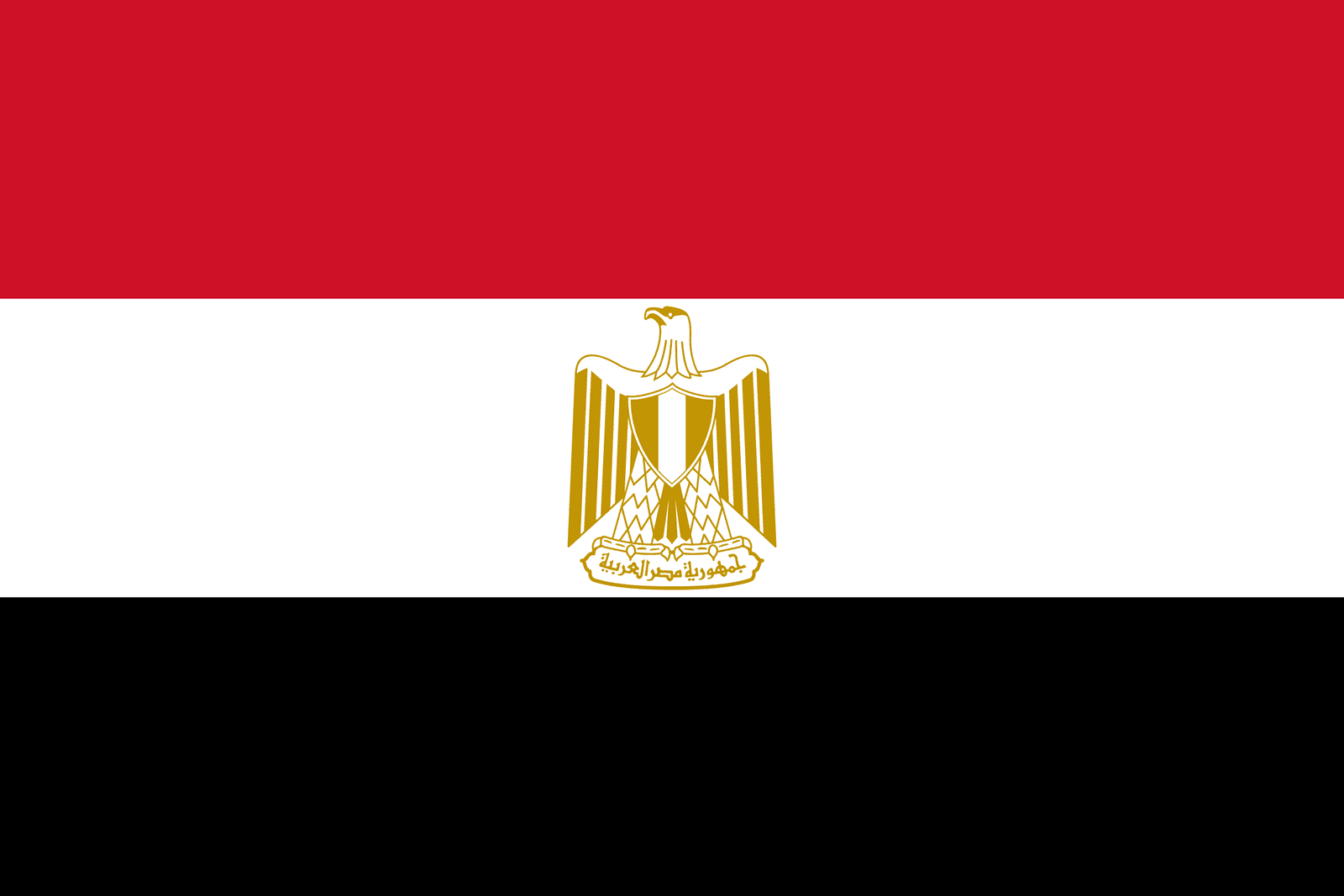
Flag of Egypt
| Legal Name | Arab Republic of Egypt |
|---|---|
| Flag |
|
| Capital City |
Cairo |
| Total Area | 1,010,408 |
| Land Area | 995,450 |
| Water Area | 14,958 |
| Population | ~110 million |
| Major Cities | Cairo (~21 million metro), Alexandria (~5.2 million), Giza (~4.8 million), Shubra El Kheima (~1.2 million) |
| Currency | Egyptian Pound (EGP) |
| GDP | ~USD 404 billion |
| GDP Per Capita | ~USD 12,700 (PPP) |
About of Egypt
Egypt is a transcontinental nation, located primarily in North Africa with the Sinai Peninsula extending into Asia. It is strategically positioned at the crossroads of Africa and the Middle East, with a coastline along the Mediterranean Sea to the north and the Red Sea to the east. Its geography is dominated by the Nile River, which flows from south to north, creating the fertile Nile Delta that has supported civilization for millennia.
The country shares land borders with Libya to the west, Sudan to the south, and Israel and the Gaza Strip to the northeast. Egypt also controls the Suez Canal, a critical maritime route connecting the Mediterranean Sea to the Red Sea, making it a key player in global trade and geopolitics.
Cairo, Egypt’s capital and largest city, is an economic, political, and cultural hub, renowned for its historic districts, universities, and vibrant marketplaces. Alexandria, the second-largest city, is an important port on the Mediterranean. Demographically, Egypt is predominantly urban, with over half the population residing along the Nile and its delta. Egypt is recognized internationally as a member of the United Nations, Arab League, African Union, and Non-Aligned Movement, serving as a strategic partner in regional diplomacy and economic development.
Etymology
The name “Egypt” originates from the ancient Greek term “Aígyptos,” which itself derived from the Egyptian name “Hwt-Ka-Ptah,” meaning “House of the Ka of Ptah,” referring to the temple of the god Ptah in Memphis. Over centuries, this name evolved through Latin and Greek usage into the modern term “Egypt,” while locally, the country is called “Misr,” a name with roots in Semitic languages meaning “country” or “land.”
History
Prehistoric and Ancient Civilizations
Egypt boasts one of the world’s oldest continuous civilizations, with evidence of human settlement dating back over 10,000 years. Ancient Egypt, famous for its pharaohs, pyramids, and monumental architecture, flourished along the Nile, establishing a complex society with sophisticated writing, mathematics, and governance.
Classical and Medieval Periods
Egypt came under Greek and Roman rule after Alexander the Great’s conquest in 332 BCE, becoming a vital province of the Roman Empire. It later became a part of the Byzantine Empire before the Arab-Muslim conquest in the 7th century, which introduced Islam and Arabic language and culture.
Major Empires and Dynasties
Throughout history, Egypt experienced various dynastic and imperial rules, including the Fatimids, Ayyubids under Saladin, and the Mamluks, who maintained the country as a regional power. The Ottoman Empire annexed Egypt in 1517, though local governance remained semi-autonomous under Mamluk administration.
Colonial and Modern Periods
In the 19th century, Muhammad Ali Pasha modernized Egypt, establishing centralized administration, industry, and military. Britain occupied Egypt in 1882, overseeing its strategic Suez Canal and political institutions. Egypt gained nominal independence in 1922 and became a republic after the 1952 revolution led by Gamal Abdel Nasser, ending the monarchy.
Key Post-Independence Events
Nasser’s presidency (1956–1970) emphasized Arab nationalism, land reform, and the nationalization of the Suez Canal. Subsequent leaders, including Anwar Sadat and Hosni Mubarak, guided Egypt through peace treaties, economic liberalization, and regional conflicts. The 2011 Arab Spring led to political transition, culminating in the presidency of Abdel Fattah el-Sisi since 2014.
Government and Politics
Egypt is a unitary semi-presidential republic. The president serves as head of state and commander-in-chief, elected for a six-year term. Executive authority is shared with the Prime Minister and cabinet. Legislative power resides in a unicameral House of Representatives, while the judiciary, headed by the Supreme Constitutional Court, operates independently.
The country is divided into 27 governorates for administrative purposes. Egypt maintains active foreign relations, participating in the UN, Arab League, African Union, Non-Aligned Movement, and regional peace efforts. Its military is one of the largest in Africa and the Middle East, emphasizing defense, counterterrorism, and national security.
Economy
Egypt is classified as an emerging market economy. Its major industries include petroleum, natural gas, textiles, food processing, tourism, and construction. Agriculture remains vital, with crops such as wheat, maize, rice, and cotton. The Suez Canal provides significant revenue from international shipping. Egypt exports oil, gas, cotton, textiles, and chemicals.
Trade partners include the European Union, the United States, China, and Arab Gulf countries. Economic challenges include high population growth, unemployment, public debt, and inflation. Ongoing reforms aim to diversify the economy, attract foreign investment, and develop renewable energy and infrastructure projects.
Demographics
Egypt has a population of roughly 110 million, predominantly ethnic Egyptians. Minorities include Nubians, Bedouins, Berbers, and Copts. Arabic is the official language, with English and French widely used in business and education. Islam is the predominant religion (majority Sunni), with a significant Coptic Christian minority. Approximately 43% of Egyptians live in urban areas, primarily along the Nile and its delta. Population growth remains high, shaping urban expansion and social services demand.
Culture and Society
Egypt’s culture is a rich blend of Pharaonic, Greco-Roman, Coptic, and Islamic heritage. National identity emphasizes pride in history, literature, and arts. Traditional music, dance, and storytelling coexist with modern pop culture. Egyptian cuisine, including koshari, ful medames, and molokhia, reflects regional and historical influences.
Social customs emphasize family, hospitality, and community. Key festivals include Ramadan, Eid al-Fitr, and Sham el-Nessim. Football is the most popular sport, alongside handball, squash, and cultural activities like music and theatre.
Education and Healthcare
Egypt has a structured education system comprising primary, preparatory, and secondary schooling, followed by higher education at universities and technical institutes. Literacy rates exceed 70%, with growing access to tertiary education. Healthcare is provided through public hospitals, private clinics, and community programs. Challenges include rural healthcare access, maternal health, and infectious diseases, but improvements continue through policy reform and infrastructure investment.
Geography and Climate
Egypt is dominated by the Nile River valley and delta, surrounded by the Sahara Desert. Major geographical features include the Sinai Peninsula, Red Sea coastline, Western Desert, and Nile Delta. The climate is predominantly arid, with hot summers, mild winters, and scarce rainfall concentrated in the north. Natural hazards include sandstorms, flash floods, and occasional earthquakes. Environmental concerns include desertification, water scarcity, and pollution.
Flora and Fauna
Egyptian biodiversity includes desert-adapted plants such as acacia and date palms, as well as Nile wetlands flora. Wildlife includes gazelles, ibex, foxes, Nile crocodiles, and a variety of migratory and resident birds. Protected areas like the Ras Muhammad National Park and Wadi El Rayan support conservation efforts.
Map of Egypt
The national flag features three horizontal stripes—red, white, and black—with the golden Eagle of Saladin centered in the white stripe, representing power, strength, and Arab unity. The coat of arms emphasizes sovereignty and national pride. The national anthem, Bilady, Bilady, Bilady, expresses patriotism. National animals and plants include the Steppe Eagle and the Lotus flower, symbols of heritage and resilience.
National Flag (Detailed Section)
The flag’s red symbolizes the struggle for independence, white represents peace, and black signifies oppression overcome. The Eagle of Saladin reflects courage and historical leadership. Adopted in 1984, the flag is flown on government buildings, national holidays, and international events. Half-mast display denotes mourning.
Realted Flags
Flag flying days
| Date | Flag Position | Occasion or Reason |
|---|---|---|
| July 23 | Full-mast | Revolution Day (1952) |
| October 6 | Full-mast | Armed Forces Day |
| January 25 | Full-mast | National Police Day |
| National Mourning Days | Half-mast | Death of leaders or national tragedies |