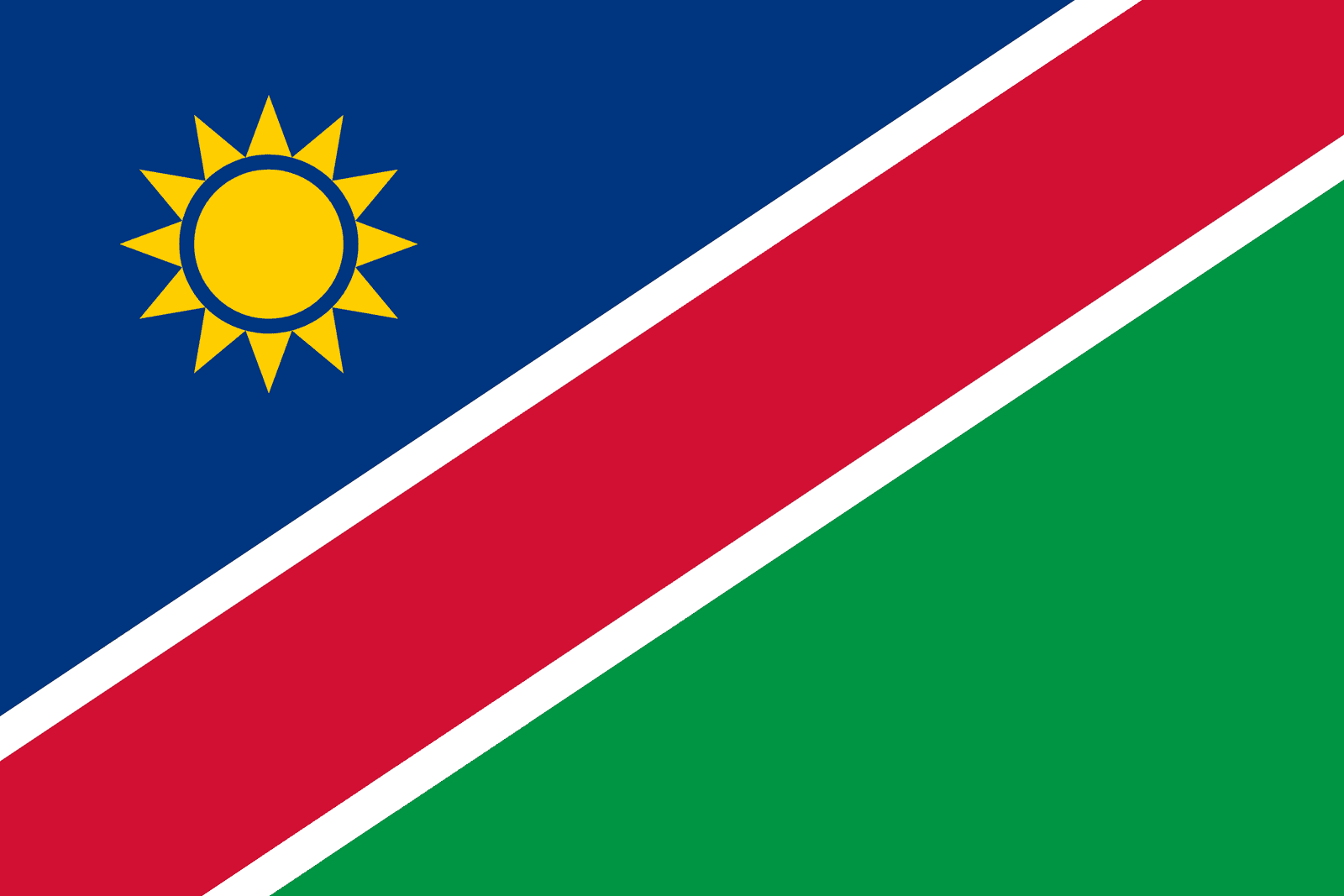
Flag of Namibia
| Legal Name | Republic of Namibia |
|---|---|
| Flag |
|
| Capital City |
Windhoek |
| Total Area | 824,292 km² |
| Land Area | 824,292 km² |
| Water Area | 0 km² |
| Population | Approximately 2.7 million |
| Major Cities | Windhoek (~430,000), Rundu (~110,000), Walvis Bay (~90,000), Swakopmund (~45,000) |
| Currency | Namibian Dollar (NAD), South African Rand (ZAR) |
| GDP | USD 14 billion |
| GDP Per Capita | USD 5,200 |
About of Namibia
Namibia is a country located in southern Africa, bordered by Angola and Zambia to the north, Botswana to the east, South Africa to the south, and the Atlantic Ocean to the west. The country occupies a diverse range of landscapes, including the Namib Desert along the Atlantic coast, the Kalahari Desert in the east, and fertile highlands in the central plateau. Its geographic position gives it significant access to maritime resources and trade routes along the southern African coast.
Windhoek serves as both the political and economic capital, acting as the administrative hub and largest urban center. Namibia has a low population density, with most inhabitants concentrated in urban centers and along river valleys. Internationally recognized as a sovereign state, Namibia is a member of the United Nations, African Union, Southern African Development Community (SADC), and other global organizations. Strategically, it holds importance due to its mineral wealth, Atlantic coastline, and relatively stable governance in a region with historical political instability.
Etymology
The name “Namibia” is derived from the Namib Desert, the oldest desert in the world, meaning “vast place” or “open space” in the local Khoekhoe language. Historically, the territory was known as German South West Africa during colonial times, and the name evolved following independence in 1990 to reflect both the country’s geography and indigenous heritage.
History
Prehistoric and Ancient Civilizations
Namibia has been inhabited for over 25,000 years, with early hunter-gatherer societies such as the San people leaving extensive rock art and evidence of early settlements. Pastoral communities, including the Khoekhoe, also occupied the region.
Colonial Period
In 1884, Germany colonized the territory, naming it German South West Africa. This period saw the establishment of settler agriculture and mining. The colonial administration led to conflicts with indigenous groups, including the Herero and Namaqua genocides (1904–1908).
After World War I, the territory became a League of Nations mandate administered by South Africa, which imposed apartheid policies. Resistance movements grew, particularly SWAPO (South West Africa People’s Organization), founded in 1960 to advocate for independence.
Independence Movement
A protracted struggle, including armed resistance and international diplomacy, culminated in Namibia gaining independence on 21 March 1990 under UN supervision. The first democratic elections brought SWAPO to power, establishing a government focused on nation-building and economic development.
Post-Independence Developments
Namibia has maintained political stability, multiparty democracy, and efforts to reconcile past injustices. Economic diversification, conservation, and social reforms have been central post-independence policies.
Government and Politics
Namibia is a unitary presidential republic governed under the Constitution of 1990, which establishes the separation of powers.
Executive: The President is both head of state and government, elected every five years.
Legislative: Bicameral Parliament consisting of the National Assembly and National Council.
Judiciary: Independent system led by the Supreme Court, High Court, and lower courts.
The country is divided into 14 regions, each with regional governors. Namibia maintains diplomatic relations globally and participates actively in African and international affairs. Defense is provided by the Namibian Defence Force, comprising land, air, and maritime components.
Economy
Namibia has an emerging economy, heavily dependent on mining, agriculture, and tourism.
Major Industries: Mining (diamonds, uranium, gold, copper), fishing, tourism, and manufacturing.
Agriculture: Cattle farming, subsistence crops, and small-scale horticulture.
Services: Government administration, banking, and tourism services.
Natural Resources: Rich in minerals, coastal fisheries, and potential for renewable energy.
Key trade partners include South Africa, China, the EU, and the US. Challenges include income inequality, droughts, high unemployment, and reliance on a limited number of export commodities. Sustainable economic policies focus on renewable energy, tourism, and diversified mining.
Demographics
Population Composition: Predominantly Ovambo (~50%), Kavango, Herero, Damara, Nama, and San minorities.
Languages: English (official), Oshiwambo, Nama/Damara, Afrikaans, and German.
Religions: Christianity dominates (Lutheran, Roman Catholic, Anglican), with traditional beliefs practiced in rural areas.
Urban vs Rural: Approximately 50% urban population, concentrated in Windhoek, Walvis Bay, and Swakopmund.
Population Trends: Moderate growth, with migration to urban centers.
Culture and Society
Namibia’s culture blends indigenous traditions and colonial influences. Traditional music, dance, and crafts are widely practiced. Cuisine includes maize-based dishes, meat stews, and game meats. National holidays include Independence Day (21 March) and Cassinga Day (4 May). Popular sports include football, rugby, and cricket, with community recreation being significant in both urban and rural areas.
Education and Healthcare
Education is free and compulsory up to grade 10, with high literacy rates. Secondary and tertiary education is offered in Windhoek and regional centers, with many pursuing studies abroad. The healthcare system is a combination of public hospitals and clinics, with access to basic care widely available. Major public health challenges include HIV/AIDS, tuberculosis, and malnutrition, while vaccination and maternal health programs have shown success.
Geography and Climate
Namibia features vast deserts, savannas, and a rugged coastline. Key geographic features include the Namib Desert, Kalahari Desert, Fish River Canyon, and the Central Plateau. The Atlantic Ocean forms the western boundary, supporting a rich marine ecosystem.
Climate: Mostly arid to semi-arid, with seasonal rains from November to April.
Natural Hazards: Droughts, occasional floods, and desertification.
Environmental Concerns: Land degradation, water scarcity, and wildlife conservation challenges.
Flora and Fauna
Namibia is known for its unique biodiversity, with deserts supporting endemic plants like Welwitschia mirabilis and succulents. Wildlife includes lions, elephants, cheetahs, oryx, and desert-adapted species. Conservation is a national priority, with protected areas such as Etosha National Park, Skeleton Coast Park, and several communal conservancies.
Map of Namibia
Flag: Blue, red, and green diagonal bands separated by white, with a golden sun.
Coat of Arms: Depicts an oryx and eagle supporting a shield with the national flag, symbolizing wildlife and vigilance.
National Anthem: Namibia, Land of the Brave
National Animals/Plants: Oryx, African Fish Eagle, Welwitschia plant.
National Flag (Detailed Section)
The Namibian flag was adopted on 21 March 1990, at independence. The blue represents the sky and Atlantic Ocean, red symbolizes the people’s heroism and unity, and green stands for agriculture and vegetation. The white diagonal stripes denote peace and harmony, while the golden sun signifies life, energy, and prosperity.
Flag Protocol: Flown on government buildings, schools, and public holidays.
Usage: The flag is a key symbol of national identity and pride.
Flag flying days
| Date | Flag Position | Occasion / Reason |
|---|---|---|
| 21 March | Full-mast | Independence Day |
| 26 August | Full-mast | Heroes’ Day |
| 4 May | Full-mast | Cassinga Day |
| National Mourning | Half-mast | Death of national leaders or tragedies |