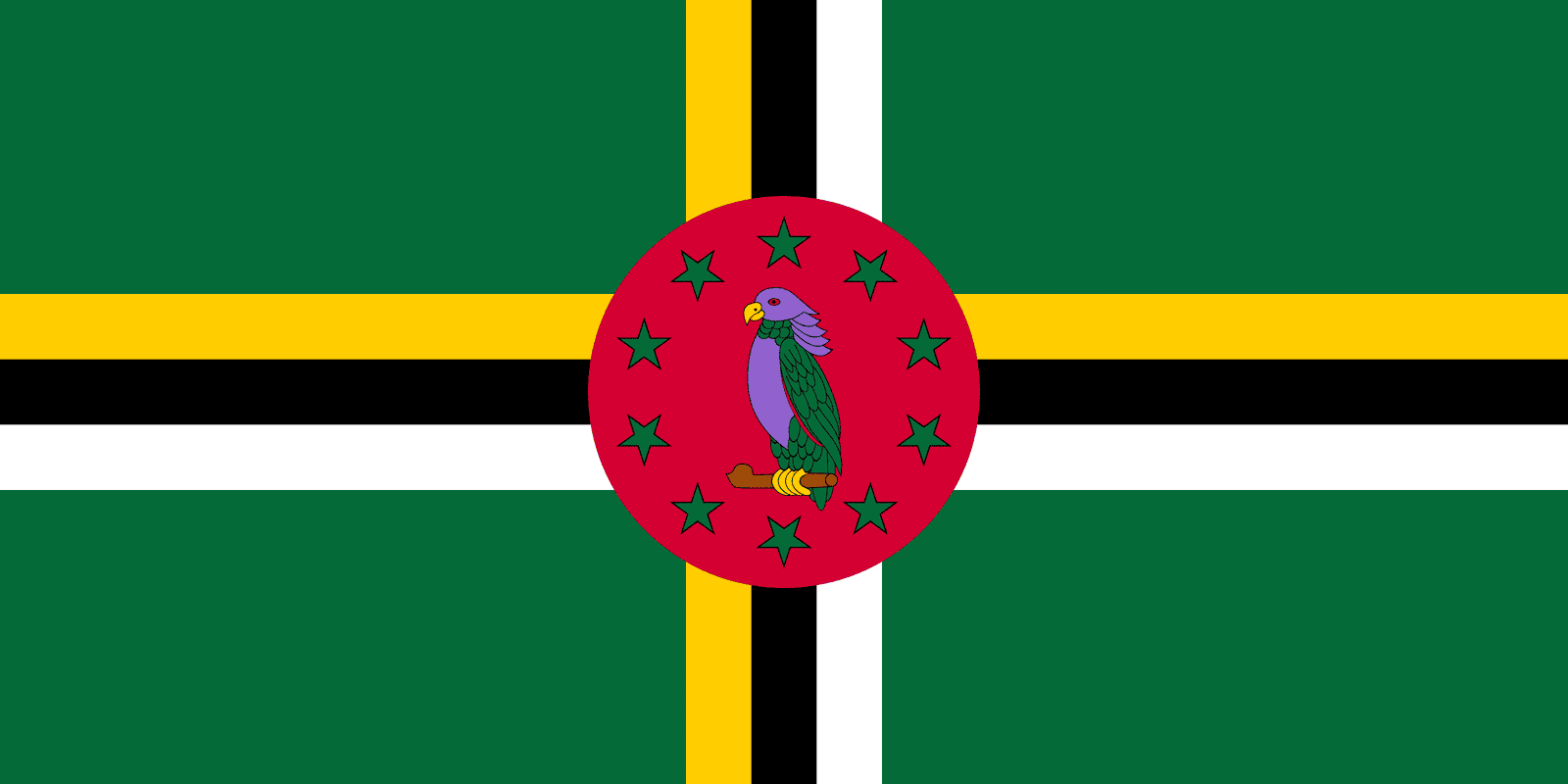
Flag of Dominica
| Legal Name | Commonwealth of Dominica |
|---|---|
| Flag |
|
| Capital City |
Roseau |
| Total Area | 751km2 |
| Land Area | 750km2 |
| Water Area | 1km2 |
| Population | ~74,000 |
| Major Cities | Roseau (~16,000), Portsmouth (~3,000), Marigot (~2,000) |
| Currency | East Caribbean Dollar (XCD) |
| GDP | ~USD 600 million |
| GDP Per Capita | ~USD 14,900 (PPP) |
About of Dominica
Dominica is a small island nation located in the eastern Caribbean Sea, part of the Lesser Antilles chain. Known as the “Nature Island of the Caribbean,” it is situated between Guadeloupe to the north and Martinique to the south, with its maritime boundaries touching both the Caribbean Sea and the Atlantic Ocean. Dominica is renowned for its lush rainforests, volcanic mountains, freshwater lakes, and extensive river systems, making it a hub for eco-tourism.
The country’s capital, Roseau, is both the political and commercial center, while Portsmouth serves as a secondary port city. Dominica has a small population concentrated mainly along the coast, with inland areas sparsely populated due to mountainous terrain. Internationally, Dominica is recognized as a sovereign state and is a member of the United Nations, the Caribbean Community (CARICOM), and the Organization of Eastern Caribbean States (OECS).
Strategically, Dominica’s significance lies in its maritime location in the Caribbean, offering access to regional trade routes and potential for sustainable tourism and renewable energy development, including geothermal resources from its volcanic regions.
Etymology
The name “Dominica” originates from the Latin word dies Dominica, meaning “Sunday,” the day Christopher Columbus reportedly sighted the island in November 1493 during his second voyage. The name reflects both European exploration and the historical influence of Christianity in the region. Over time, the name became firmly associated with the island nation and its identity.
History
Dominica’s earliest inhabitants were the Kalinago (Carib) people, who settled on the island several centuries before European contact, establishing villages and developing agricultural practices. The island was largely bypassed during the classical and medieval European period until Columbus’s second voyage.
During the 17th and 18th centuries, Dominica became a contested territory between France and Britain. French colonists initially attempted to settle, but persistent conflicts with the Kalinago and later British forces limited large-scale colonization. The Treaty of Paris in 1763 formally ceded the island to Britain, though the French retained cultural influence in certain areas.
Under British colonial rule, the island economy developed around plantations producing sugar, coffee, and other tropical crops, relying heavily on enslaved African labor. Dominica gained self-governance in 1967 as an associated state and full independence on November 3, 1978, under the leadership of Patrick John.
Modern political developments include stable parliamentary democracy, periodic elections, and active participation in regional organizations. Environmental resilience, particularly after hurricanes, has shaped both infrastructure development and national policy.
Government and Politics
Dominica is a parliamentary democracy within the framework of a republic. The president serves as the ceremonial head of state, while executive power rests with the prime minister and cabinet. The unicameral legislature, known as the House of Assembly, enacts laws, and the judiciary operates independently, with the Eastern Caribbean Supreme Court overseeing legal matters.
The country is divided into 10 parishes for administrative purposes. Dominica maintains diplomatic relations worldwide and participates actively in CARICOM, OECS, and the United Nations. Defense is limited, with security provided by the Royal Dominica Police Force and coast guard, while regional partnerships support disaster response and maritime security.
Economy
Dominica’s economy is classified as developing, with a focus on agriculture, eco-tourism, and services. Traditional agriculture includes bananas, citrus fruits, and root crops, though tourism has grown as the largest foreign exchange earner. Small-scale manufacturing, including food processing and craft industries, contributes to local employment.
Natural resources include geothermal energy potential, forests, freshwater, and volcanic soil suitable for agriculture. Key trade partners include the United States, European Union nations, and Caribbean neighbors. Challenges include vulnerability to hurricanes, limited diversification, and dependence on foreign aid. The future outlook emphasizes sustainable tourism, renewable energy, and agricultural modernization.
Demographics
Dominica has a population of approximately 74,000. The majority of inhabitants are of African descent, with a small Kalinago indigenous community and mixed-race individuals. English is the official language, while Dominican Creole French (Kwéyòl) is widely spoken. The population is predominantly Christian, with Roman Catholicism being the largest denomination.
Most residents live along the coast, particularly in Roseau and Portsmouth, while mountainous interiors remain sparsely populated. Population growth is low, influenced by emigration trends, particularly to the United States, Canada, and the United Kingdom.
Culture and Society
Dominica’s culture reflects African, Kalinago, and European influences. National identity is closely linked to environmental preservation and indigenous heritage. Music, dance, and festivals, such as the World Creole Music Festival and Carnival, play central roles in social life.
Cuisine includes local root vegetables, tropical fruits, fish, and seafood, often flavored with herbs and spices unique to the island. Social norms emphasize family networks, community participation, and respect for traditional practices. Sports such as cricket, football, and athletics are popular, fostering national pride and community engagement.
Education and Healthcare
Dominica provides free primary and secondary education, with literacy rates above 90%. Tertiary education includes institutions like the Dominica State College and the regional Ross University School of Medicine.
Healthcare is delivered through public hospitals and health centers, supplemented by private clinics. Key challenges include access in remote areas, hurricane-related health impacts, and non-communicable diseases. Public health initiatives focus on immunization, maternal health, and disaster preparedness.
Geography and Climate
Dominica is characterized by mountainous terrain, volcanic peaks, and dense tropical rainforests. Major rivers include the Layou and Roseau rivers, and coastal plains host urban and agricultural areas. The island experiences a tropical rainforest climate with a wet season from June to November and a dry season from December to May.
Natural hazards include hurricanes, tropical storms, landslides, and volcanic activity. Environmental concerns include deforestation, biodiversity loss, and coral reef degradation. The government actively promotes conservation and sustainable land use.
Flora and Fauna
Dominica hosts exceptional biodiversity, with over 50% of its land designated as protected areas. The Sisserou Parrot, endemic to Dominica, serves as a national symbol. Rainforests contain endemic plant species such as the tropical fern and various orchids. Wildlife includes tropical birds, bats, and freshwater fish. National parks, such as Morne Trois Pitons National Park, protect these ecosystems and promote ecotourism.
Map of Dominica
The national flag features a green field with a cross of yellow, black, and white, symbolizing the Trinity and unity. At the center, a red disk displays the Sisserou Parrot, representing pride and endemic wildlife. The coat of arms contains the parrot, native flora, and national motto “Apres Bondie C’est La Ter” (“After God, the Earth”). The national anthem, Isle of Beauty, Isle of Splendour, celebrates the island’s natural richness and heritage.
National Flag (Detailed Section)
The flag’s green represents forests and vitality, yellow symbolizes sunshine and agriculture, black denotes rich soil and heritage, and white signifies clarity and peace. The red disk reflects social justice and national strength. The Sisserou Parrot emphasizes ecological uniqueness. The flag was adopted upon independence in 1978, with modern iterations refining proportions and color balance.
Protocol dictates display on government buildings, during public ceremonies, and national holidays, with half-mast reserved for mourning or official remembrance.
Realted Flags
Flag flying days
| Date | Flag Position | Occasion or Reason |
|---|---|---|
| November 3 | Full-mast | Independence Day |
| October 27 | Full-mast | National Heroes Day |
| National Mourning Days | Half-mast | Official mourning for tragedies or deaths of prominent figures |
| May 1 | Full-mast | Labour Day |