Flag of Ecuador
| Legal Name | Republic of Ecuador |
|---|---|
| Flag |
|
| Capital City |
Quito |
| Total Area | 283,561 |
| Land Area | 276,841 |
| Water Area | 6,720 |
| Population | ~18.2 million |
| Major Cities | Quito (~2.8 million), Guayaquil (~3.1 million), Cuenca (~0.4 million), Santo Domingo (~0.3 million) |
| Currency | United States Dollar (USD) |
| GDP | ~USD 111 billion |
| GDP Per Capita | ~USD 19,800 (PPP) |
About of Ecuador
Ecuador is a diverse nation located in northwestern South America, straddling the equator from which it derives its name. It shares borders with Colombia to the north, Peru to the east and south, and the Pacific Ocean to the west. Ecuador also claims sovereignty over the Galápagos Islands, a unique archipelago in the Pacific, which is renowned for its biodiversity and historical significance in the development of evolutionary theory.
The country’s terrain ranges from the coastal lowlands to the Andean highlands and the Amazon rainforest in the east. Quito, the capital, is located in the Andean highlands at an elevation of 2,850 meters, making it one of the highest capitals in the world. Guayaquil, Ecuador’s largest city, is a vital economic and port center on the Pacific coast. Ecuador’s population is predominantly urban, with diverse ethnic and cultural communities reflecting Indigenous, European, African, and mixed heritage. Internationally, Ecuador is recognized as a stable member of the United Nations, Organization of American States (OAS), and other regional alliances, playing a critical role in environmental and maritime policy due to its location and biodiversity.
Etymology
The name “Ecuador” comes from the Spanish word for “equator,” reflecting the country’s position along the equatorial line. Historically, during the colonial period, the territory was part of the Spanish viceroyalty of Peru and later Gran Colombia. After gaining independence in 1830, the country adopted the name “República del Ecuador” to emphasize its geographic identity. The term embodies the nation’s connection to its unique equatorial geography and climatic diversity.
History
Prehistoric and Ancient Civilizations
Ecuador has been inhabited for thousands of years by diverse Indigenous groups, including the Valdivia, Machalilla, and Cotocollao cultures. These early societies practiced agriculture, pottery, and trade along the coastal and highland regions.
Classical and Medieval Periods
The Inca Empire extended into northern Ecuador in the late 15th century, incorporating it into a sophisticated administrative and agricultural system. Indigenous communities maintained local cultural practices, many of which survive today.
Colonial and Imperial Rule
Spanish conquest began in the early 16th century, integrating Ecuador into the Viceroyalty of Peru and later the Viceroyalty of New Granada. The Spanish introduced Catholicism, European governance structures, and new agricultural and mining systems.
Independence Movement
Inspired by regional liberation efforts, Ecuador declared independence from Spain on August 10, 1809. After a series of battles, Ecuador joined Gran Colombia under Simón Bolívar, before becoming a separate republic in 1830.
Key Post-Independence Events
Ecuador experienced political instability throughout the 19th and early 20th centuries, marked by frequent leadership changes and border conflicts with Peru and Colombia. The country gradually modernized infrastructure, expanded education, and strengthened democratic institutions during the 20th century.
Modern Political Developments
Recent decades have seen constitutional reforms, economic liberalization, and social programs aimed at reducing poverty and inequality. Ecuador’s government maintains a balance of powers and engages in regional diplomacy through organizations such as UNASUR and the Pacific Alliance.
Government and Politics
Ecuador is a unitary presidential republic. The president serves as both head of state and government, elected for a four-year term. Executive power is exercised through the president and cabinet, while legislative authority is vested in the unicameral National Assembly. The judiciary operates independently, with the Constitutional Court overseeing legal compliance and rights protections. Ecuador is divided into 24 provinces for administrative purposes. It maintains active foreign relations, participating in international organizations and treaties focused on trade, security, and environmental protection. The Ecuadorian military safeguards national sovereignty, borders, and maritime zones.
Economy
Ecuador is classified as an emerging market economy with key sectors including petroleum, agriculture, aquaculture, mining, manufacturing, and tourism. Oil exports account for a significant portion of foreign revenue. Agriculture produces bananas, cocoa, coffee, sugar, and flowers, while aquaculture emphasizes shrimp and fish exports. The service sector, including banking, commerce, and tourism, also contributes substantially to GDP. Ecuador faces economic challenges such as dependence on oil, fiscal deficits, and income inequality. Diversification, infrastructure development, and sustainable environmental policies are central to future economic growth.
Demographics
Ecuador’s population is ethnically diverse: Mestizos (~70%), Indigenous (~7%), Afro-Ecuadorians (~7%), and Whites (~7%), with smaller minorities including Montubios and other groups. Spanish is the official language, with Kichwa and Shuar recognized as official Indigenous languages. The majority religion is Roman Catholicism, with growing Protestant and Evangelical communities. Approximately 64% of the population is urban, concentrated in cities like Quito, Guayaquil, and Cuenca. Population growth has slowed due to urbanization and migration trends.
Culture and Society
Ecuador’s culture blends Indigenous, Spanish, and African heritage. Traditional music includes Andean folk instruments such as the pan flute and charango, while contemporary music reflects global influences. Literature, art, and oral storytelling celebrate history and national identity. Ecuadorian cuisine varies regionally, featuring ceviche, llapingachos, and seafood along the coast, and corn and potato-based dishes in the highlands. Festivals include Inti Raymi, Carnival, and national holidays celebrating independence. Football is the most popular sport, alongside volleyball, basketball, and cultural dances.
Education and Healthcare
Ecuador’s education system consists of basic education (primary and secondary) and higher education at universities and polytechnic institutes. Literacy rates exceed 94%, and the government promotes universal access to education. Healthcare is provided through public institutions and private clinics. Major public health challenges include maternal and child health, infectious diseases, and access in rural areas. Reforms aim to expand coverage and improve quality of services.
Geography and Climate
Ecuador features diverse landscapes, including coastal plains, Andean highlands, Amazon rainforest, and the Galápagos Islands. Prominent mountains include Chimborazo and Cotopaxi, while the Amazon basin covers the eastern provinces. The climate ranges from tropical along the coast, temperate in the highlands, to humid rainforest in the east. Natural hazards include volcanic eruptions, earthquakes, floods, and landslides. Environmental concerns focus on deforestation, biodiversity loss, and water resource management.
Flora and Fauna
Ecuador is a global biodiversity hotspot. Native plant species include orchids, bromeliads, and mangroves. Wildlife includes jaguars, Andean condors, spectacled bears, and Galápagos giant tortoises. National parks and reserves, such as Yasuni and Galápagos National Park, protect habitats and promote conservation, research, and eco-tourism.
Map of Ecuador
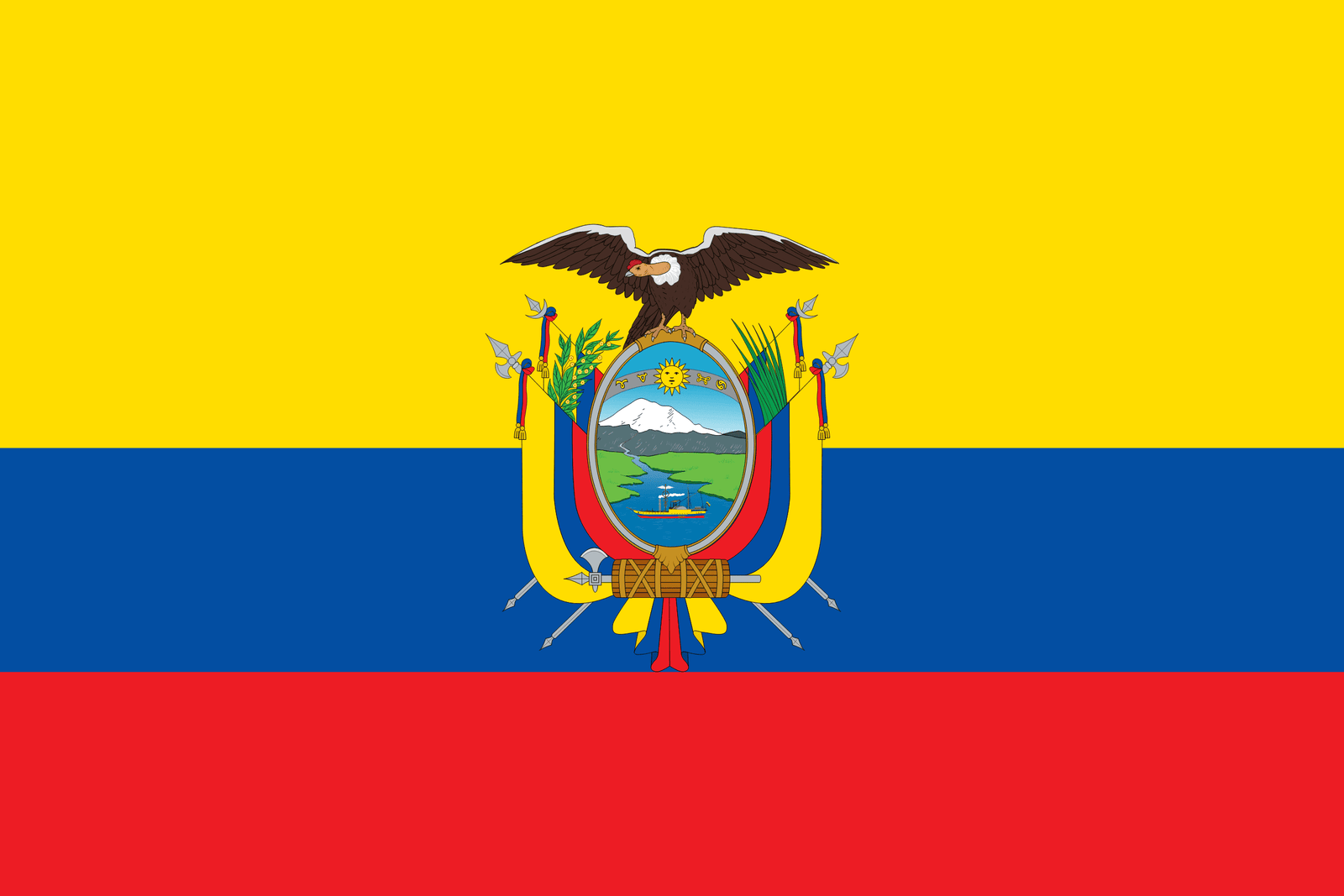
The national flag of Ecuador features horizontal stripes: yellow (double-width) symbolizing abundance, blue representing the ocean and sky, and red for the blood of heroes. The coat of arms depicts Mount Chimborazo, the Guayas River, and a condor, representing freedom and power. The national anthem, Salve, Oh Patria, celebrates independence and national pride. Notable national symbols include the Andean condor and the rose tree (rosa de los Andes).
National Flag (Detailed Section)
The Ecuadorian flag, adopted in 1860, combines historical and symbolic colors reflecting heritage, geography, and national struggle. The yellow stripe signifies abundance and fertility, blue represents the sea and sky, and red honors the sacrifices of freedom fighters. The coat of arms conveys national identity, economic resources, and independence. The flag is displayed on public buildings, national holidays, and international events, with half-mast protocol during periods of mourning.
Flag flying days
| Date | Flag Position | Occasion or Reason |
|---|---|---|
| August 10 | Full-mast | First Cry of Independence (1809) |
| May 24 | Full-mast | Battle of Pichincha Day |
| October 9 | Full-mast | Independence from Spain (1820) |
| National Mourning Days | Half-mast | Death of leaders or national tragedies |