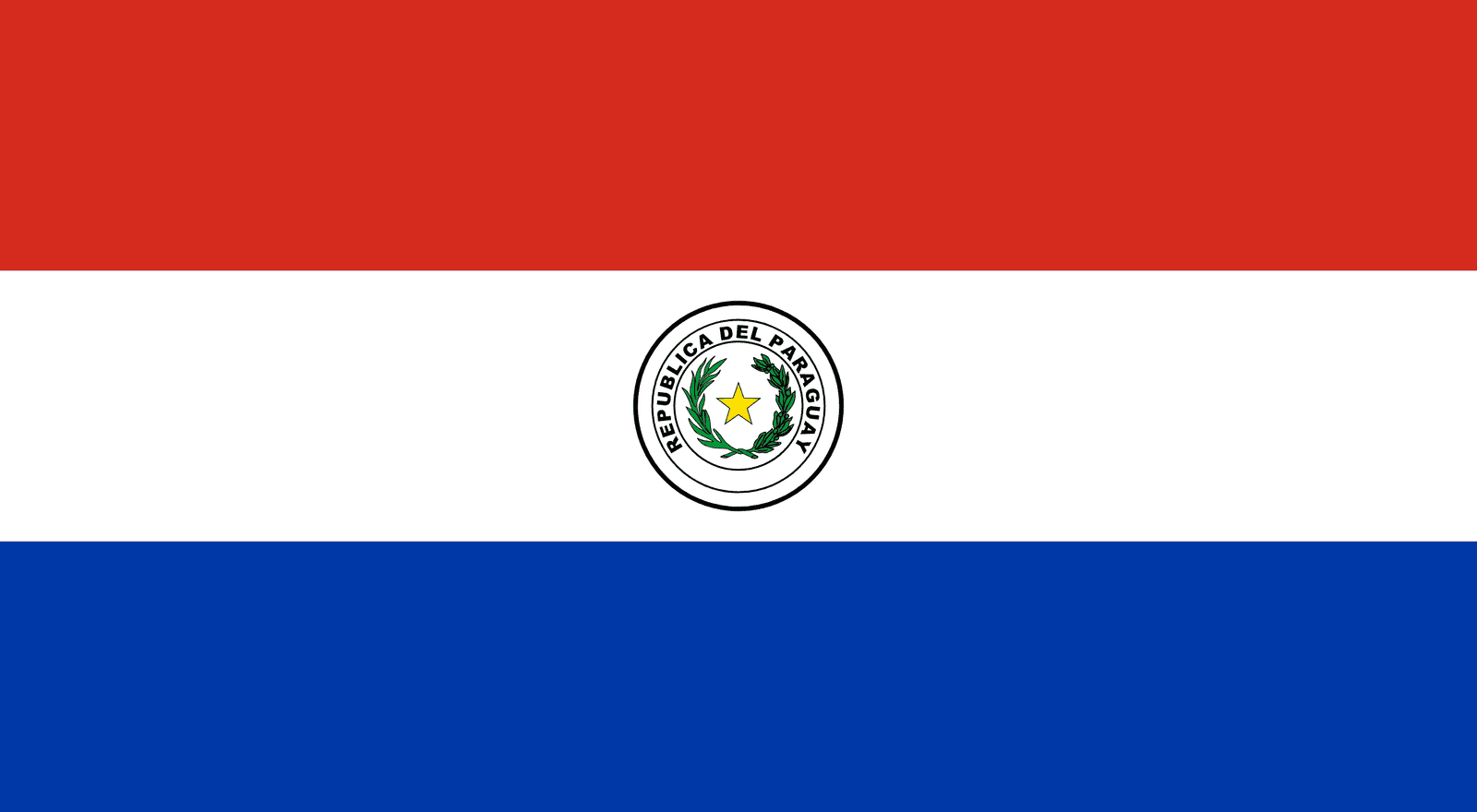
Flag of Paraguay
| Legal Name | Paraguay |
|---|---|
| Flag |
|
| Capital City |
Asunción |
| Total Area | 406,752 km² |
| Land Area | 397,302 km² |
| Water Area | 9,450 km² |
| Population | Approximately 7.4 million |
| Major Cities | Asunción (~525,000), Ciudad del Este (~320,000), San Lorenzo (~230,000), Luque (~220,000), Capiatá (~210,000) |
| Currency | Paraguayan Guaraní (PYG) |
| GDP | USD 40 billion |
| GDP Per Capita | USD 13,000 (PPP) |
About of Paraguay
Paraguay is a landlocked country in central South America, strategically located between Brazil, Argentina, and Bolivia. Its location along major rivers, such as the Paraguay and Paraná, has historically facilitated trade and transportation, despite its lack of a coastline. The nation is divided geographically into two distinct regions: the Eastern region, which is fertile and highly populated, and the Western Chaco region, which is sparsely inhabited and dominated by dry forests and savannas.
The capital and largest city, Asunción, serves as the political, cultural, and economic hub of Paraguay. Other major cities, including Ciudad del Este, San Lorenzo, and Luque, contribute to trade and industrial activity. Paraguay’s population of over 7 million is predominantly mestizo, reflecting the blending of indigenous Guaraní and European ancestry. The country enjoys international recognition as a sovereign republic and participates in organizations such as the United Nations, MERCOSUR, OAS, and the Community of Latin American and Caribbean States (CELAC). Paraguay’s geopolitical importance stems from its location at the heart of South America and its role in regional trade and energy production, particularly through hydroelectric power from the Itaipú Dam.
Etymology
The name “Paraguay” is believed to derive from the Guaraní language, possibly meaning “river of the painted or rosy waters,” referring to the Paraguay River. Historical records suggest that early Spanish explorers adopted the indigenous term to describe both the river and the surrounding territory. Over time, “Paraguay” became the official designation of the sovereign nation following independence from Spain in 1811.
History
Prehistoric and Ancient Civilizations
Human habitation in Paraguay dates back thousands of years, with hunter-gatherer societies inhabiting the river valleys. Early agricultural communities cultivated maize, beans, and cassava, laying the foundations for later complex societies.
Colonial Period
In the early 16th century, Spanish explorers arrived, establishing Asunción in 1537 as a strategic colonial outpost. Paraguay became part of the Viceroyalty of Peru and later the Viceroyalty of the Río de la Plata, serving as a center for trade and missionary activity. Jesuit missions, known as reducciones, played a crucial role in organizing indigenous communities and spreading Christianity.
Independence Movement
Paraguay declared independence from Spain on May 14–15, 1811, becoming one of the first South American nations to gain sovereignty. The early post-independence period was marked by political consolidation under leaders such as José Gaspar Rodríguez de Francia, who established an autocratic yet stabilizing government.
19th and 20th Centuries
Paraguay experienced turbulent periods, including the Paraguayan War (1864–1870) against Brazil, Argentina, and Uruguay, which devastated its population and economy. In the 20th century, Paraguay underwent alternating periods of democratic and authoritarian rule, including the long dictatorship of Alfredo Stroessner (1954–1989). Democratic transition began in 1989, leading to political reforms and increased civil liberties.
Modern Political Developments
Since the 1990s, Paraguay has strengthened its democratic institutions, joined regional trade blocs such as MERCOSUR, and developed its economy while confronting challenges including corruption, social inequality, and environmental management.
Government and Politics
Type of Government: Unitary presidential republic
Constitution: 1992 Constitution guarantees separation of powers, civil liberties, and representative government
Executive: President is head of state and government, elected for a five-year term; supported by a cabinet
Legislative: Bicameral National Congress (Senate and Chamber of Deputies)
Judiciary: Independent judicial system with Supreme Court, lower courts, and Constitutional Court
Administrative Divisions: 17 departments (departamentos) plus the capital district of Asunción
Foreign Relations: Active member of UN, MERCOSUR, OAS; engages in regional diplomacy and energy trade
Defense: Paraguayan Armed Forces include Army, Navy, and Air Force; focus on border security and disaster response
Economy
Economic Classification: Developing country, upper-middle-income
Major Industries: Agriculture, livestock, forestry, energy, manufacturing, services, and commerce
Agriculture: Soybeans, maize, wheat, sugarcane, cotton, beef
Manufacturing: Food processing, beverages, textiles, chemicals
Services: Trade, finance, tourism, logistics
Natural Resources: Fertile land, rivers for hydroelectric power, forests, minerals
Trade Partners: Brazil, Argentina, United States, China, Chile
Economic Challenges: Dependency on commodity exports, informal economy, poverty reduction
Outlook: Growth driven by agriculture, hydroelectric exports, trade diversification, and sustainable development initiatives
Demographics
Population Composition: Approximately 7.4 million, largely mestizo
Ethnic Groups: Mestizo (~95%), Indigenous (~4%), European (~1%)
Languages: Spanish (official), Guaraní (co-official), recognized indigenous languages
Religions: Predominantly Roman Catholic (~89%), Protestant and other Christian groups (~6%), other religions (~5%)
Urban vs Rural: ~63% urban, concentrated in Asunción, Ciudad del Este, and surrounding metropolitan areas
Population Growth: Moderate, with urban migration and declining fertility rates
Culture and Society
Cultural Heritage: Blend of Guaraní traditions and Spanish influence; strong family and community values
National Identity: Pride in bilingualism, folklore, music, and resilience through historical challenges
Arts & Music: Traditional Paraguayan harp music, polka, guarania, visual arts, crafts
Cuisine: Sopa paraguaya, chipa, mbeju, tereré (herbal tea), regional flavors
Social Norms: Emphasis on family, hospitality, and community participation
Festivals: Independence Day (May 14–15), Virgin of Caacupé Day, National Folklore Festival
Sports & Recreation: Soccer, volleyball, basketball, traditional games
Education and Healthcare
Education System: Primary, secondary, and tertiary education; public and private schools; bilingual education in Spanish and Guaraní
Literacy Rate: Approximately 94%
Healthcare System: Mix of public and private facilities; focus on primary care and maternal-child health
Public Health Challenges: Malnutrition, access in rural areas, infectious diseases, chronic conditions
Geography and Climate
Physical Geography: Eastern fertile plains, Western Gran Chaco (dry forests and savannas), major rivers (Paraguay, Paraná, Pilcomayo)
Climate Zones: Subtropical and tropical, hot summers, mild winters, seasonal rainfall
Natural Hazards: Flooding, droughts, occasional storms, deforestation impacts
Environmental Concerns: Deforestation, soil degradation, water pollution, biodiversity conservation
Flora and Fauna
Biodiversity: Rich ecosystems in Atlantic forests and Chaco region
Native Plants: Lapacho trees, yerba mate, palm species, medicinal plants
Wildlife: Jaguars, pumas, capybaras, armadillos, toucans, macaws, river dolphins
National Parks & Conservation: Defensores del Chaco National Park, Cerro Cora National Park, conservation of Chaco forests and wetlands
Map of Paraguay
Flag: Horizontal tricolor of red, white, and blue; coat of arms on obverse, treasury seal on reverse
Coat of Arms: Features a star, palm, and olive branches symbolizing independence, peace, and honor; reverse includes lion, Phrygian cap, national motto
National Anthem: Himno Nacional Paraguayo
National Animals / Plants: Ybycuí Palm, jaguar, lapacho tree, national flower – Mburucuyá (passionflower)
National Flag (Detailed Section)
Design and Layout: Horizontal red, white, and blue bands; coat of arms in white on obverse side; reverse features treasury seal
Historical Development: Adopted in 1842, derived from revolutionary ideals and influence from neighboring countries’ colors
Symbolism: Red for courage and patriotism, white for peace and unity, blue for liberty; coat of arms emphasizes national sovereignty and resources
Flag Protocol: Displayed at government offices, schools, national holidays, half-mast during mourning
Flag Usage: Civic, ceremonial, and educational; represents national pride and identity
| Date | Flag Position | Occasion / Reason |
|---|---|---|
| May 14–15 | Full-mast | Independence Day |
| August 15 | Full-mast | Virgin of Caacupé Day |
| September 29 | Full-mast | National Folklore Day |
| National Mourning | Half-mast | Death of national leaders or tragic events |