
Flag of Uruguay
| Legal Name | Oriental Republic of Uruguay |
|---|---|
| Flag |
|
| Capital City |
Montevideo |
| Total Area | ~176,215 km² |
| Land Area | ~173,626 km² |
| Water Area | ~2,589 km² |
| Population | ~3.5 million |
| Major Cities | Montevideo (~1.3M metro), Salto (~105,000), Paysandú (~95,000), Las Piedras (~72,000), Rivera (~65,000) |
| Currency | Uruguayan peso (UYU) |
| GDP | ~USD 80–85 billion |
| GDP Per Capita | ~USD 23,000 (nominal) |
About of Uruguay
Uruguay is a sovereign country located in southeastern South America, positioned between Brazil to the north and east and Argentina to the west. To the south and southeast, it is bordered by the Río de la Plata estuary and the Atlantic Ocean, giving it strategic access to major maritime routes of the Southern Cone.
The capital and largest city, Montevideo, lies along the northern shore of the Río de la Plata and serves as the country’s political, economic, and cultural center. Other important urban areas include Salto and Paysandú along the Uruguay River and Rivera near the Brazilian border. Uruguay is one of the most urbanized countries in Latin America, with a large share of its population concentrated in and around Montevideo.
Demographically, Uruguay has a relatively small and aging population with high human development indicators. It is known for social stability, strong institutions, and a long tradition of democratic governance.
Internationally, Uruguay is widely recognized for its commitment to democracy, rule of law, and multilateralism. Despite its modest size, it plays an influential diplomatic role in regional affairs and global forums, particularly through trade, peacekeeping, and human rights advocacy.
Etymology
The name “Uruguay” originates from the Uruguay River, which forms much of the country’s western border. The term comes from indigenous Guaraní language roots, though its exact meaning has been debated. Common interpretations include “river of the painted birds,” “river of the snails,” or “river where the bird lives.”
The name became associated with the territory during the colonial era and was formally adopted at independence. The official name, “Oriental Republic of Uruguay,” refers to the country’s location east (oriental) of the Uruguay River.
History
Prior to European contact, the region was inhabited by indigenous peoples, most notably the Charrúa, who practiced hunting, fishing, and limited agriculture. There were no large centralized states, but complex social structures existed among indigenous groups.
Spanish explorers arrived in the early 16th century, though settlement was slow due to limited mineral resources and resistance from indigenous populations. The territory later became a contested frontier between Spanish and Portuguese empires, eventually incorporated into the Spanish Viceroyalty of the Río de la Plata.
In the early 19th century, the region experienced upheaval amid independence movements across South America. José Gervasio Artigas emerged as a key figure advocating autonomy and federalism. Following periods of Brazilian and Argentine influence, Uruguay achieved independence in 1828, recognized as a buffer state between larger neighbors.
The late 19th and early 20th centuries saw political consolidation and significant social reforms, including secularization, public education, and labor protections. Uruguay earned a reputation as one of Latin America’s most progressive societies.
The country experienced a period of authoritarian rule between 1973 and 1985, after which democracy was restored. Since then, Uruguay has maintained stable democratic institutions and pursued social and economic reforms, including expanded civil rights and welfare policies.
Government and Politics
Uruguay is a presidential republic with a strong democratic tradition. The constitution, adopted in 1967 and amended several times, establishes a separation of powers among the executive, legislative, and judicial branches.
The President serves as both head of state and government and is elected by popular vote. Legislative authority is vested in the General Assembly, a bicameral body consisting of the Chamber of Deputies and the Senate. The judiciary is independent, with the Supreme Court at its apex.
Administratively, Uruguay is divided into 19 departments, each governed by an elected intendant and departmental assembly.
Uruguay maintains active foreign relations and is a member of the United Nations, Organization of American States, MERCOSUR, and numerous international institutions. Its armed forces are modest in size and focus on national defense, disaster response, and international peacekeeping operations.
Economy
Uruguay is classified as a high-income developing economy with strong institutions and a diversified economic base. It consistently ranks highly in Latin America for economic stability, transparency, and social inclusion.
Agriculture is a cornerstone of the economy, with major products including beef, soybeans, rice, dairy, and wool. Manufacturing focuses on food processing, chemicals, and pulp and paper, while services—particularly finance, logistics, tourism, and information technology—contribute the largest share of GDP.
The country has limited mineral resources but benefits from fertile land and abundant renewable energy, particularly wind, solar, and hydropower. Uruguay is a regional leader in clean energy generation.
Major trade partners include China, Brazil, Argentina, the European Union, and the United States. Key exports are agricultural products, cellulose, and meat.
Economic challenges include demographic aging, productivity growth, and vulnerability to external market fluctuations. Long-term prospects emphasize innovation, digital services, and sustainable development.
Demographics
Uruguay’s population is largely of European descent, primarily Spanish and Italian, with smaller communities of African, indigenous, and mixed heritage. The country has one of the lowest population growth rates in the region.
Spanish is the official and dominant language. Roman Catholicism has historically been influential, though Uruguay is one of the most secular societies in the Americas, with many citizens identifying as non-religious.
More than 90 percent of the population lives in urban areas, reflecting high levels of urbanization and access to public services.
Culture and Society
Uruguayan culture blends European influences with regional traditions of the Río de la Plata. Social values emphasize equality, civic participation, and personal freedom.
The arts play an important role in national life, including literature, theater, and music. Tango and candombe are key musical traditions, while cuisine features beef, asado, mate, and chivito sandwiches.
Social customs include strong family ties, informal social interaction, and widespread participation in cultural events. National holidays and festivals reinforce historical memory and collective identity.
Football is the most popular sport, with Uruguay holding a prominent place in international football history. Basketball, rugby, and equestrian sports are also practiced.
Education and Healthcare
Uruguay has a comprehensive public education system providing free education from primary through university levels. Literacy rates are high, and institutions such as the University of the Republic play a central role in higher education.
Healthcare operates under a mixed public–private system known as the National Integrated Health System, ensuring broad access to medical services. Public health indicators are strong, with high life expectancy and low infant mortality.
Geography and Climate
The country’s landscape is characterized by gently rolling plains, low hills, fertile grasslands, and extensive river systems. There are no major mountain ranges, and the coastline consists of sandy beaches and estuaries.
Uruguay has a temperate climate with four distinct seasons, mild winters, and warm summers. Natural hazards include occasional flooding and storms.
Environmental concerns focus on soil conservation, water quality, and sustainable land use.
Flora and Fauna
Uruguay’s natural vegetation is dominated by grasslands, supporting livestock grazing. Native plant species include grasses, shrubs, and riparian forests.
Wildlife includes capybaras, deer, foxes, armadillos, and diverse bird species. Conservation efforts protect wetlands, coastal zones, and grassland ecosystems through national parks and reserves.
Map of Uruguay
The national flag is a central symbol of independence and identity. The coat of arms features scales, a fortress, a horse, and an ox, representing justice, strength, freedom, and abundance. The national anthem commemorates the struggle for independence. Symbolic monuments include Independence Square and the Mausoleum of Artigas.
National Flag (Detailed Section)
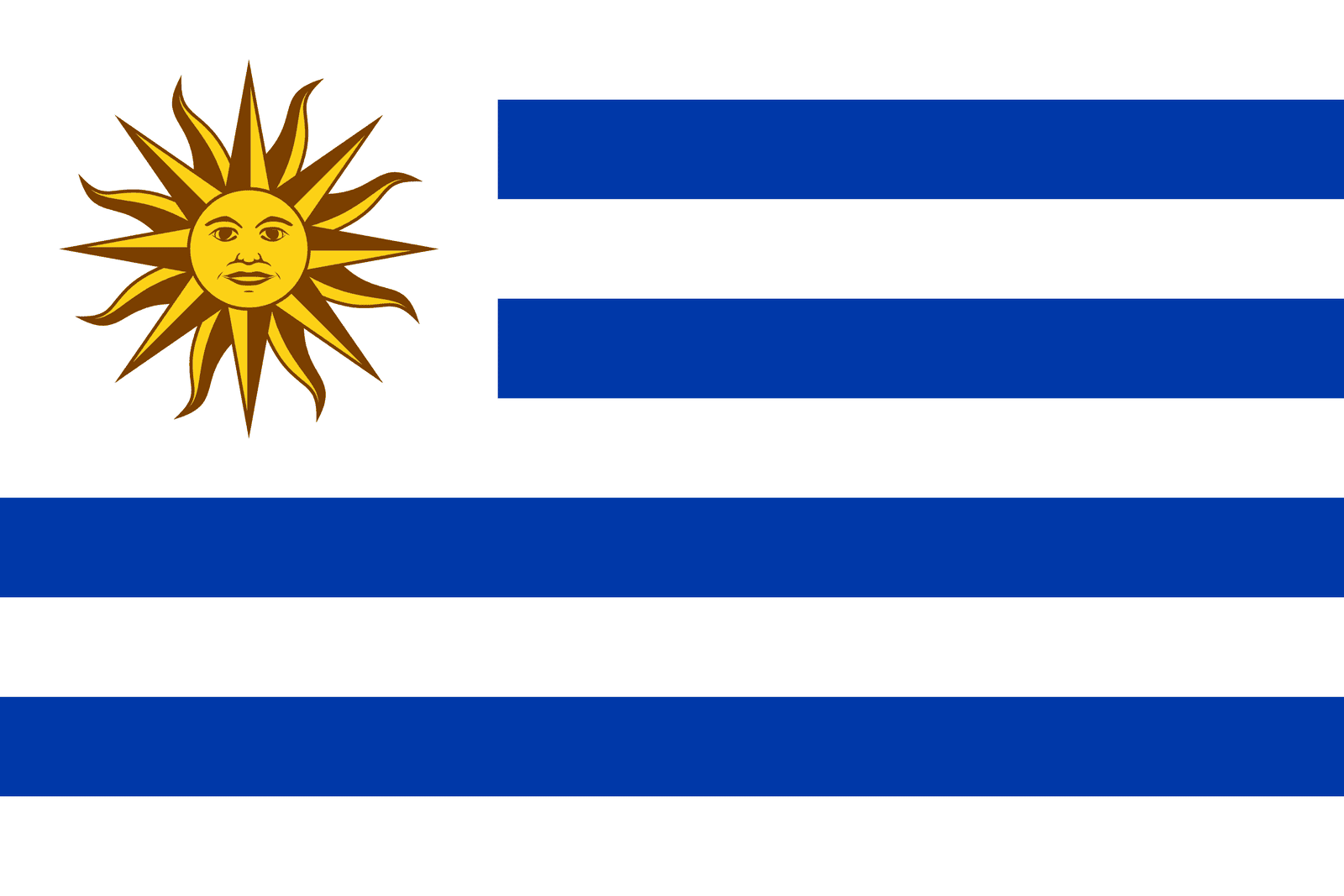
The flag of Uruguay consists of nine horizontal stripes alternating white and blue, with a white canton displaying the Sun of May in gold. The design was inspired by the flag of Argentina and early revolutionary banners.
Adopted in the 19th century, the stripes originally represented the country’s early departments. The Sun of May symbolizes freedom, independence, and the birth of the nation.
The flag is flown on government buildings, schools, and during official ceremonies, following established national protocols.
Flag flying days
| Date | Flag Position | Occasion or Reason |
|---|
| 19 June | Full-mast | Birth of José Gervasio Artigas |
| 18 July | Full-mast | Constitution Day |
| 25 August | Full-mast | Independence Day |
| As decreed | Half-mast | National mourning or remembrance periods |