Flag of Venezuela
| Legal Name | Bolivarian Republic of Venezuela |
|---|---|
| Flag |
|
| Capital City |
Caracas |
| Total Area | ~912,050 km² |
| Land Area | ~882,050 km² |
| Water Area | ~30,000 km² |
| Population | ~31.8–34.8 million |
| Major Cities | Caracas (~2.9M), Maracaibo (~1.7M), Valencia (~1.4M), Barquisimeto (~1.3M), Maracay (~1.0M) |
| Currency | Venezuelan bolívar (VED) |
| GDP | ~USD 82.8 billion (2025 est.) |
| GDP Per Capita | ~USD 3,100 (nominal, 2025 est.) |
About of Venezuela
Venezuela is a sovereign state located on the northern coast of South America, facing the Caribbean Sea and the Atlantic Ocean. Its mainland territory is complemented by numerous islands and archipelagos in the Caribbean basin, including Margarita Island, Los Roques, and La Tortuga, which contribute to its maritime jurisdiction. The nation spans diverse geographical regions, from coastal plains and Caribbean beaches to the Andean highlands and the expansive plains of the Llanos.
The country’s northernmost position on the continent places it adjacent to major maritime routes linking the Atlantic and Caribbean, while its interior connects to the Amazon and Orinoco basins. Venezuela shares land borders with Colombia to the west and south, Brazil to the south, and Guyana to the east.
Caracas, the capital and largest city, is located in a valley overlooking the Caribbean and is the primary political, economic, and cultural hub. Other major urban centers such as Maracaibo, Valencia, Barquisimeto, and Maracay host significant industrial and commercial activity and reflect the country’s highly urbanized population distribution.
Venezuela’s demographic profile features a blend of European, African, and indigenous ancestries, shaped by centuries of migration and colonial history. It is recognized internationally as a founding member of the United Nations and Organization of American States. Its strategic importance is tied to vast energy resources—particularly the world’s largest proven oil reserves—geopolitically significant maritime territory, and its role in regional diplomacy and energy markets.
Etymology
The name “Venezuela” is believed to have originated during the first European explorations in the early 16th century. Italian explorer Amerigo Vespucci and Spanish navigator Alonso de Ojeda visited the region and observed stilt houses built over water in Lake Maracaibo, reportedly reminding them of Venice (Venezia in Italian). This prompted the name Venezuela, literally meaning “Little Venice.” Over time the name was formalized to designate the territory and the emerging political entity. Its official title, the Bolivarian Republic of Venezuela, honors Simón Bolívar, a central figure in the region’s independence movements and a symbol of Latin American liberation.
History
Archaeological evidence indicates human habitation in what is now Venezuela since prehistoric times, with indigenous groups such as the Arawak and Carib occupying diverse ecological zones. The arrival of Europeans in the late 15th and early 16th centuries initiated a period of Spanish colonization that dramatically reshaped local societies, cultures, and economies.
During colonial rule, Venezuela was part of the Spanish Empire’s Viceroyalty of New Granada, providing agricultural products and, later, cocoa to imperial markets. Resistance to colonial rule grew over time, culminating in early 19th-century independence movements inspired by broader Latin American revolutions. Simón Bolívar emerged as a defining leader, and following a series of military campaigns, Venezuela became part of the short-lived Gran Colombia before establishing itself as an independent republic in 1830.
The 20th century witnessed periods of economic modernization, dictatorship, and democratic reform. The discovery and commercialization of vast oil reserves transformed Venezuela into one of Latin America’s wealthiest economies for much of the mid-20th century. However, political and economic volatility marked later decades, including the rise of Hugo Chávez in 1999 and the initiation of the Bolivarian Revolution, which instituted socialist policies and expanded social programs funded by oil revenues.
In the early 21st century, declining oil prices, economic mismanagement, and political polarization contributed to deepening crises in governance, public services, and economic stability. Under Nicolás Maduro’s leadership, these challenges intensified, leading to significant emigration and international controversy over electoral legitimacy, human rights, and institutional erosion. In early 2026, geopolitical tensions escalated with international interventions and contested political transitions that drew global attention.
Government and Politics
Venezuela is constitutionally defined as a federal presidential republic; however, political practice has been characterized by concentrated executive power and contested democratic institutions in recent years. The 1999 constitution expanded participatory mechanisms and enshrined the Bolivarian ideological framework, emphasizing popular sovereignty, social justice, and national sovereignty. Executive authority lies with the President, who is both head of state and government.
Legislative functions are vested in the unicameral National Assembly, whose composition and legitimacy have been central points of political contention. The judiciary is constitutionally independent, though its autonomy has been challenged by political pressures and institutional crises. Administratively, the country is divided into 23 states, a Capital District, and federal dependencies encompassing offshore islands.
In foreign relations, Venezuela historically maintained active engagement in Latin American regional organizations, the Non-Aligned Movement, and OPEC as a major oil exporter. In recent years, diplomatic relations have been strained with multiple states due to sanctions, disputes over political legitimacy, and human rights concerns. The armed forces are structurally tasked with national defense and internal security; their role in politics has been significant during periods of crisis.
Economy
Venezuela’s economy is classified as an emerging market with significant structural challenges. Its historical dependence on petroleum exports—facilitated by the world’s largest proven oil reserves—has shaped economic development and fiscal policy for decades. Oil production and related industries were central to growth during the 20th century, and petroleum continues to dominate export earnings and government revenues.
Other sectors include agriculture, mining (including coal and minerals), and services, though these are comparatively smaller in contribution. Hydroelectric power, particularly from the Guri Dam on the Caroní River, supplies a substantial portion of domestic electricity.
Trade partners traditionally include the United States, China, and regional neighbors. However, economic output has contracted sharply since the 2010s due to political instability, falling oil production, external sanctions, and macroeconomic mismanagement, contributing to hyperinflation, currency depreciation, and widespread shortages of basic goods and services. Efforts at economic diversification include coal exports and policy reforms, though challenges remain acute.
Demographics
Venezuela’s population is ethnically diverse, consisting mainly of people of mixed European, African, and indigenous ancestry, alongside smaller communities of European and Middle Eastern descent. Spanish is the official language, and numerous indigenous languages are recognized constitutionally.
The predominant religion is Roman Catholicism, with Protestant and other faiths present. Urbanization is high, with most residents living in metropolitan areas along the northern coast. Population growth has fluctuated due to migration, economic crisis, and demographic transitions.
Culture and Society
Venezuelan culture synthesizes indigenous, Spanish, and African influences. Family and community bonds are foundational social elements, and music—such as joropo and salsa—plays a central role in social life. Venezuelan cuisine features staples like arepas, pabellón criollo, and hallacas, reflecting regional diversity. Celebrations such as Carnival and Independence Day underscore national identity and cultural continuity.
Sports, especially baseball and football (soccer), are widely followed, with Venezuela producing notable athletes in domestic and international arenas. The arts encompass literature, cinema, visual arts, and popular media, illustrating the country’s complex social narratives.
Education and Healthcare
Education in Venezuela includes compulsory primary and secondary schooling, supported by public and private institutions. Literacy rates have historically been high due to sustained educational campaigns, though resource constraints affect quality and access. Universities and technical centers provide higher education and research opportunities.
Healthcare is delivered through a combination of public and private systems. Significant improvements in health indicators occurred earlier in the 21st century through expanded access and preventive programs; however, recent economic and institutional crises have strained healthcare infrastructure, medicine availability, and public health outcomes.
Geography and Climate
Venezuela’s physical geography encompasses the Caribbean coastal plains, the Andean mountain ranges in the west, the Orinoco River basin and Llanos grasslands, and the Guiana Highlands with tepuis and dense forests. The country includes varied ecosystems, from mangrove swamps and coral reefs to cloud forests and savannas.
The climate is predominantly tropical, with hot, humid lowlands and more temperate conditions in higher elevations. The rainy season typically spans from May to November. Natural hazards include flooding, landslides, and occasional droughts. Environmental concerns include deforestation, water contamination, and the ecological impacts of resource extraction.
Flora and Fauna
Venezuela is recognized for biodiversity, hosting numerous endemic plant and animal species across ecosystems. Tropical rainforests support hardwoods, palms, and orchids, while grasslands and highlands sustain grasses and shrubs adapted to varied climates. Wildlife includes jaguars, capybaras, giant anteaters, numerous bird species, and rich marine life.
National parks, such as Canaima with Angel Falls—the world’s highest uninterrupted waterfall—protect habitats and promote conservation. Ongoing efforts address habitat preservation and sustainable tourism.
Map of Venezuela
The national flag represents independence, courage, and unity. The coat of arms incorporates symbols of liberty and the nation’s agricultural wealth. The national anthem, Gloria al Bravo Pueblo (“Glory to the Brave People”), reflects patriotic fervor. Other symbols include iconic natural monuments and cultural heritage sites that embody national identity.
National Flag (Detailed Section)
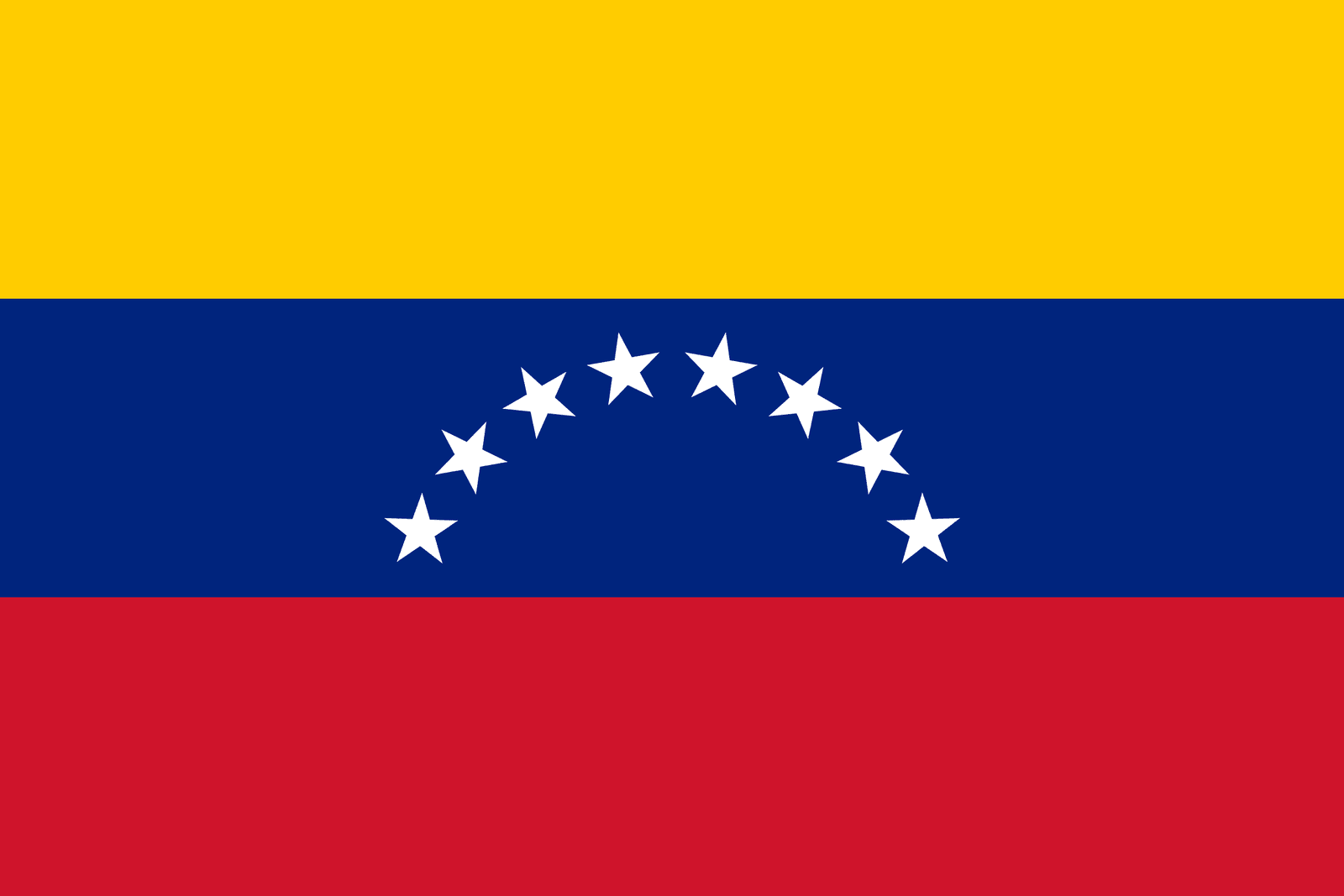
Venezuela’s flag consists of three horizontal bands—yellow, blue, and red—from top to bottom. In the blue band, eight white stars form an arc representing the provinces that supported independence. The country’s coat of arms appears in the upper hoist corner of the yellow stripe.
Adopted initially in the 19th century and modified over time, the flag’s colors symbolize national virtues: yellow for wealth and generosity, blue for the sea and courage, and red for the blood shed for independence. The stars represent unity and the historic provinces. The flag is displayed on government buildings, schools, and public spaces, with protocols governing respectful display and ceremonial usage.
Flag flying days
| Date | Flag Position | Occasion or Reason |
|---|
| 5 July | Full-mast | Independence Day |
| 24 June | Full-mast | Battle of Carabobo Day |
| As decreed | Half-mast | National mourning or remembrance |