
Flag of San Marino
| Legal Name | Most Serene Republic of San Marino |
|---|---|
| Flag |
|
| Capital City |
City of San Marino |
| Total Area | Approximately 61 km² |
| Land Area | Approximately 61 km² |
| Water Area | Negligible |
| Population | About 34,000 |
| Major Cities | Dogana (9,000+), Borgo Maggiore (7,000+), City of San Marino (4,000+) |
| Currency | Euro (EUR) |
| GDP | Approximately USD 1.7–1.9 billion |
| GDP Per Capita | USD 45,000–50,000 (approx.) |
About of San Marino
San Marino is a landlocked microstate located in Southern Europe, completely surrounded by Italy. It lies on the northeastern side of the Apennine Mountains, near the Adriatic coast, and is one of the smallest countries in the world by both area and population.
The capital, the City of San Marino, sits atop Mount Titano and serves as the historic, political, and cultural heart of the republic. While the capital is symbolic and administrative, the largest urban concentration is Dogana, a commercial hub in the municipality of Serravalle.
San Marino is notable for being the world’s oldest surviving republic, with a continuous constitutional government dating back to the early Middle Ages. It is fully recognized as a sovereign state and maintains strong diplomatic and economic ties with Italy and the wider international community. Despite its small size, San Marino holds symbolic geopolitical importance as a long-standing model of republican governance and political continuity.
Etymology
The name “San Marino” originates from Saint Marinus, a Christian stonemason from Dalmatia. According to tradition, Marinus founded a small Christian community on Mount Titano in the early 4th century.
Over time, the settlement grew and adopted his name in recognition of his role as founder and spiritual figure. The name evolved into “San Marino,” reflecting both its religious heritage and its enduring identity as an independent republic.
History
Human presence in the area dates back to prehistoric times, with archaeological evidence indicating early settlements in the Apennine region. During the Roman era, the territory lay near important trade routes but remained largely autonomous due to its mountainous terrain.
The formal foundation of San Marino is traditionally dated to 301 CE, when Saint Marinus established a refuge for persecuted Christians. During the medieval period, San Marino gradually developed institutions of self-governance and resisted absorption by surrounding feudal powers.
Unlike much of Europe, San Marino avoided long-term domination by major empires. It maintained independence through diplomacy, strategic alliances, and its defensible geography. The republic briefly expanded its territory in the 15th century and has largely retained its borders since.
San Marino survived the Napoleonic era and the unification of Italy without losing sovereignty. In the modern period, it experienced political reforms, neutrality during major conflicts, and economic modernization. Today, it functions as a stable democratic republic with strong institutional continuity.
Government and Politics
San Marino is a parliamentary republic with a unique political system rooted in centuries-old traditions. Executive authority is jointly held by two Captains Regent, who serve as heads of state for six-month terms, elected by the legislature.
The constitution is based on a collection of legal statutes, most notably the Statutes of 1600, one of the world’s oldest written constitutional documents still in force. Legislative power resides in the Grand and General Council, a unicameral parliament elected by proportional representation.
The judiciary is independent and includes multiple levels of courts. Administratively, San Marino is divided into nine municipalities, known as castelli. In foreign relations, San Marino is a member of the United Nations, Council of Europe, and other international organizations. Defense relies primarily on neutrality, limited military units, and cooperation with Italy.
Economy
San Marino has a developed, high-income economy characterized by a strong services sector. Banking, finance, tourism, and retail trade play central roles, supported by a favorable tax environment.
Manufacturing focuses on ceramics, electronics, textiles, and furniture, while agriculture is limited but includes wine, olives, and small-scale farming. The country lacks significant natural resources, making trade and external economic relations essential.
Italy is San Marino’s primary trade partner, though commercial ties extend across Europe. Economic challenges include financial sector regulation, demographic aging, and maintaining competitiveness. Future growth strategies emphasize sustainable tourism, regulatory transparency, and innovation.
Demographics
San Marino has a small, stable population composed primarily of native Sammarinese and Italian residents. Immigration contributes modestly to population growth.
Italian is the official and dominant language. Roman Catholicism is the predominant religion, deeply influencing cultural traditions and public life. Most residents live in urban or semi-urban settings, reflecting the country’s compact size.
Culture and Society
Sammarinese culture reflects a blend of Italian heritage and distinct republican traditions. National identity is strongly tied to independence, civic responsibility, and historical continuity.
The arts include medieval architecture, painting, and traditional music. Cuisine closely resembles Italian regional cooking, featuring pasta, meats, cheeses, and local wines. Social customs emphasize community, respect for institutions, and family life. Major festivals celebrate national independence, religious observances, and historical reenactments. Football, motorsports, and traditional games are popular recreational activities.
Education and Healthcare
Education in San Marino is compulsory and publicly funded, with high literacy rates and strong emphasis on civic education. Higher education opportunities are available domestically and through partnerships with Italian universities.
Healthcare is universal and publicly funded, providing comprehensive coverage and high health outcomes. Public health indicators are comparable to those of other Western European countries, with challenges primarily related to aging populations.
Geography and Climate
San Marino’s geography is dominated by Mount Titano and surrounding hills. There are no coastlines, rivers of major significance, or plains. The terrain contributes to scenic landscapes and historical fortifications.
The climate is Mediterranean, with warm summers and mild to cool winters. Natural hazards are limited, though occasional earthquakes and landslides may occur. Environmental concerns focus on land management, conservation, and sustainable tourism.
Flora and Fauna
Despite its small size, San Marino hosts diverse plant life typical of the Apennine region, including oak forests and Mediterranean shrubs. Wildlife includes small mammals, birds, and reptiles common to central Italy.
Protected natural areas and environmental regulations aim to preserve landscapes and biodiversity, particularly around Mount Titano, a UNESCO-recognized cultural and natural landmark.
Map of San Marino
San Marino’s national symbols emphasize liberty, sovereignty, and faith. The flag, coat of arms, and anthem are central expressions of national identity. Mount Titano and the Three Towers are iconic national monuments representing defense and independence.
National Flag (Detailed Section)
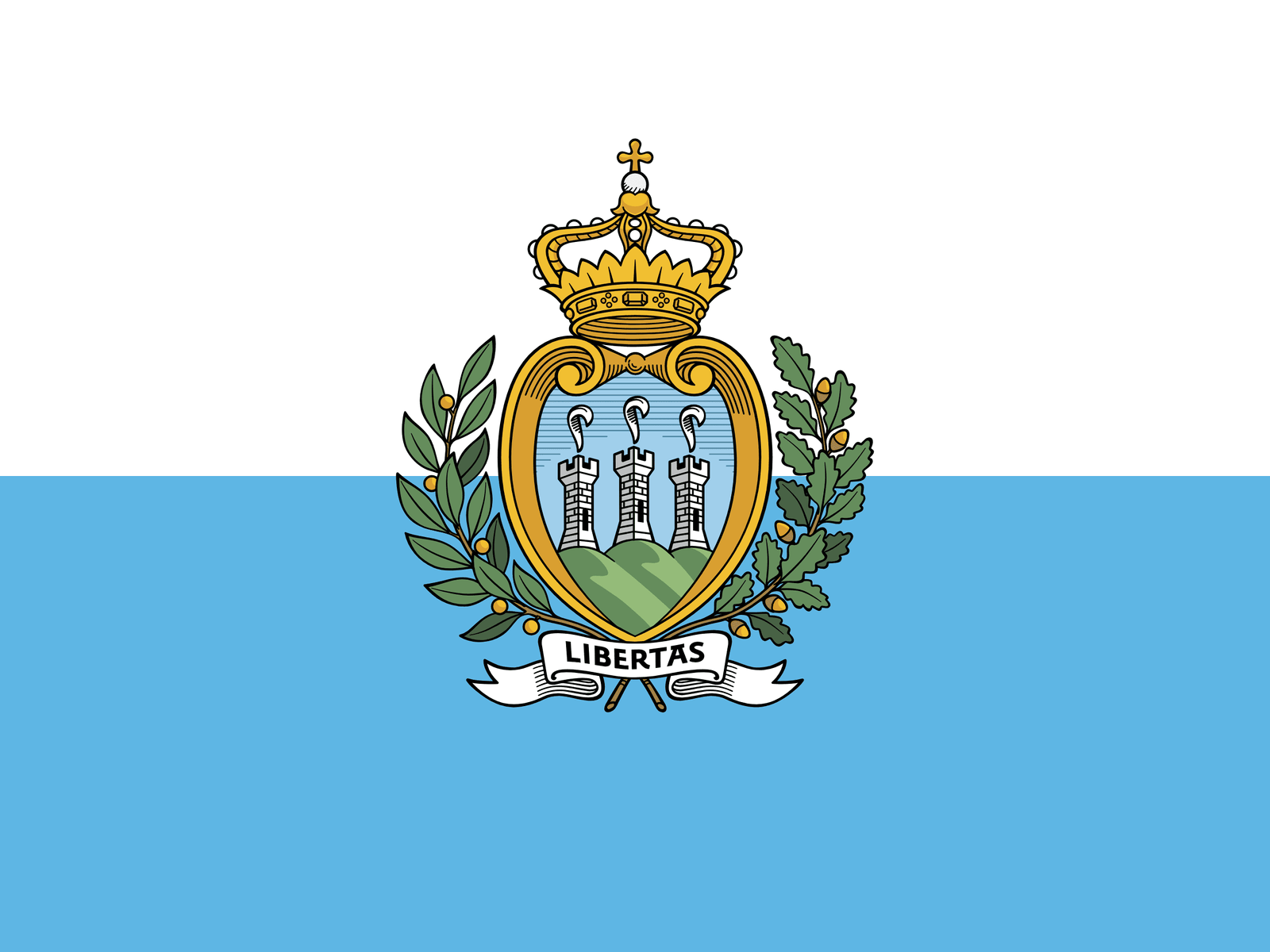
The national flag of San Marino consists of two horizontal stripes: white on the top and light blue on the bottom, with the coat of arms centered. The current design was officially adopted in the 19th century.
White symbolizes peace and liberty, while blue represents freedom and the sky. The coat of arms features a shield with three towers atop Mount Titano, crowned and flanked by branches, with the motto “Libertas.” The flag is displayed on government buildings, during national celebrations, and at international events in accordance with established protocol.
Realted Flags
Flag flying days
| Date | Flag Position | Occasion or Reason |
|---|
| February 5 | Full-mast | Feast Day of Saint Agatha |
| April 1 & October 1 | Full-mast | Installation of the Captains Regent |
| September 3 | Full-mast | Feast of Saint Marinus / National Day |
| Official mourning periods | Half-mast | National days of mourning |