
Flag of Vatican City
| Legal Name | Vatican City State |
|---|---|
| Flag |
|
| Capital City |
Vatican City |
| Total Area | ~0.49 km² |
| Land Area | ~0.49 km² |
| Water Area | 0 km² |
| Population | ~800–1,000 residents |
| Major Cities | Vatican City (~800–1,000); no other cities |
| Currency | Euro (EUR) |
| GDP | Not formally reported; estimated ~USD 0.8–1.0 billion |
| GDP Per Capita | Not meaningful due to unique economic structure |
About of Vatican City
Vatican City is a sovereign city-state enclaved entirely within the city of Rome, Italy, in Southern Europe. It is the smallest internationally recognized independent state in the world by both area and population. Despite its size, Vatican City holds exceptional global influence as the spiritual and administrative center of the Roman Catholic Church.
The territory consists of a walled enclave on the Vatican Hill, along with several extraterritorial properties in Rome and Italy, such as major basilicas and papal residences. Vatican City has no maritime borders and shares its entire land boundary with Italy. Its urban landscape includes St. Peter’s Basilica, St. Peter’s Square, the Apostolic Palace, the Vatican Museums, and the Vatican Gardens.
Vatican City functions simultaneously as a territorial state and as the seat of the Holy See, which is the central governing body of the Catholic Church and a subject of international law. While the Holy See conducts diplomatic relations, Vatican City provides the territorial sovereignty that ensures its independence.
Strategically, Vatican City holds immense geopolitical and cultural importance through its moral authority, diplomatic network, and influence over more than one billion Catholics worldwide. It plays a distinctive role in global dialogue on peace, ethics, humanitarian issues, and interfaith relations.
Etymology
The name “Vatican” derives from Mons Vaticanus, the Vatican Hill, one of the hills on the western bank of the Tiber River in ancient Rome. The origin of the term Vaticanus is debated, but it is commonly associated with Latin words related to prophecy or divination, reflecting the area’s pre-Christian religious associations.
Over time, the name became firmly linked with the residence of the Pope and the central institutions of the Catholic Church. “Vatican City State” formally designates the sovereign territory established in the 20th century, distinguishing it from the broader concept of the Holy See.
History
The area of the Vatican was inhabited in ancient Roman times but lay outside the sacred boundary of the city of Rome. During the Roman Empire, it became associated with early Christianity, particularly after the martyrdom and burial of Saint Peter near what is now St. Peter’s Basilica.
In the medieval period, as the authority of the Papacy grew, the popes gradually acquired temporal power over extensive territories in central Italy known as the Papal States. For centuries, the Pope functioned both as a spiritual leader and a secular ruler.
The unification of Italy in the 19th century led to the annexation of the Papal States in 1870, resulting in the “Roman Question,” a prolonged dispute over the Pope’s sovereignty and status. This was resolved in 1929 with the Lateran Treaties between the Holy See and the Kingdom of Italy, which established Vatican City as an independent state.
Since its foundation, Vatican City has remained politically stable. Modern developments have focused on governance reforms, transparency, and the global mission of the Catholic Church, particularly under successive pontificates addressing contemporary religious, social, and ethical challenges.
Government and Politics
Vatican City is an elective absolute monarchy and a theocratic state, with the Pope serving as head of state, head of government, and supreme legislator. The Pope is elected by the College of Cardinals during a conclave and exercises full executive, legislative, and judicial authority.
The legal framework is rooted in canon law, supplemented by Vatican statutes and civil laws adopted from Italian legislation when compatible. Executive functions are largely delegated to the Pontifical Commission for Vatican City State and the Governorate.
Judicial authority is exercised through Vatican tribunals, including a first-instance tribunal, an appeals court, and a supreme court. Administratively, Vatican City has no internal subdivisions due to its small size.
Internationally, the Holy See maintains diplomatic relations with the majority of the world’s states and holds observer status in various international organizations. Defense is symbolic and ceremonial, primarily entrusted to the Pontifical Swiss Guard, which is responsible for the Pope’s personal security.
Economy
Vatican City has a unique, non-commercial economy that does not fit conventional economic classifications. It does not engage in industrial production or large-scale agriculture. Instead, its revenues derive from donations to the Catholic Church, returns on investments, museum admissions, postal services, and the sale of publications and commemorative coins.
There are no natural resources or export-oriented industries. Financial operations are managed with an emphasis on sustainability, transparency, and support for the Church’s global mission.
Economic challenges include maintaining financial accountability, funding cultural preservation, and supporting charitable activities worldwide. The future outlook centers on institutional reform, ethical investment, and digital modernization.
Demographics
Vatican City’s population consists primarily of clergy, members of religious orders, Swiss Guards, and lay professionals who work for the Holy See. Citizenship is functional and temporary, granted on the basis of service rather than birth or ethnicity.
Residents represent many nationalities, reflecting the international character of the Catholic Church. Latin and Italian are the primary official and working languages, with many others used in daily administration.
Roman Catholicism is the defining religion of the state. The population is entirely urban, and demographic changes occur through appointments rather than natural population growth.
Culture and Society
Vatican City’s culture is deeply rooted in Christian tradition, theology, and centuries of artistic patronage. Its identity centers on spiritual service, religious scholarship, and cultural preservation rather than national culture in the conventional sense.
The Vatican has played a pivotal role in the development of Western art, music, and architecture. Its museums house some of the world’s most significant collections, while sacred music, including Gregorian chant, remains an important tradition.
Public celebrations revolve around the liturgical calendar, major papal events, and Catholic feast days. Sports and recreation are limited but include amateur activities among residents and Swiss Guards.
Education and Healthcare
Vatican City itself does not operate a conventional public education system, but it hosts some of the world’s most influential academic institutions, including pontifical universities and research centers that attract students globally.
Healthcare services are provided through Vatican medical facilities and agreements with Italian institutions. The state maintains high standards of care for residents, with a strong focus on preventive health and ethical medical practice.
Geography and Climate
Geographically, Vatican City is a compact urban enclave situated on a low hill near the Tiber River. It has no mountains, rivers, deserts, or coastlines within its borders.
The climate is Mediterranean, characterized by hot, dry summers and mild, wet winters. Natural hazards are minimal, though the area is subject to occasional seismic activity typical of central Italy. Environmental efforts focus on sustainability, energy efficiency, and green spaces such as the Vatican Gardens.
Flora and Fauna
Due to its size, Vatican City has limited biodiversity. Plant life is primarily cultivated within the Vatican Gardens, featuring ornamental trees, shrubs, and flowers from various regions.
Wildlife is minimal and consists mainly of birds and small urban species. Conservation efforts emphasize environmental stewardship, renewable energy use, and ecological responsibility within the broader Catholic social teaching framework.
Map of Vatican City
The national flag symbolizes papal authority and spiritual sovereignty. The coat of arms features crossed keys representing the keys of Saint Peter and the Papal tiara symbolizing the Pope’s authority. Vatican City does not have a national anthem in the conventional sense; instead, it uses the “Pontifical Anthem,” associated with ceremonial occasions.
Architectural landmarks such as St. Peter’s Basilica and the Apostolic Palace serve as enduring national monuments.
National Flag (Detailed Section)
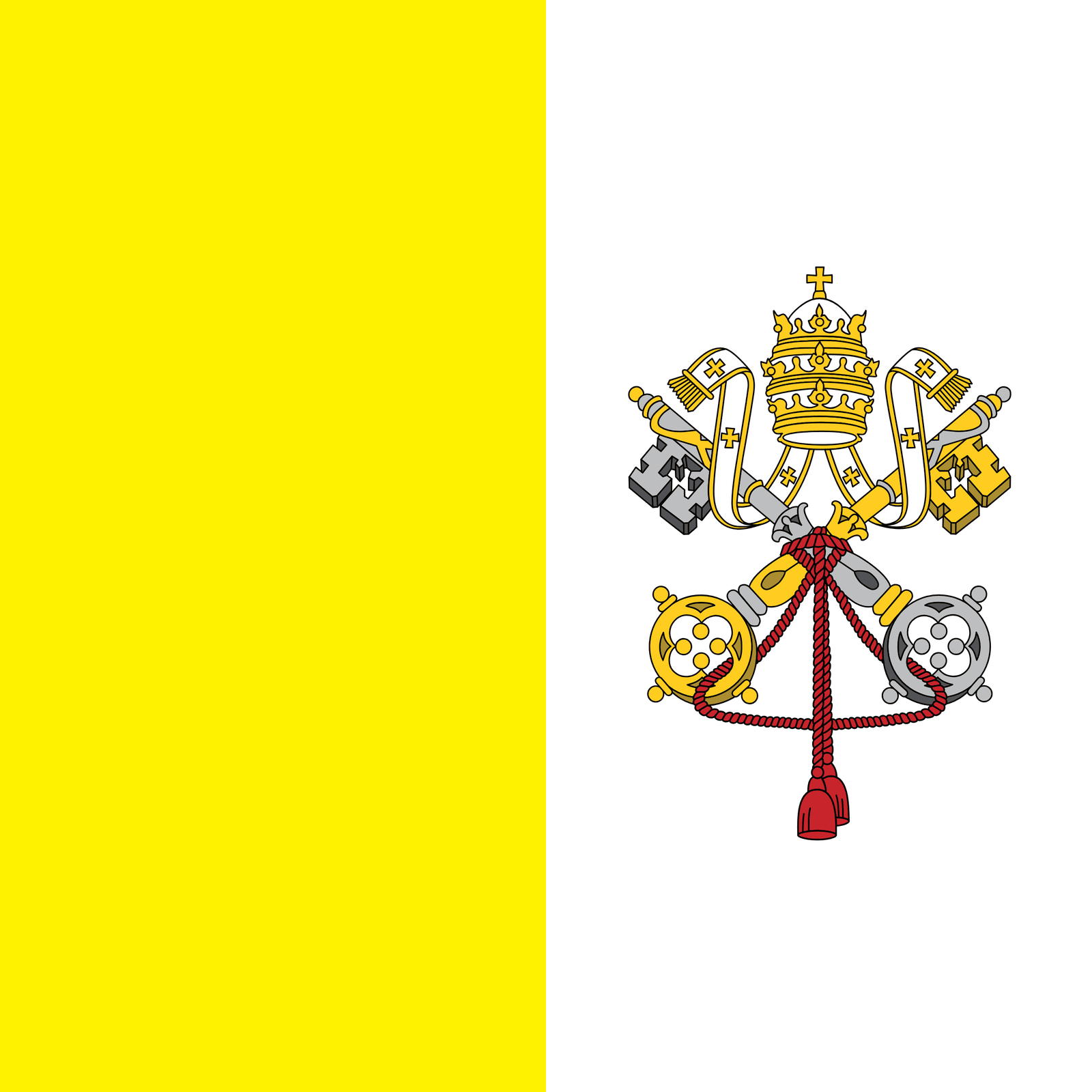
The flag of Vatican City is a vertical bicolor divided into two equal bands of yellow and white. Centered on the white band is the coat of arms of the Holy See, consisting of two crossed keys—one gold and one silver—bound by a red cord beneath the Papal tiara.
Adopted in its current form in 1929 following the establishment of Vatican City State, the flag reflects papal sovereignty. The gold and silver keys symbolize spiritual and temporal authority, while the tiara represents the Pope’s role as supreme pastor of the Catholic Church.
The flag is flown on official buildings and during religious and state ceremonies. Its use follows strict protocols reflecting the dignity and religious significance of the state.
Related Flags

Flag flying days
| Date | Flag Position | Occasion or Reason |
|---|
| 11 February | Full-mast | Anniversary of the Lateran Treaties |
| Variable | Full-mast | Papal elections, major liturgical celebrations |
| As decreed | Half-mast | Periods of mourning, including the death of a Pope |