
Flag of Brunei
| Legal Name | Nation of Brunei, the Abode of Peace |
|---|---|
| Flag |
|
| Capital City |
Bandar Seri Begawan |
| Total Area | 5,765 km² |
| Land Area | 5,765 km² |
| Water Area | 0 km² |
| Population | ~470,000 |
| Major Cities | Bandar Seri Begawan (~100,000), Kuala Belait (~36,000), Seria (~28,000) |
| Currency | Brunei Dollar (BND) |
| GDP | ~US$15 billion |
| GDP Per Capita | ~US$32,000 |
About of Brunei
Brunei Darussalam is a small, wealthy nation located on the northern coast of the island of Borneo in Southeast Asia. It is entirely surrounded by Malaysia’s state of Sarawak and has a coastline along the South China Sea. Despite its small size, Brunei plays a significant role in regional economic and energy markets due to its oil and natural gas reserves.
The capital and largest city, Bandar Seri Begawan, serves as the administrative, economic, and cultural center. Other important urban centers include Kuala Belait and Seria, where the country’s petroleum industry is concentrated.
With a population of just under half a million, Brunei is sparsely populated but highly urbanized. It enjoys a high standard of living, comprehensive social welfare programs, and political stability under an absolute monarchy. Brunei is internationally recognized for its wealth, strict governance, and role in ASEAN, maintaining strong diplomatic and economic ties in the Asia-Pacific region.
3. Etymology
The name “Brunei” is believed to derive from the Sanskrit word “Varun”, a reference to the Hindu god of water, reflecting early maritime influences. Other theories suggest a derivation from “Barunai”, meaning “blessed by God” or “a land that flows with abundance.” Over centuries, “Brunei” evolved as the standardized name of the sultanate, symbolizing both the country’s natural wealth and spiritual heritage.
4. History
Human settlement in Brunei dates back thousands of years, with early communities involved in trade with China, India, and the Malay Archipelago. By the 7th century, Brunei was a small Hindu-Buddhist kingdom, later converting to Islam by the 14th century, establishing the Bruneian Sultanate.
During its 15th–17th century peak, Brunei controlled much of Borneo and parts of the Philippines, flourishing through trade in spices, gold, and forest products. The arrival of European powers, particularly the British, led to treaties in the 19th century that established Brunei as a British protectorate in 1888.
Brunei retained its sultanate while navigating colonial pressures until full independence on 1 January 1984, maintaining close ties with Britain. Since independence, Brunei has been governed as an absolute monarchy under the Sultan, focusing on wealth management from petroleum and natural gas, social development, and regional diplomacy.
5. Government and Politics
Brunei is an absolute monarchy, ruled by the Sultan of Brunei, who serves as head of state, head of government, prime minister, defense minister, and finance minister.
Constitution: The 1959 Constitution establishes the framework for governance, balancing traditional monarchy with limited administrative councils.
Legislative branch: The Legislative Council, appointed by the Sultan, advises on laws and policies.
Judiciary: A dual legal system combines civil courts and Sharia law for certain criminal and family matters.
Administratively, Brunei is divided into four districts: Brunei-Muara, Belait, Tutong, and Temburong. The country maintains active diplomatic and trade relations through ASEAN, the Commonwealth, and bilateral ties with major economies. Its military is small but professional, focused on territorial defense and internal security.
6. Economy
Brunei is classified as a high-income, resource-based economy. Its wealth is primarily derived from petroleum and natural gas, which account for the majority of GDP and export revenue.
Other economic sectors include banking, finance, construction, and services, while agriculture and manufacturing are relatively minor. Brunei has a high per capita income, universal healthcare, and extensive social welfare programs.
Key trade partners include Japan, Singapore, Malaysia, China, and the United States. Economic challenges include diversifying the economy beyond hydrocarbons and preparing for long-term sustainability amid global energy transitions.
7. Demographics
Brunei’s population is ethnically diverse, with Malay, Chinese, and indigenous groups. The official language is Malay, and English is widely used in business and education.
Islam is the official religion, practiced by the majority, with small Christian, Buddhist, and indigenous faith communities. Approximately 80% of the population lives in urban areas, mainly in the Brunei-Muara district. Population growth is moderate, supported by government incentives and a high standard of living.
8. Culture and Society
Brunei’s culture blends Malay traditions, Islamic principles, and indigenous practices. National identity is closely tied to Islamic values, monarchy, and social harmony.
Arts and literature emphasize Islamic calligraphy, traditional Malay dances, music, and handicrafts. Cuisine features rice, seafood, and tropical fruits, with regional specialties reflecting Malay heritage.
Social norms emphasize modesty, family cohesion, and respect for the monarchy. Major festivals include Hari Raya Aidilfitri, National Day, and the Sultan’s birthday, with sports like football and water-based activities popular for recreation.
9. Education and Healthcare
Brunei offers free public education, including primary, secondary, and tertiary levels. The country emphasizes Islamic studies alongside general education, with universities such as Universiti Brunei Darussalam providing higher education. Literacy rates exceed 95%.
Healthcare is provided through a comprehensive national system, offering free or subsidized services to citizens. Public health challenges are limited, with achievements in maternal and child health, infectious disease control, and life expectancy.
10. Geography and Climate
Brunei is mostly low-lying coastal plains with hilly interior terrain. Key rivers include the Brunei River, supporting urban and economic development.
The country has a tropical rainforest climate, with high humidity, abundant rainfall, and consistently warm temperatures year-round. Natural hazards are limited, though occasional flooding and landslides occur. Environmental concerns focus on deforestation, biodiversity conservation, and coastal management.
11. Flora and Fauna
Brunei hosts rich biodiversity, with tropical rainforests, mangroves, and wetlands supporting diverse ecosystems.
Flora: Dipterocarp trees, rattan, orchids, and medicinal plants.
Fauna: Bornean pygmy elephants, clouded leopards, proboscis monkeys, hornbills, and various amphibians and reptiles.
Conservation efforts include Ulu Temburong National Park, protecting pristine rainforest and endemic species.
Map of Brunei
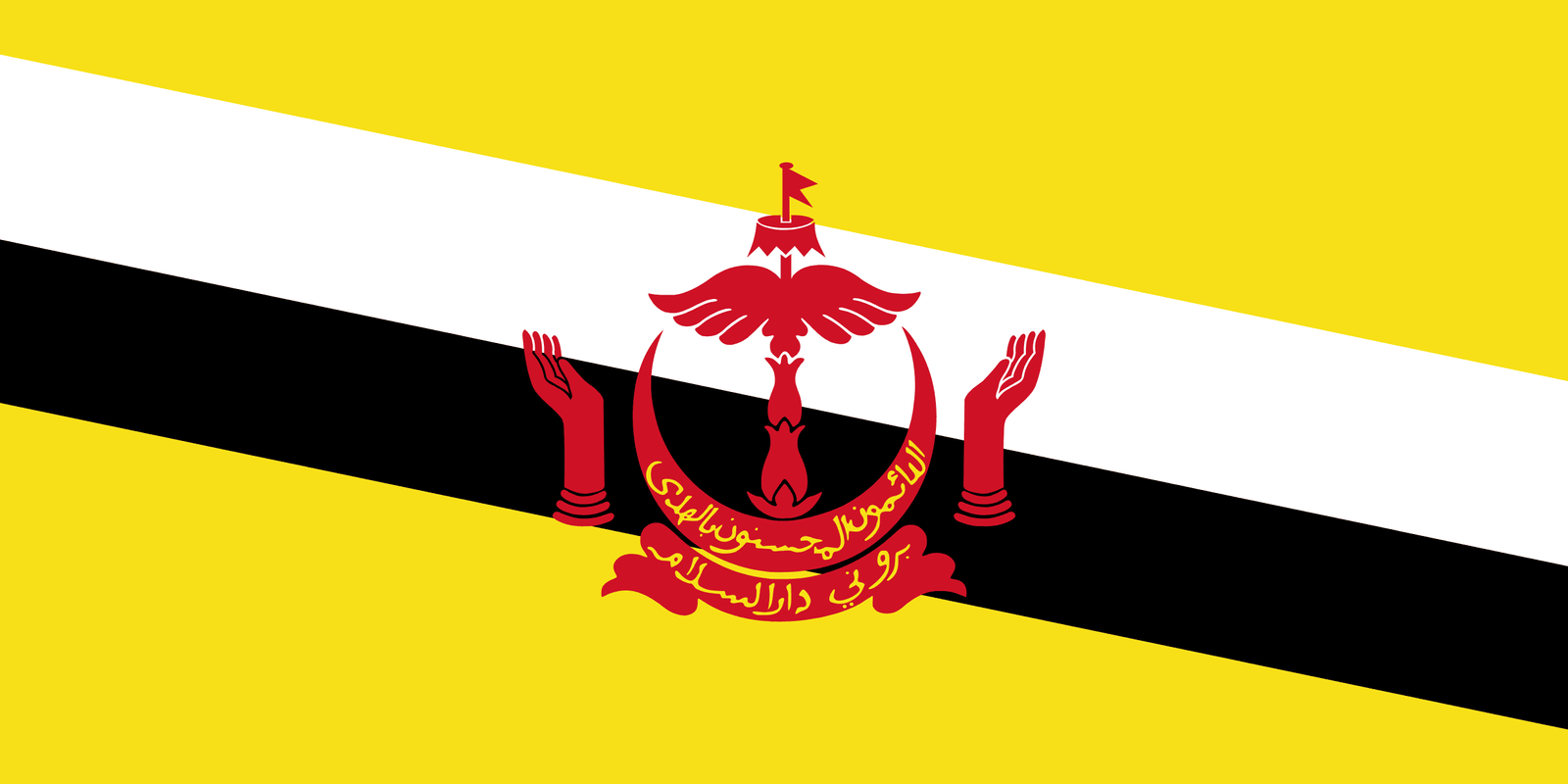
National Flag: Yellow field with white and black diagonal stripes and red crest.
Coat of Arms: Red crest featuring a parasol, wings, hands, crescent, and banner with national motto.
National Anthem: “Allah Peliharakan Sultan.”
National Animal: White-bellied sea eagle.
National Plant: Simpur flower.
National Monument: Sultan Omar Ali Saifuddin Mosque.
National Flag (Detailed Section)
The flag of Brunei, adopted in 1959, symbolizes monarchy and Islam:
Yellow field: Represents the Sultan.
Diagonal white and black stripes: Represent the chief ministers’ roles.
Red crest: Includes a parasol (Sultan’s protection), wings (justice and prosperity), hands (benevolence), and crescent (Islam).
Flag protocol requires respectful display at government buildings, mosques, and during national celebrations.
Realted Flags

Flag flying days
| Date | Flag Position | Occasion |
|---|---|---|
| 23 February | Full-mast | Brunei National Day |
| 1 January | Full-mast | New Year |
| Sultan’s Birthday | Full-mast | Celebrates the Sultan’s birth |
| State mourning | Half-mast | Death of a Sultan or national tragedy |