Flag of United Arab Emirates
| Legal Name | United Arab Emirates |
|---|---|
| Flag |
|
| Capital City |
Abu Dhabi |
| Total Area | ~83,600 km² |
| Land Area | ~83,600 km² |
| Water Area | Negligible (primarily coastal and territorial waters) |
| Population | ~9.5–10 million |
| Major Cities | Dubai (~3.6M), Abu Dhabi (~1.6M), Sharjah (~1.4M), Al Ain (~0.8M), Ajman (~0.5M) |
| Currency | United Arab Emirates dirham (AED) |
| GDP | ~USD 500–510 billion |
| GDP Per Capita | ~USD 50,000 (nominal) |
About of United Arab Emirates
The United Arab Emirates is a federation of seven emirates located in the southeastern corner of the Arabian Peninsula in Western Asia. It lies along the southern coast of the Persian Gulf and the northwestern coast of the Gulf of Oman, placing it at the crossroads of major maritime trade routes between Asia, Africa, and Europe.
The UAE shares land borders with Saudi Arabia to the south and west and Oman to the east and northeast. Its maritime borders extend across the Persian Gulf toward Iran and Qatar. The capital city, Abu Dhabi, is the political and administrative center of the federation, while Dubai is the largest city and a global hub for commerce, tourism, and transportation.
The country has a highly urbanized population, with the vast majority of residents living in metropolitan areas along the coast. A distinctive demographic feature is the predominance of expatriates, who constitute a large majority of the population and come from South Asia, the Middle East, Africa, Europe, and East Asia.
Internationally, the UAE is recognized as a sovereign state and an influential regional actor. It plays a significant strategic role due to its energy resources, advanced infrastructure, stable governance, and active participation in global trade, diplomacy, and security initiatives.
Etymology
The name “United Arab Emirates” reflects both the political structure and cultural identity of the country. “United” signifies the federation formed by formerly independent emirates, while “Arab” denotes the shared linguistic and cultural heritage of the Arab people. “Emirates” derives from the Arabic word imārah, meaning a territory ruled by an emir.
Historically, the region consisted of autonomous sheikhdoms along the Trucial Coast. The modern name emerged in 1971 to describe the newly unified state, emphasizing collective governance while preserving the authority and traditions of each emirate.
History
Archaeological evidence indicates human settlement in the region as early as the Bronze Age, with notable ancient sites such as Umm Al Nar and Mleiha demonstrating trade links with Mesopotamia and the Indus Valley. In antiquity, the area was influenced by Persian, Hellenistic, and later Islamic civilizations.
With the spread of Islam in the 7th century, the region became part of the wider Islamic world and participated in Indian Ocean trade networks. From the 16th century onward, European powers, particularly the Portuguese and later the British, sought control of strategic maritime routes.
In the 19th century, Britain established a series of treaties with local rulers, leading to the designation of the area as the Trucial States under British protection. This arrangement lasted until the late 20th century.
Following the British decision to withdraw from the region, six emirates formed the United Arab Emirates on 2 December 1971; Ras Al Khaimah joined in 1972. Under the leadership of Sheikh Zayed bin Sultan Al Nahyan, the UAE embarked on rapid state-building, fueled by oil revenues.
In the decades since independence, the country has diversified its economy, developed world-class infrastructure, and expanded its international role. Recent years have seen increased emphasis on innovation, sustainability, and global diplomacy.
Government and Politics
The UAE is a federal elective monarchy composed of seven emirates: Abu Dhabi, Dubai, Sharjah, Ajman, Umm Al Quwain, Fujairah, and Ras Al Khaimah. Each emirate is ruled by a hereditary emir, and together they form the Federal Supreme Council, the highest constitutional authority.
The constitution establishes the division of powers between the federal government and the individual emirates. The President and Vice President are elected by the Federal Supreme Council, with the presidency traditionally held by the ruler of Abu Dhabi and the premiership by the ruler of Dubai.
Executive authority is exercised by the Council of Ministers (Cabinet). The Federal National Council serves as a consultative legislative body, with members partly elected and partly appointed. The judiciary operates at both federal and local levels, applying a legal system influenced by civil law and Islamic jurisprudence.
Administratively, each emirate retains significant autonomy. The UAE maintains active foreign relations and is a member of organizations such as the United Nations, Gulf Cooperation Council, Arab League, and Organization of Islamic Cooperation. Its armed forces are well-equipped and focus on territorial defense, regional security, and international peacekeeping.
Economy
The United Arab Emirates is classified as a high-income, emerging-to-developed economy. While hydrocarbons historically formed the backbone of economic activity, the country has pursued extensive diversification.
Major sectors include energy, finance, trade, logistics, tourism, aviation, real estate, manufacturing, and increasingly, technology and renewable energy. Agriculture plays a limited role due to arid conditions, but modern methods support date farming and small-scale production.
The UAE possesses significant oil and natural gas reserves, primarily in Abu Dhabi. It is a major exporter of crude oil, refined petroleum products, aluminum, and petrochemicals. Key trading partners include China, India, Japan, the European Union, and the United States.
Economic challenges include reducing dependence on hydrocarbons, managing demographic imbalances, and adapting to global energy transitions. Long-term strategies emphasize knowledge-based industries, sustainability, and innovation.
Demographics
The population of the UAE is characterized by exceptional diversity. Emirati citizens form a minority, while expatriates constitute the majority of residents. Ethnic groups include Arabs, South Asians, Southeast Asians, Africans, and Western expatriates.
Arabic is the official language, though English is widely used in business and daily life. Other commonly spoken languages include Hindi, Urdu, Malayalam, and Tagalog. Islam is the official religion, with the majority of citizens being Sunni Muslims, alongside Christian, Hindu, Sikh, and other religious communities.
Urbanization exceeds 85 percent, and population growth has been driven primarily by immigration related to economic development.
Culture and Society
Emirati culture is rooted in Arab and Islamic traditions, shaped by Bedouin heritage and maritime history. Hospitality, family ties, and respect for elders are central social values.
The arts encompass traditional poetry, music, and dance, alongside contemporary visual arts and architecture. Emirati cuisine features rice, meat, seafood, and spices, with dishes such as machboos and harees.
Social norms emphasize modesty and respect for local customs. Major public holidays include Islamic festivals and National Day. Sports such as football, camel racing, and falconry are popular, alongside international sporting events.
Education and Healthcare
Education is compulsory for Emirati citizens at the primary level, with a system comprising public and private institutions. Literacy rates are high, and the country hosts several international universities and research centers.
Healthcare is modern and well-funded, offering advanced medical services through public and private providers. The UAE has achieved notable improvements in life expectancy and maternal and child health, while continuing to address lifestyle-related diseases.
Geography and Climate
The UAE’s geography is dominated by desert plains, sand dunes, and salt flats, with the Hajar Mountains rising in the east. It has no permanent rivers, relying instead on groundwater, desalination, and wadis.
The climate is arid, with extremely hot summers and mild winters. Coastal humidity is high, while inland areas experience more extreme temperature variations. Natural hazards include sandstorms and occasional flooding.
Environmental concerns focus on water scarcity, coastal preservation, and biodiversity protection.
Flora and Fauna
Despite harsh conditions, the UAE supports adapted plant species such as date palms, ghaf trees, and mangroves. Wildlife includes Arabian oryx, gazelles, desert foxes, and a wide variety of migratory birds.
Protected areas and national parks aim to conserve ecosystems and endangered species, reflecting growing environmental awareness.
Map of United Arab Emirates
The national flag symbolizes unity and Arab heritage. The coat of arms features a golden falcon with seven feathers representing the emirates. The national anthem, “Ishy Bilady,” expresses patriotism and loyalty. National symbols also include the Arabian oryx and the ghaf tree.
National Flag (Detailed Section)
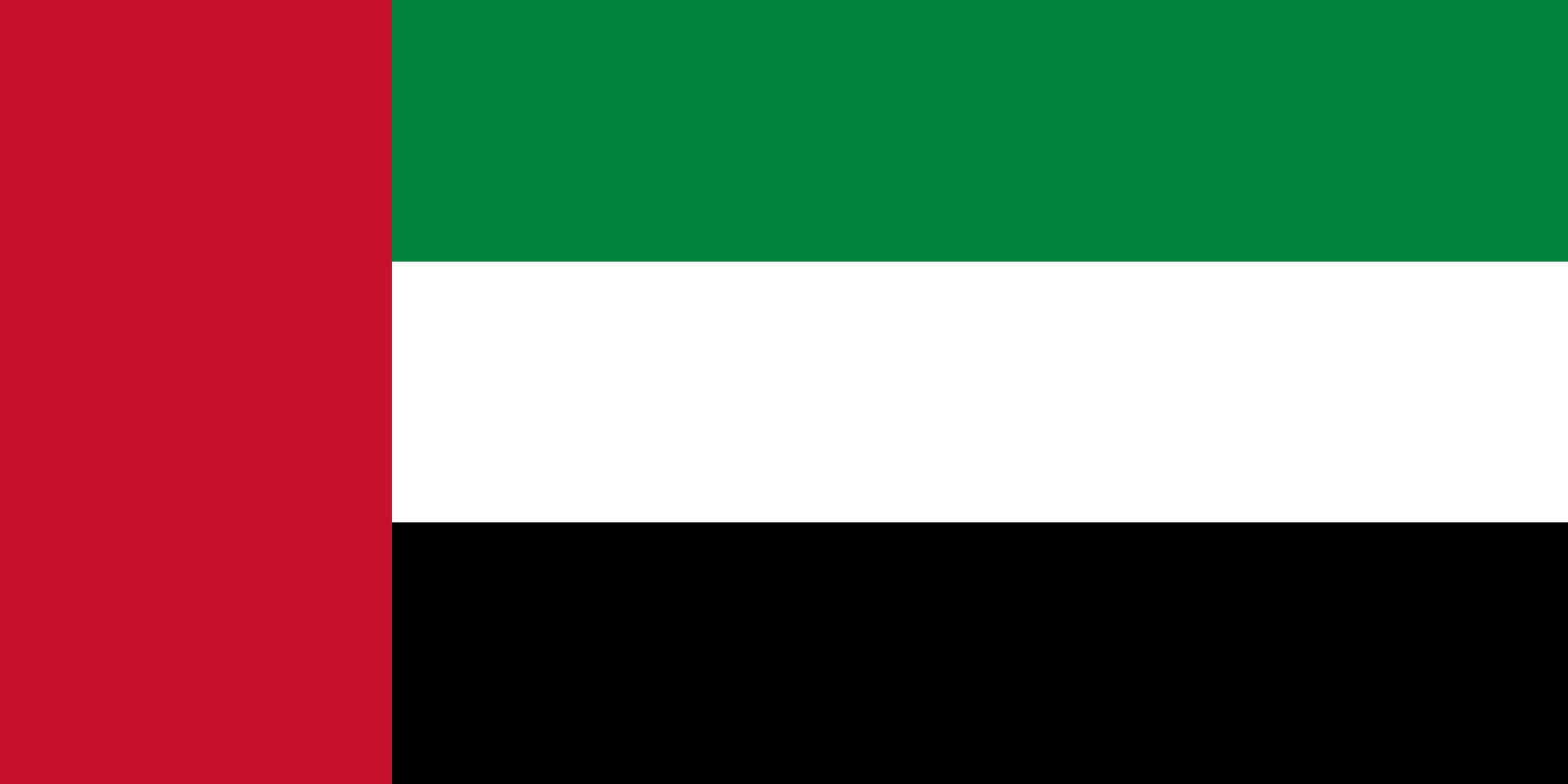
The UAE flag consists of a vertical red stripe at the hoist and three horizontal stripes of green, white, and black. It was designed in 1971 following a national competition.
The colors are Pan-Arab, historically associated with Arab unity and independence. Red represents strength and bravery, green symbolizes growth and prosperity, white stands for peace and honesty, and black reflects resilience and the defeat of adversaries.
The flag is flown on government buildings, schools, and public institutions, with protocols governing respectful display and usage
Realted Flags
Flag flying days
| Date | Flag Position | Occasion or Reason |
|---|
| 2 December | Full-mast | National Day |
| 30 November | Half-mast (morning), then Full-mast | Commemoration Day (Martyrs’ Day) |
| As decreed | Half-mast | Official periods of national mourning |