
Flag of Jordan
| Legal Name | Hashemite Kingdom of Jordan |
|---|---|
| Flag |
|
| Capital City |
Amman |
| Total Area | 89,342 km² |
| Land Area | Approximately 88,802 km² |
| Water Area | Approximately 540 km² |
| Population | ~11.3 million |
| Major Cities | Amman (~4.6m metro), Zarqa (~1.5m), Irbid (~1.1m), Russeifa (~500k), Aqaba (~200k) |
| Currency | Jordanian Dinar (JOD) |
| GDP | Approximately USD 50 billion |
| GDP Per Capita | Approximately USD 4,500 (nominal) / USD 11,500 (PPP) |
About of Jordan
Jordan is a Middle Eastern country located in Western Asia, at the crossroads of the Levant, the Arabian Peninsula, and Mesopotamia. Despite its relatively small size, Jordan occupies a region of immense historical, cultural, and geopolitical importance. The country’s landscape ranges from fertile highlands in the northwest to vast deserts in the east and south.
Jordan shares land borders with Saudi Arabia, Iraq, Syria, Israel, and the Palestinian territories, and has a short but strategically vital coastline along the Gulf of Aqaba, providing access to the Red Sea. The capital, Amman, is the political, economic, and cultural heart of the country and also its largest urban center.
The population is predominantly urban and youthful, shaped by natural growth and successive waves of refugees from regional conflicts. Jordan is widely recognized for its political stability in a turbulent region and maintains strong diplomatic relations with both regional and global powers.
Geopolitically, Jordan plays a critical role as a moderating and stabilizing force in the Middle East. Its location, peace agreements, and diplomatic engagement make it a key partner in regional security, humanitarian coordination, and international dialogue.
Etymology
The name Jordan is derived from the Jordan River, which forms part of the country’s western boundary. The river’s name originates from the Semitic root Y-R-D, meaning “to descend” or “to flow downward,” reflecting the river’s steep descent from the Galilee region to the Dead Sea.
Over time, the name came to designate the land east of the river, historically referred to as Transjordan. Following independence, the modern state adopted the name Jordan, later formalized as the Hashemite Kingdom of Jordan.
History
Human settlement in what is now Jordan dates back to prehistoric times, with some of the world’s earliest known agricultural communities discovered in the Jordan Valley. Ancient civilizations such as the Amorites, Edomites, and Moabites established early kingdoms in the region.
During classical antiquity, the area became part of the Nabataean Kingdom, whose capital at Petra emerged as a major trade and cultural center. The region later fell under Roman and Byzantine rule, leaving behind extensive archaeological remains, including cities of the Decapolis.
Following the rise of Islam in the 7th century, Jordan became part of successive Islamic caliphates. Control later passed to the Ayyubids, Mamluks, and eventually the Ottoman Empire, which ruled the area for several centuries.
After World War I, Jordan became a British-administered territory known as the Emirate of Transjordan. Full independence was achieved in 1946, and the Hashemite monarchy was established. Post-independence history includes regional conflicts, territorial changes, and major refugee influxes. In recent decades, Jordan has pursued political reform, economic modernization, and an active diplomatic role.
Government and Politics
Jordan is a constitutional monarchy led by the Hashemite royal family. The King serves as head of state and holds significant executive authority, while the government operates within a constitutional framework.
The political system includes an executive branch headed by the Prime Minister, a bicameral National Assembly consisting of the Senate and the House of Representatives, and an independent judiciary. The constitution guarantees civil rights while balancing royal authority and parliamentary governance.
Administratively, Jordan is divided into governorates, each overseen by appointed officials. Jordan maintains strong foreign relations and is an active member of international organizations, including the United Nations and the Arab League. Its armed forces focus on national defense, border security, and international peacekeeping missions.
Economy
Jordan is classified as a developing, upper-middle-income economy with limited natural resources. Economic activity is driven primarily by services, industry, and trade rather than resource extraction.
Key sectors include tourism, banking, information technology, pharmaceuticals, and manufacturing. Agriculture plays a smaller role but remains important for rural livelihoods. Jordan possesses modest natural resources, including phosphates and potash, which are significant export commodities.
Major trade partners include regional neighbors, the United States, and European markets. Economic challenges include water scarcity, energy dependence, unemployment, and public debt. Future prospects focus on renewable energy, digital transformation, logistics, and regional trade integration.
Demographics
Jordan’s population is predominantly Arab, with smaller communities of Circassians, Chechens, Armenians, and others. The country has absorbed large numbers of refugees, contributing to its demographic complexity.
Arabic is the official language, with English widely used in business and education. Islam is the dominant religion, primarily Sunni, with a recognized Christian minority.
Most Jordanians live in urban areas, particularly in the northwest. Population growth remains relatively high, driven by natural increase and migration.
Culture and Society
Jordanian culture reflects a blend of Bedouin traditions, Arab heritage, and modern influences. Hospitality, respect, and family cohesion are central social values.
The arts include traditional music, poetry, crafts, and contemporary literature. Jordanian cuisine emphasizes dishes such as mansaf, flatbreads, and regional stews. Social customs are shaped by Islamic and Arab norms, with strong emphasis on community and honor.
National celebrations include independence and royal occasions. Sports such as football, basketball, and martial arts are popular, alongside traditional activities.
Education and Healthcare
Jordan has a well-developed education system with compulsory basic education and a strong emphasis on literacy and higher learning. Universities and research institutions attract students from across the region.
Healthcare is regarded as one of the most advanced in the Middle East, combining public and private services. Achievements include improved life expectancy and medical tourism, though challenges remain in funding and access for vulnerable populations.
Geography and Climate
Jordan’s geography includes highlands, deserts, fertile valleys, and the Dead Sea, the lowest point on Earth’s surface. The eastern desert covers much of the country, while the Jordan Valley supports agriculture.
The climate ranges from Mediterranean in the northwest to arid desert in the east and south. Natural hazards include droughts, flash floods, and seismic activity. Environmental concerns focus on water scarcity, desertification, and ecosystem protection.
Flora and Fauna
Despite its arid environment, Jordan hosts diverse ecosystems. Native plants include desert shrubs, acacias, and medicinal herbs.
Wildlife includes gazelles, wolves, ibex, and migratory birds. Protected areas such as Dana Biosphere Reserve and Wadi Rum play a key role in conservation and sustainable tourism.
Map of Jordan
Jordan’s national symbols reflect Arab unity, Islamic heritage, and Hashemite legitimacy. These include the national flag, coat of arms, national anthem, and historic landmarks such as Petra and the Dead Sea.
National Flag (Detailed Section)
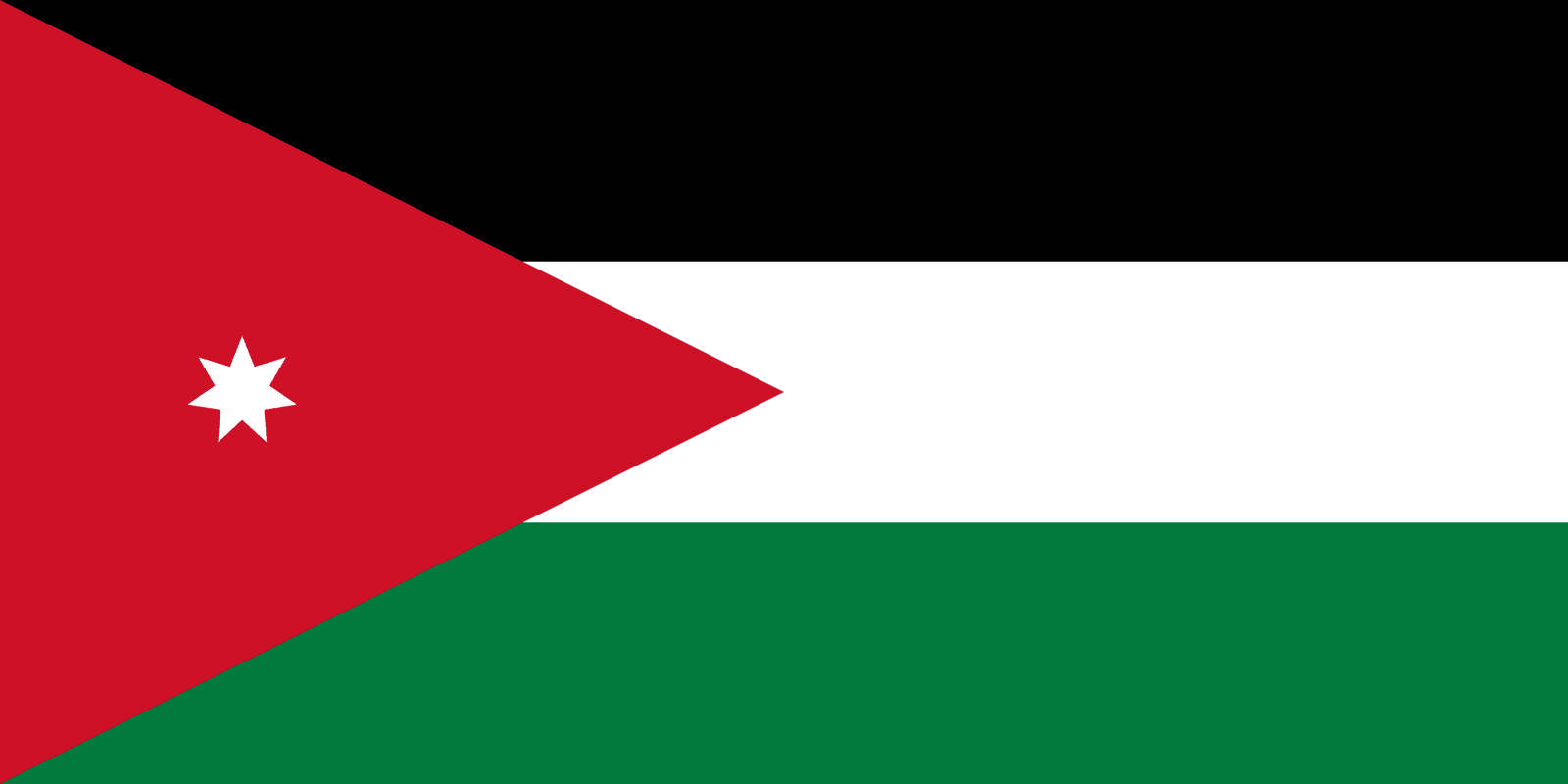
The flag of Jordan consists of three horizontal stripes—black, white, and green—representing historic Islamic caliphates. A red triangle at the hoist symbolizes the Hashemite dynasty and the Arab Revolt.
Within the triangle is a white seven-pointed star, representing unity, faith, and the seven verses of the opening chapter of the Quran. Adopted in its modern form in 1928, the flag is protected by law and displayed according to strict national protocol.

Flag flying days
| Date | Flag Position | Occasion or Reason |
|---|
| January 30 | Full-mast | King’s Birthday |
| May 25 | Full-mast | Independence Day |
| June 10 | Full-mast | Great Arab Revolt Day |
| Official Mourning Days | Half-mast | National or royal mourning |