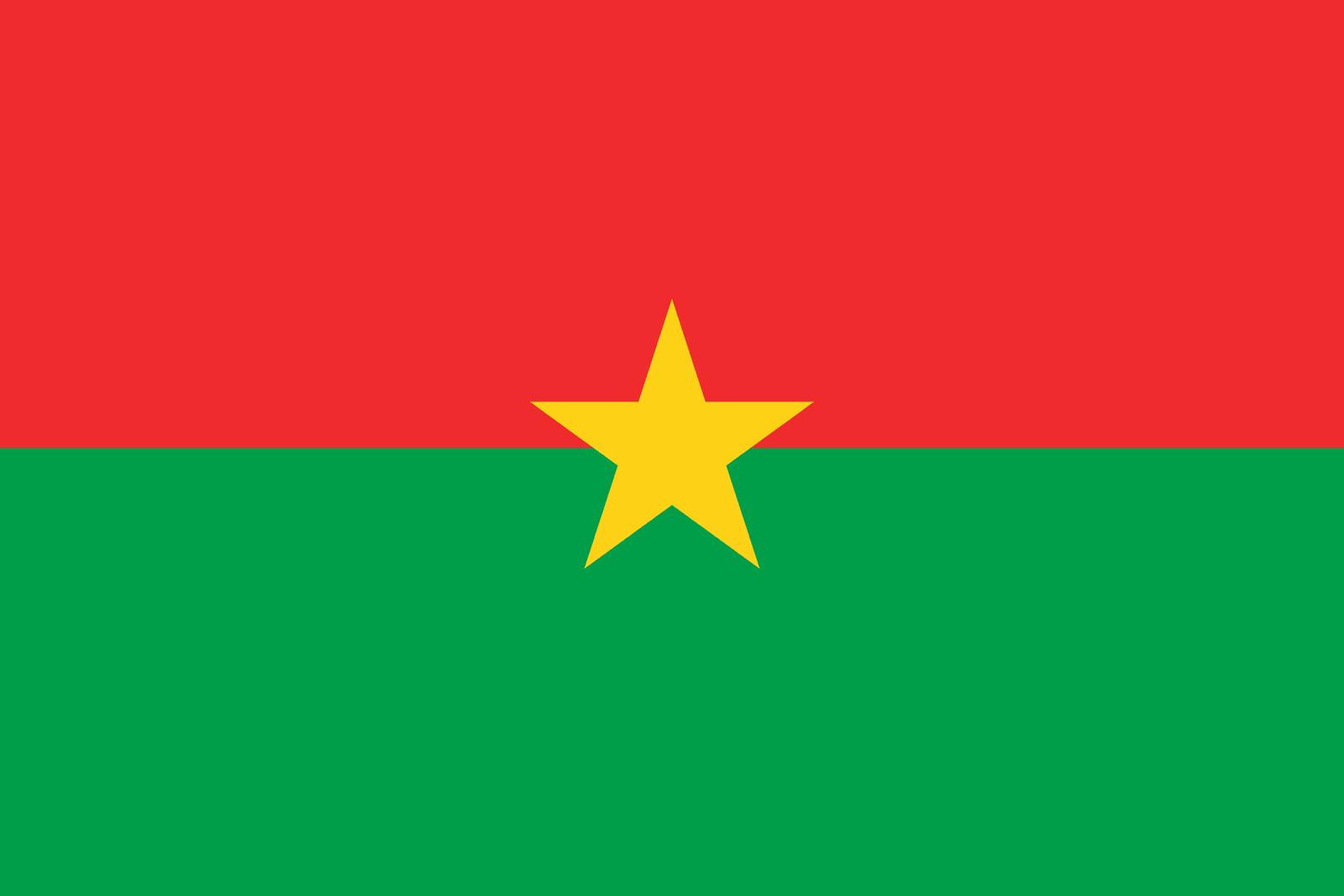
Flag of Burkina Faso
| Legal Name | Burkina Faso |
|---|---|
| Flag |
|
| Capital City |
Ouagadougou |
| Total Area | ~274,200 km² |
| Land Area | ~273,800 km² |
| Water Area | ~400 km² |
| Population | ~23 million |
| Major Cities | Ouagadougou (2.8M), Bobo-Dioulasso (900K), Koudougou (150K), Banfora (120K), Ouahigouya (110K) |
| Currency | West African CFA Franc (XOF) |
| GDP | ~US$20–22 billion |
| GDP Per Capita | ~US$900–1,000 |
About of Burkina Faso
Burkina Faso is a landlocked country located in West Africa, positioned within the Sahel region—a semi-arid transition zone between the Sahara Desert to the north and the savannas to the south. Its geographical placement gives it both cultural and ecological diversity, as it blends Saharan, Sahelian, and sub-Saharan influences. Despite lacking a coastline, the country plays a significant role in regional trade and migration routes across West Africa.
The nation shares land borders with Mali to the north and west, Niger to the east, Benin to the southeast, Togo and Ghana to the south, and Côte d’Ivoire to the southwest. Because it is entirely landlocked, all of its borders are terrestrial. Its central location in West Africa makes it an important transit point for goods and people traveling between coastal states and inland Sahel nations.
Ouagadougou, the capital and largest city, serves as the political, economic, and cultural heart of the country. Other key urban centers such as Bobo-Dioulasso and Koudougou contribute to trade, agriculture, and regional administration. The population is youthful, with a high percentage under the age of 25, reflecting broader demographic trends in sub-Saharan Africa.
Burkina Faso is internationally recognized as a sovereign state and is a member of major international and regional organizations including the United Nations, African Union, and Economic Community of West African States (ECOWAS). Strategically, it holds geopolitical importance due to its location in the Sahel, an area that has been central to regional security, migration dynamics, and counter-terrorism initiatives.
Etymology
The name “Burkina Faso” was adopted in 1984, replacing the former colonial name Upper Volta. The new name combines words from two major local languages: “Burkina” from the Mossi language meaning “upright” or “honest people,” and “Faso” from the Dioula language meaning “fatherland” or “homeland.” Together, the name translates roughly to “Land of Upright People.”
This change symbolized a move toward national identity, unity, and independence from colonial legacies. The earlier name “Upper Volta” referred to the upper basin of the Volta River system, a geographic rather than cultural designation.
History
Human settlement in the region dates back thousands of years, with archaeological evidence showing early agricultural communities and trade networks. Prehistoric societies cultivated millet and sorghum and engaged in ironworking, which became a defining technological advancement.
During the medieval period, the territory was home to powerful kingdoms, particularly the Mossi Kingdoms, which dominated central Burkina Faso for centuries. These states maintained complex political systems and resisted external invasions, including attempts by neighboring empires.
In the late 19th century, the region came under French colonial rule and became part of French West Africa under the name Upper Volta. Colonial administration introduced new economic structures, forced labor policies, and infrastructure projects that reshaped local societies.
Burkina Faso gained independence in 1960, but the decades that followed were marked by frequent coups and political instability. A significant turning point occurred in 1983–1987 under the leadership of Thomas Sankara, who introduced sweeping social and economic reforms emphasizing self-reliance and anti-corruption. After his assassination, political transitions continued with varying degrees of stability.
In the 21st century, Burkina Faso has experienced both democratic elections and periods of military intervention. Security challenges, especially in the northern and eastern regions, have influenced modern political developments and international relations.
Government and Politics
Burkina Faso is officially a republic, though its political landscape has undergone multiple transitions between civilian and military governance. The constitutional framework establishes separation of powers among executive, legislative, and judicial branches, although practical implementation has varied over time.
The executive branch is headed by a president and government ministers. The legislative branch traditionally consists of a national assembly responsible for lawmaking, while the judiciary operates through a system of courts designed to uphold constitutional and civil law.
Administratively, the country is divided into regions, provinces, and communes, enabling decentralized governance. Internationally, Burkina Faso participates in diplomatic and economic organizations such as the UN, AU, ECOWAS, and the West African Economic and Monetary Union (WAEMU).
Defense and security forces include the national army, gendarmerie, and police. In recent years, military affairs have played a significant role in national politics due to internal security concerns.
Economy
Burkina Faso is classified as a developing economy with strong reliance on agriculture and natural resources. Despite limited industrialization, the economy has shown periods of growth driven largely by mining and export sectors.
Agriculture employs a large share of the population, with major crops including cotton, sorghum, millet, maize, and livestock production. Gold mining is a primary economic driver, making Burkina Faso one of Africa’s significant gold producers. Other sectors include small-scale manufacturing, telecommunications, and services.
The country’s principal trade partners are regional West African nations, as well as European and Asian markets. Exports typically consist of gold and cotton, while imports include machinery, fuel, and consumer goods.
Economic challenges include vulnerability to climate change, limited infrastructure, security concerns, and dependence on commodity prices. Future outlooks often emphasize diversification, renewable energy, and regional trade integration.
Demographics
Burkina Faso has a young and rapidly growing population, with high fertility rates contributing to steady demographic expansion. The majority of residents live in rural areas, although urbanization is gradually increasing.
The population is ethnically diverse, with major groups including the Mossi, Fulani, Gourmantché, Bobo, and Lobi peoples. French is the official language, while numerous indigenous languages such as Mooré, Dioula, and Fulfulde are widely spoken.
Religiously, the population is predominantly Muslim, followed by Christian communities and practitioners of traditional African religions. Population growth trends remain upward, creating both economic opportunities and pressures on resources.
Culture and Society
Burkinabé culture reflects a blend of ethnic traditions, music, dance, and oral storytelling. Traditional festivals, masks, and crafts play an important role in social life and community identity. Music styles featuring drums and balafons are widely recognized.
Cuisine commonly includes dishes made from millet, sorghum, rice, and sauces with vegetables or meat. Social customs emphasize hospitality, respect for elders, and community cooperation.
Sports such as football (soccer) are highly popular, and the country has hosted major cultural events including international film festivals that highlight African cinema.
Education and Healthcare
The education system is structured into primary, secondary, and tertiary levels, with efforts ongoing to improve access and literacy rates. Universities and vocational institutions are concentrated in larger cities.
Healthcare services are a mix of public and private facilities, with improvements in vaccination programs and maternal health over recent decades. Challenges include rural healthcare access, funding limitations, and disease prevention.
Geography and Climate
Burkina Faso’s terrain consists largely of savannas, plateaus, and low hills, with several seasonal rivers such as the Black, White, and Red Volta. The northern regions are drier and closer to desert conditions, while the south receives more rainfall.
The climate is primarily tropical with distinct wet and dry seasons. Natural hazards include droughts and occasional floods. Environmental concerns involve desertification, deforestation, and soil degradation.
Flora and Fauna
The country supports savanna ecosystems with grasses, acacia trees, and baobabs. Wildlife includes elephants, antelopes, monkeys, and various bird species. Protected areas and national parks aim to conserve biodiversity and manage wildlife populations.
Map of Burkina Faso
National Symbols
Burkina Faso’s national symbols include its flag, coat of arms, and national anthem, all reflecting themes of unity and integrity. National emblems often incorporate agricultural tools and stars symbolizing hope and progress.
National Flag (Detailed Section)
The national flag consists of two horizontal bands—red on top and green below—with a yellow five-pointed star at the center. Adopted in 1984, it replaced the earlier Upper Volta tricolor. The red represents the revolution and struggle for independence, green symbolizes agricultural wealth and hope, and the yellow star signifies the guiding light of the nation’s future. The flag is used on government buildings, national celebrations, and international representations.
Realted Flags
Flag flying days
| Date | Flag Position | Occasion or Reason |
|---|---|---|
| 11 December | Full-mast | Independence Day |
| 4 August | Full-mast | National Revolution Day |
| 1 January | Full-mast | New Year’s Day |
| National Mourning Days | Half-mast | Periods of official remembrance or tragedy |