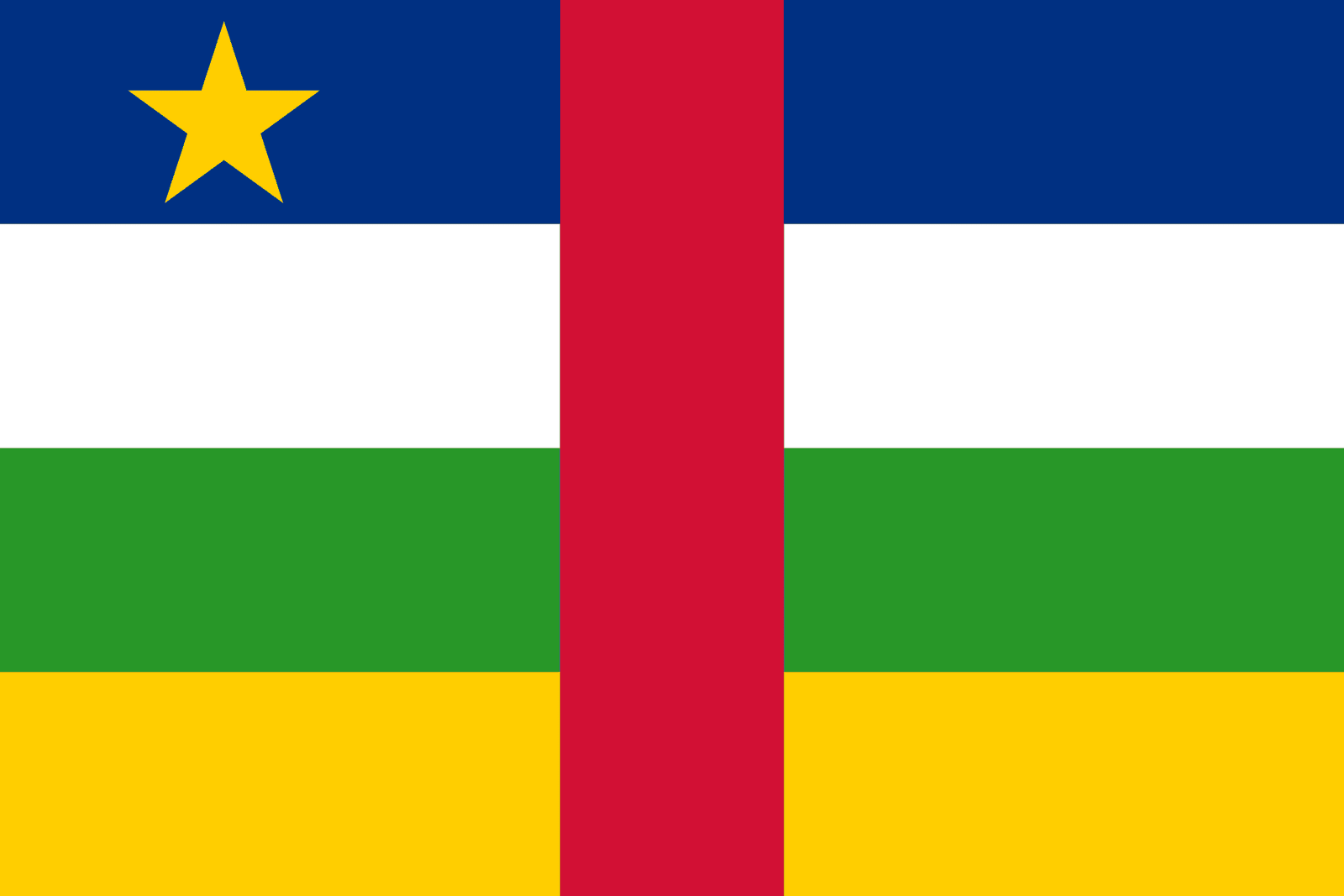
Flag of Central African Republic
| Legal Name | Central African Republic |
|---|---|
| Flag |
|
| Capital City |
Bangui |
| Total Area | ~622,984 km² |
| Land Area | ~622,436 km² |
| Water Area | ~548 km² |
| Population | ~5.7 million |
| Major Cities | Bangui (900K), Bimbo (300K), Berbérati (80K), Bambari (45K), Bouar (40K) |
| Currency | Central African CFA Franc (XAF) |
| GDP | ~US$2.5–3 billion |
| GDP Per Capita | ~US$500–550 |
About of Central African Republic
The Central African Republic (CAR) is a landlocked nation located in the heart of the African continent, positioned within Central Africa. Its central placement gives the country its name and reflects its geographic significance as a crossroads between West, East, and Southern Africa. CAR is characterized by vast plateaus, river systems, and extensive forested areas in the south, transitioning to savanna landscapes toward the north.
The country shares land borders with Chad to the north, Sudan to the northeast, South Sudan to the east, the Democratic Republic of the Congo and the Republic of the Congo to the south, and Cameroon to the west. Because it is fully landlocked, all international boundaries are terrestrial. Despite its inland position, major rivers such as the Ubangi and Sangha serve as vital transportation and trade routes.
Bangui, the capital and largest city, lies along the Ubangi River and functions as the political, administrative, and economic center of the nation. Other urban areas remain comparatively small, reflecting the country’s largely rural population distribution. The demographic structure is youthful, with a significant proportion of citizens under 25 years of age.
The Central African Republic is internationally recognized as a sovereign state and is a member of organizations such as the United Nations, African Union, Economic Community of Central African States (ECCAS), and the Organisation of Islamic Cooperation. Strategically, the country holds geopolitical importance due to its mineral resources, central geographic position, and role in regional peace and security initiatives.
Etymology
The name “Central African Republic” directly reflects the country’s geographic location at the center of the African continent. During the colonial period, the territory was known as Ubangi-Shari, named after its principal rivers. Upon gaining independence in 1960, the name was changed to emphasize sovereignty and geographic identity rather than colonial administrative designations.
Linguistically, the name is descriptive rather than derived from indigenous ethnic or linguistic roots, symbolizing neutrality and inclusivity among the country’s many ethnic groups.
History
Archaeological evidence indicates that the region has been inhabited for thousands of years by hunter-gatherer communities and early agricultural societies. These early populations engaged in ironworking and regional trade long before the arrival of external powers.
During the medieval era, the territory lay on the periphery of powerful regional empires such as Kanem-Bornu and various Sudanic states. While not fully integrated into large empires, local chieftaincies and kingdoms developed complex social and trade networks.
In the late 19th century, European colonial expansion brought the region under French control, forming part of French Equatorial Africa under the name Ubangi-Shari. Colonial rule introduced infrastructure projects but also exploitative labor systems and economic extraction.
The nation achieved independence in 1960. The decades that followed were marked by political instability, military coups, and authoritarian leadership. One of the most notable periods was the self-proclaimed empire under Jean-Bédel Bokassa in the 1970s, which ended with his removal from power.
Since the late 20th century and into the 21st century, the Central African Republic has experienced cycles of conflict, peace agreements, and transitional governments. Modern political developments have focused on constitutional reforms, reconciliation efforts, and stabilization initiatives supported by international peacekeeping missions.
Government and Politics
The Central African Republic is formally a republic with a semi-presidential political system, although governance structures have evolved in response to internal conflicts and constitutional reforms. The legal framework is based on civil law traditions influenced by French legal systems.
The executive branch is led by a president and a prime minister, while the legislative branch is typically composed of a national assembly responsible for lawmaking. The judiciary operates through constitutional and supreme courts designed to uphold the rule of law.
Administratively, the country is divided into prefectures and sub-prefectures, enabling regional governance. In foreign relations, CAR maintains diplomatic ties with neighboring states and participates in global organizations such as the UN, AU, ECCAS, and Francophonie.
The defense sector includes the national armed forces and security services, often supported by international peacekeeping missions due to ongoing security challenges in various regions.
Economy
The Central African Republic is classified as a low-income developing economy with significant reliance on natural resources and subsistence agriculture. Despite abundant mineral wealth, economic output remains limited by infrastructure constraints and political instability.
Agriculture forms the backbone of the economy, employing a majority of the population. Key crops include cassava, maize, millet, coffee, and cotton. The country is also rich in diamonds, gold, uranium, and timber, making mining and forestry important sectors.
Trade relationships are largely regional, with exports primarily consisting of diamonds, timber, and agricultural goods, while imports include machinery, fuel, and consumer products. Economic challenges include limited industrialization, transportation barriers, and vulnerability to commodity price fluctuations.
The long-term economic outlook often emphasizes diversification, improved governance, and infrastructure development as critical pathways toward sustainable growth.
Demographics
The population of the Central African Republic is ethnically diverse, consisting of numerous groups such as the Baya, Banda, Mandjia, Sara, and Mboum peoples. This diversity contributes to rich cultural traditions but also presents governance and social integration challenges.
The official languages are French and Sango, with Sango widely used as a lingua franca across ethnic lines. Religious composition includes Christianity, Islam, and traditional African belief systems.
A significant portion of the population lives in rural areas, with urbanization gradually increasing around Bangui and other towns. Population growth trends remain moderate but steady, influenced by high birth rates and varying life expectancy levels.
Culture and Society
Cultural life in CAR reflects deep traditions in music, dance, storytelling, and craftsmanship. Drumming and vocal music play central roles in ceremonies and communal gatherings. Handicrafts, wood carving, and textile production are important expressions of artistic identity.
Cuisine typically features staples such as cassava, plantains, rice, and stews prepared with vegetables or meat. Social norms emphasize extended family structures, respect for elders, and communal solidarity.
Sports, particularly football, are widely followed, while traditional games and dance festivals remain integral to community celebrations and national identity.
Education and Healthcare
The education system consists of primary, secondary, and tertiary levels, with ongoing efforts to improve literacy and school attendance. Universities and vocational institutions are primarily concentrated in urban centers, especially Bangui.
Healthcare services include public hospitals, clinics, and international aid-supported facilities. Public health challenges involve access to medical care in rural regions, infectious diseases, and funding limitations, while achievements include vaccination campaigns and community health initiatives.
Geography and Climate
The Central African Republic features plateaus, rolling savannas, tropical forests in the south, and river basins that feed into the Congo River system. Major rivers such as the Ubangi provide essential transportation and water resources.
The climate is generally tropical, with wet and dry seasons varying by region. The north experiences more arid conditions, while the south receives heavier rainfall. Natural hazards include floods and periodic droughts. Environmental concerns involve deforestation, wildlife poaching, and soil erosion.
Flora and Fauna
The nation hosts diverse ecosystems ranging from dense rainforests to savanna woodlands. Native plant life includes hardwood trees, grasses, and medicinal plants. Wildlife features elephants, gorillas, antelopes, buffalo, and numerous bird species.
National parks and reserves aim to protect biodiversity, although conservation efforts face challenges related to funding and enforcement.
Map of Central African Republic
National symbols of the Central African Republic include its flag, coat of arms, and national anthem, which represent unity, independence, and cultural diversity. Emblems frequently incorporate stars, shields, and national mottos emphasizing dignity and progress.
National Flag (Detailed Section)
The national flag consists of four horizontal stripes—blue, white, green, and yellow—with a vertical red stripe intersecting them at the center and a yellow five-pointed star in the upper hoist corner. Adopted in 1958, the design was created to symbolize both French colonial heritage and African unity.
Blue and white represent peace and the sky, green symbolizes hope and the country’s forests, yellow stands for tolerance and savannas, while the red vertical stripe signifies unity and the shared blood of the nation. The yellow star represents independence and a guiding light toward national progress. The flag is displayed on public buildings, official ceremonies, and international events.
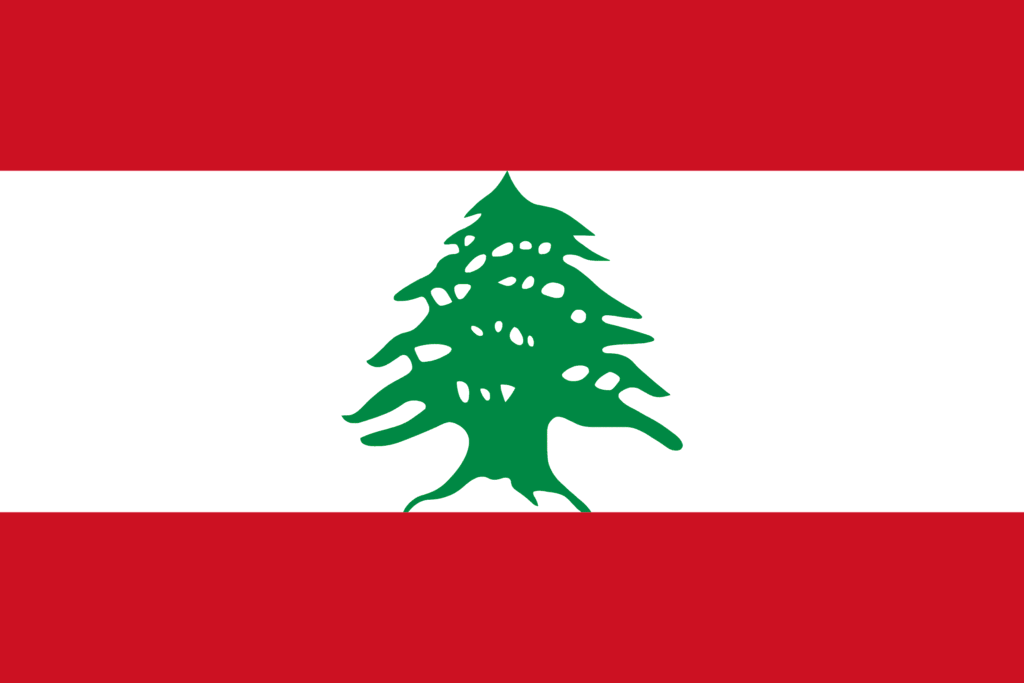
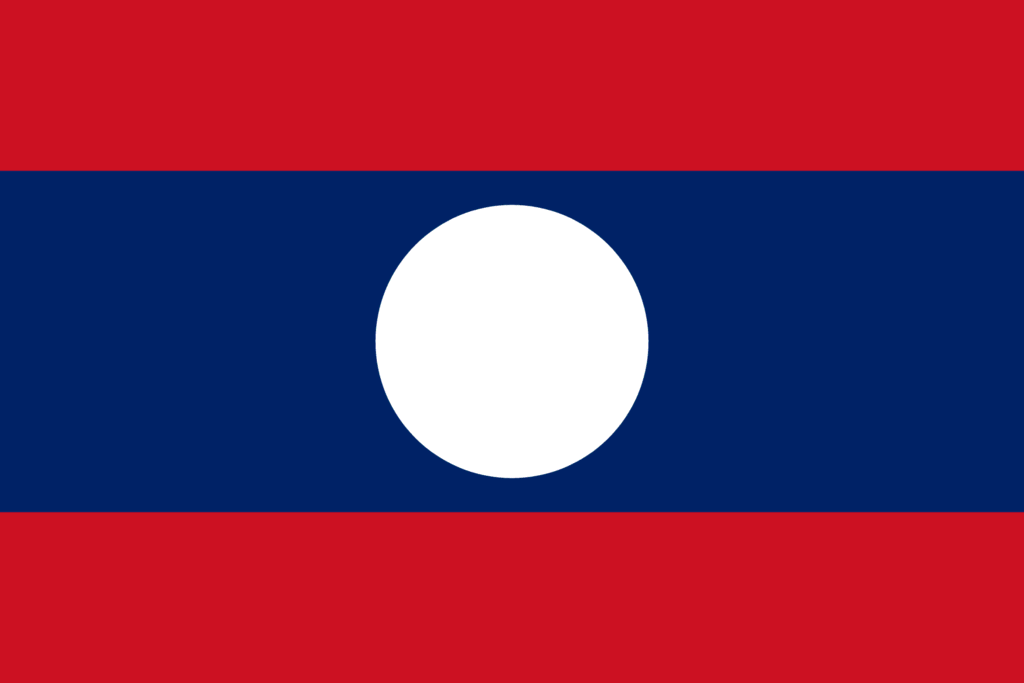
Realted Flags
Flag flying days
| Date | Flag Position | Occasion or Reason |
|---|
| 1 December | Full-mast | National Day / Proclamation of the Republic |
| 13 August | Full-mast | Independence Day |
| 1 January | Full-mast | New Year’s Day |
| Official Mourning Days | Half-mast | National remembrance or tragedy |