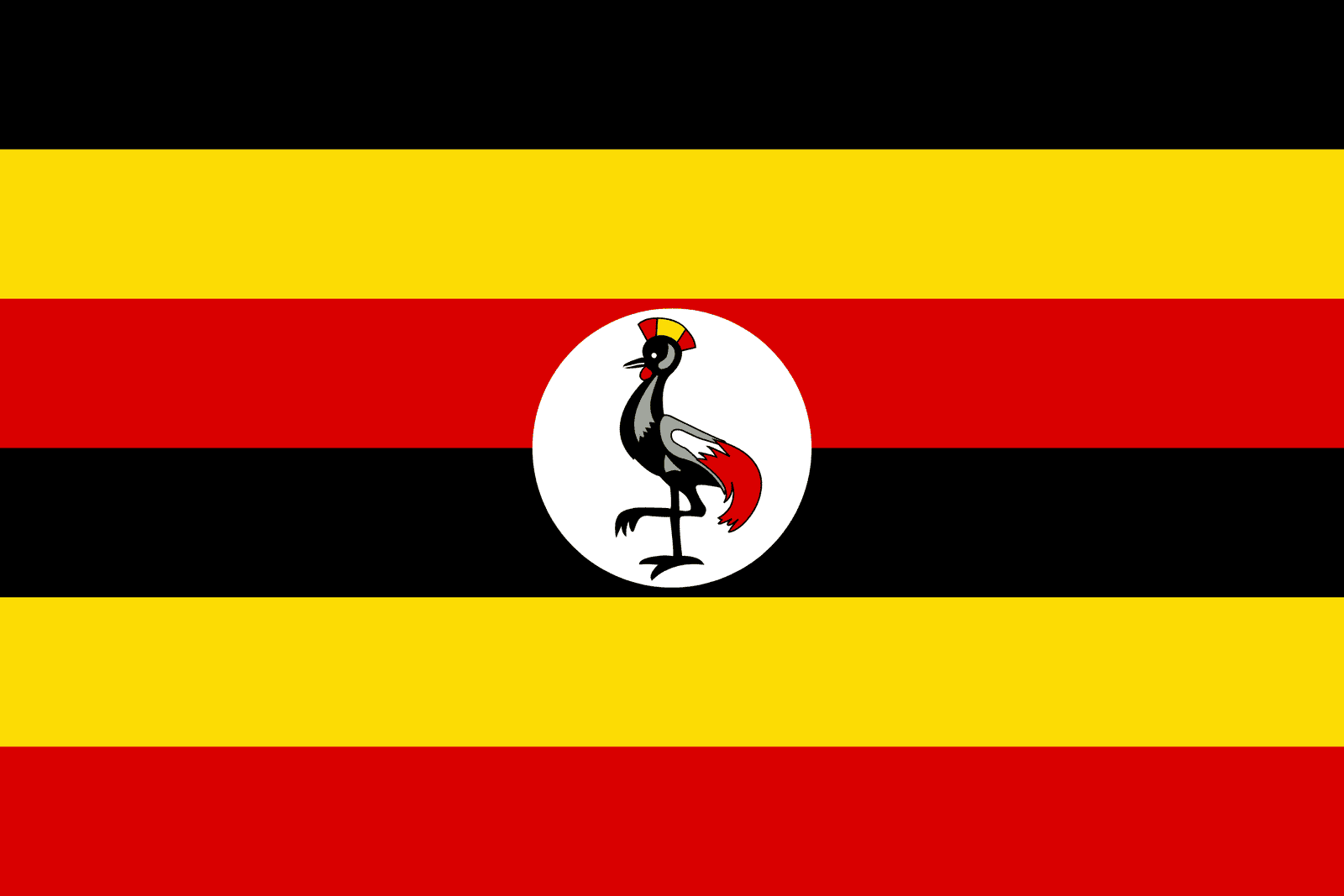
Flag of Uganda
| Legal Name | Republic of Uganda |
|---|---|
| Flag |
|
| Capital City |
Kampala |
| Total Area | 241,550 km² |
| Land Area | Approximately 41,750 km² |
| Water Area | Approximately 41,750 km² |
| Population | Approximately 49–50 million |
| Major Cities | Kampala (1.7 million city; 4+ million metro), Gulu (160,000), Lira (120,000), Mbarara (110,000), Jinja (100,000) |
| Currency | Ugandan Shilling (UGX) |
| GDP | Approximately USD 50–55 billion |
| GDP Per Capita | Approximately USD 1,100 (nominal) |
About of Uganda
Uganda is a landlocked country located in East-Central Africa, straddling the equator and forming part of the African Great Lakes region. It is known for its diverse landscapes, which include fertile plateaus, rolling hills, wetlands, and large freshwater lakes. Uganda’s natural endowments and climate have historically supported agriculture and dense human settlement.
The country shares land borders with Kenya to the east, South Sudan to the north, the Democratic Republic of the Congo to the west, Rwanda to the southwest, and Tanzania to the south. Although landlocked, Uganda has significant access to freshwater resources, including Lake Victoria, Africa’s largest lake by surface area, which it shares with Kenya and Tanzania. Kampala, the capital and largest city, serves as the political, economic, and cultural center.
Uganda is internationally recognized as a sovereign state and is an active member of regional and global organizations. Its strategic importance lies in its central position in East Africa, its role in regional trade and security, and its participation in peacekeeping and diplomatic initiatives across the continent.
Etymology
The name “Uganda” is derived from the Kingdom of Buganda, one of the most influential pre-colonial states in the region. The term “Buganda” refers to the land of the Ganda people. During the colonial period, the British anglicized the name to “Uganda,” which was later adopted as the name of the independent state. Over time, the name came to represent a multi-ethnic nation rather than a single kingdom.
History
Prehistoric and Ancient Civilizations
Human presence in present-day Uganda dates back to prehistoric times, with archaeological evidence indicating early hunter-gatherer societies and later agricultural communities. The region’s fertile soils and reliable rainfall supported early settlement and population growth.
Classical and Medieval Periods
By the late first millennium, several organized societies and kingdoms had emerged. Notable among these were the Bunyoro-Kitara Empire and the Buganda, Busoga, and Ankole kingdoms. These states developed systems of governance, trade networks, and cultural traditions that continue to influence Ugandan society.
Colonial Rule
In the late 19th century, Uganda became a British protectorate. Colonial administration relied heavily on indirect rule through local kingdoms, particularly Buganda. While colonial rule introduced modern infrastructure and education, it also reshaped political boundaries and economic structures.
Independence Movement
Uganda gained independence from Britain on 9 October 1962. The early post-independence years were marked by political experimentation, including federal arrangements and power-sharing between traditional leaders and central authorities.
Post-Independence and Modern Developments
Following independence, Uganda experienced periods of political instability, military rule, and economic decline. Since the late 1980s, the country has pursued relative stability, reconstruction, and economic reform. Contemporary Uganda continues to navigate political reform, development challenges, and regional engagement.
Government and Politics
Uganda is a presidential republic with a centralized political system. The Constitution provides the legal framework for governance and establishes the separation of powers. The president serves as both head of state and government, supported by the cabinet.
Legislative authority is vested in a unicameral parliament. The judiciary operates independently and includes a hierarchy of courts up to the Supreme Court. Administratively, Uganda is divided into regions, districts, and local governments. In foreign relations, Uganda maintains active diplomatic ties and participates in regional and international organizations. The Uganda People’s Defence Forces are responsible for national defense and contribute to regional security efforts.
Economy
Uganda is classified as a developing economy with strong growth potential. Agriculture remains a cornerstone of the economy, employing a large portion of the population and contributing significantly to exports. Major agricultural products include coffee, tea, maize, bananas, and fish.
The industrial sector is expanding, particularly in agro-processing, construction materials, and light manufacturing. Services such as trade, transport, telecommunications, and financial services have grown rapidly in recent decades. Uganda is endowed with natural resources, including fertile land, freshwater, and emerging oil and gas reserves. Key trade partners include regional neighbors and global markets. Economic challenges include infrastructure gaps, population pressure, and external shocks, while future prospects depend on industrialization, energy development, and human capital investment.
Demographics
Uganda has one of the youngest and fastest-growing populations in the world. The population is ethnically diverse, comprising numerous groups such as the Baganda, Banyankole, Basoga, Bakiga, Acholi, and Langi. English and Swahili are official languages, while many indigenous languages are widely spoken.
Christianity is the dominant religion, alongside Islam and traditional beliefs. Uganda remains predominantly rural, though urbanization is accelerating, particularly around Kampala. Population growth trends reflect high fertility rates and improving life expectancy.
Culture and Society
Ugandan culture is shaped by its ethnic diversity and strong community traditions. Music, dance, and storytelling play central roles in cultural expression, with each region maintaining distinctive styles. National identity emphasizes unity within diversity and respect for cultural heritage.
Ugandan cuisine features staples such as matoke (cooked bananas), posho, millet, and groundnuts. Social customs value family ties, hospitality, and respect for elders. Public holidays commemorate independence, religious events, and national achievements. Sports, especially football and athletics, are widely followed and supported.
Education and Healthcare
Uganda’s education system includes primary, secondary, and tertiary levels, with efforts to expand access through universal education programs. Literacy rates have improved steadily, and universities in Kampala and other cities play a growing role in regional education.
Healthcare is provided through a mix of public and private facilities. Public health priorities include maternal and child health, infectious disease control, and strengthening primary healthcare services. Achievements include improved vaccination coverage and disease prevention, though challenges remain in funding and access.
Geography and Climate
Uganda’s physical geography is characterized by a central plateau surrounded by mountains and rift valleys. Notable features include the Rwenzori Mountains in the west, Lake Victoria in the south, and the Albertine Rift. Numerous rivers and wetlands support agriculture and biodiversity.
The climate is generally tropical, moderated by altitude. Rainfall is distributed throughout the year, with wetter and drier seasons rather than extreme temperature variation. Natural hazards include floods and occasional droughts. Environmental concerns focus on deforestation, wetland degradation, and land use pressure.
Flora and Fauna
Uganda is one of Africa’s most biodiverse countries, hosting a wide range of ecosystems from savannahs to tropical forests. Native plant species include hardwood forests and grasslands, while wildlife features elephants, lions, chimpanzees, and mountain gorillas.
The country maintains an extensive network of national parks and wildlife reserves, including Bwindi Impenetrable National Park and Queen Elizabeth National Park. Conservation efforts aim to balance ecological protection with community livelihoods and tourism development.
Map of Uganda
Uganda’s national symbols reflect its history, unity, and natural heritage. The flag, coat of arms, and anthem emphasize independence, cultural pride, and progress. The grey crowned crane, featured prominently in national symbolism, represents grace, prosperity, and respect for nature.
National Flag (Detailed Section)
The national flag of Uganda consists of six horizontal stripes of black, yellow, and red, repeated twice, with a white disc at the center bearing a grey crowned crane. Adopted at independence in 1962, the flag’s design symbolizes unity and progress. Black represents the African people, yellow the sunshine of Africa, and red the brotherhood of humanity. The crane, long associated with Uganda, signifies elegance, peace, and resilience. The flag is displayed on public buildings and during official events in accordance with national protocol.
Realted Flags
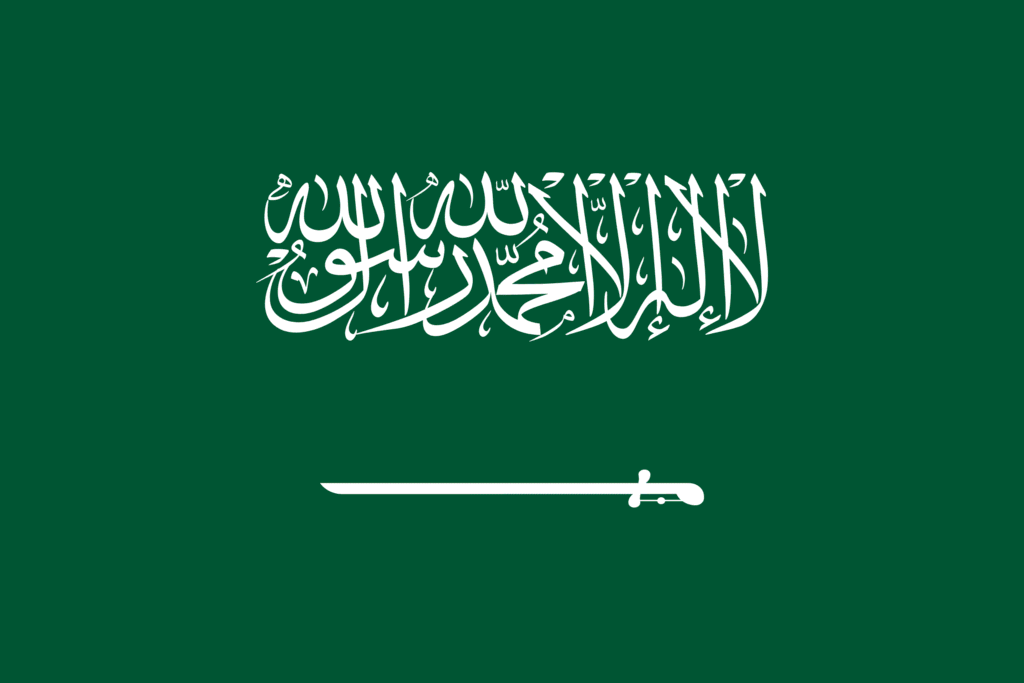
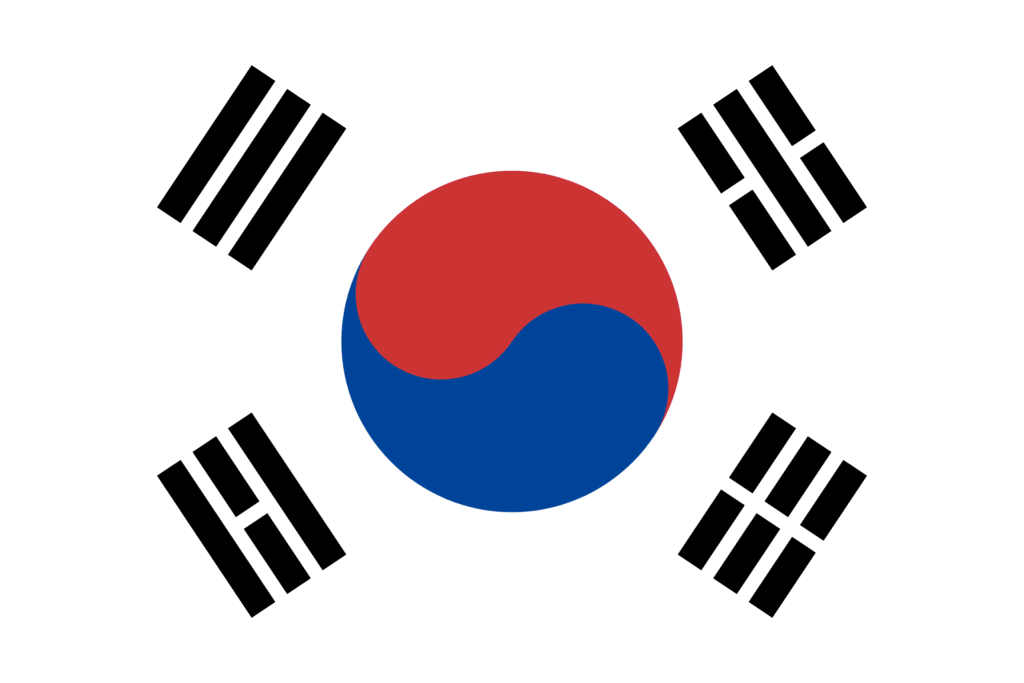
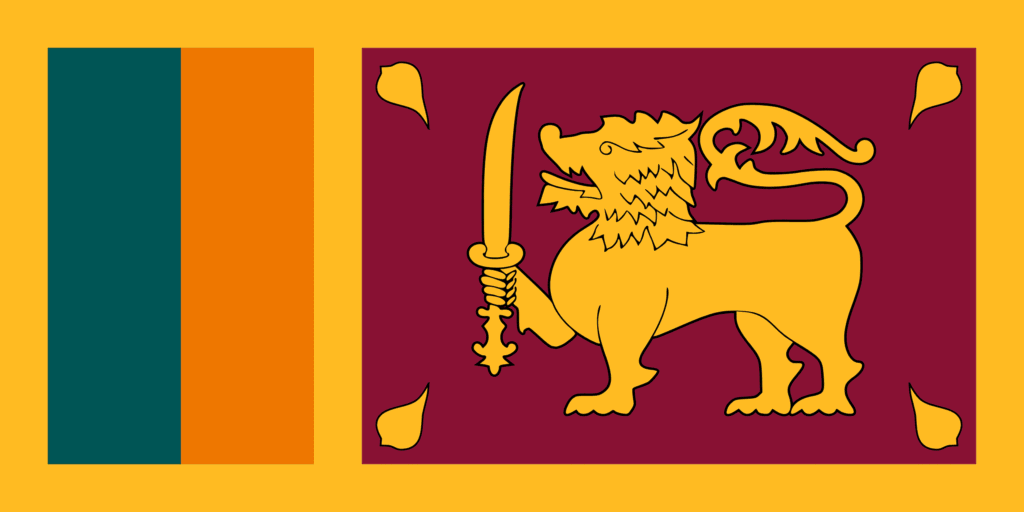
Flag flying days
| Date | Flag Position | Occasion or Reason |
|---|---|---|
| January 26 | Full-mast | Liberation Day |
| March 8 | Full-mast | International Women’s Day |
| May 1 | Full-mast | Labour Day |
| June 9 | Full-mast | National Heroes’ Day |
| October 9 | Full-mast | Independence Day |
| As Declared | Half-mast | National mourning or remembrance |