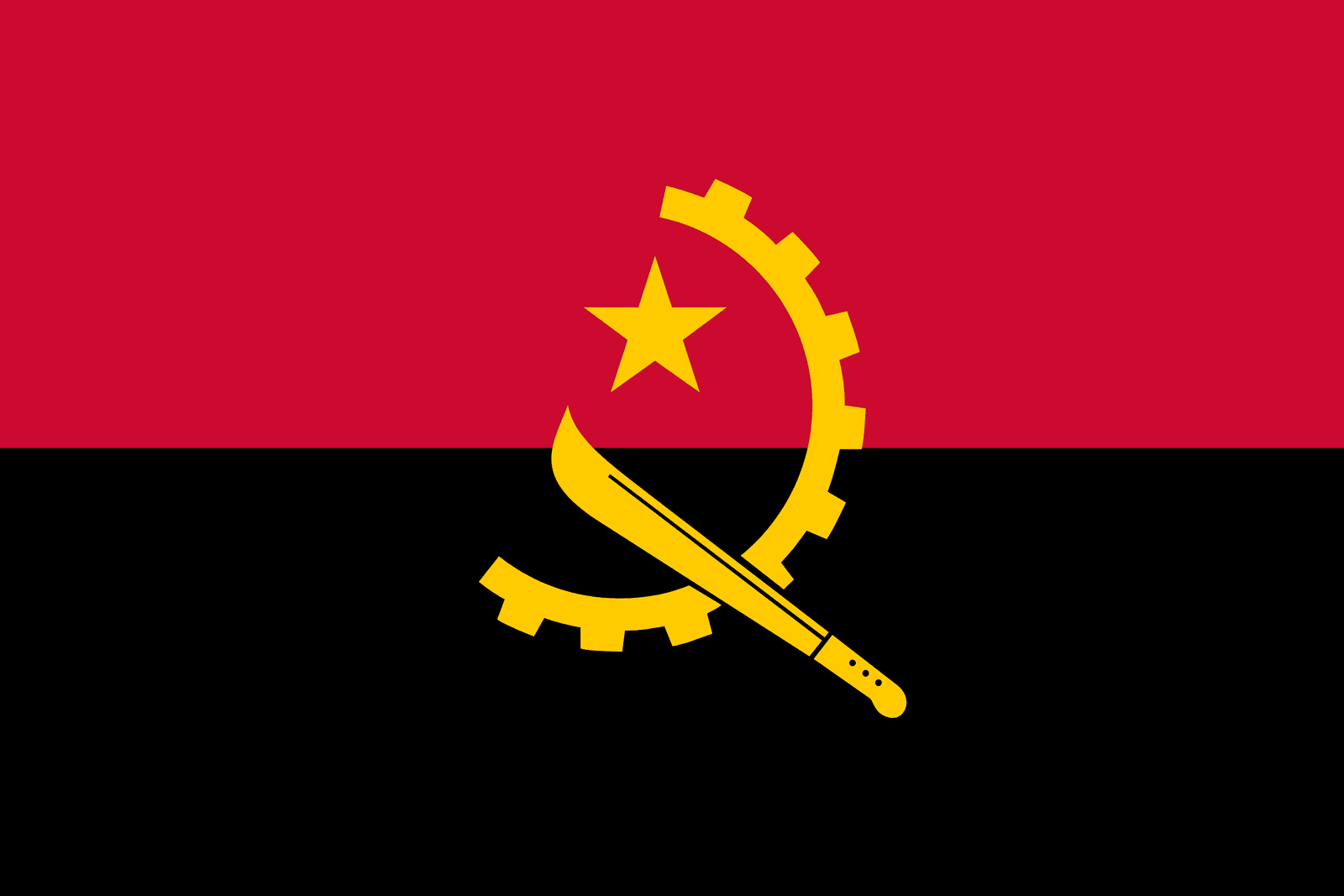
Flag of Angola
| Legal Name | Republic of Angola |
|---|---|
| Flag |
|
| Capital City | Luanda |
| Total Area | ~1,246,700 km² |
| Land Area | ~1,246,700 km² |
| Water Area | ~2,500 km² (approx.) |
| Population | ~36 million |
| Major Cities | Luanda (~3 million), N’dalatando (~500,000), Huambo (~600,000), Lobito (~400,000), Benguela (~400,000) |
| Currency | Kwanza (AOA) |
| GDP | ~US$100–110 billion |
| GDP Per Capita | ~US$2,800–3,000 (nominal est.) |
About of Angola
Angola is a Southwestern African nation located along the Atlantic coast, forming part of the Southern African region. It occupies a vast area of over 1.2 million square kilometers, making it the seventh-largest country in Africa. Its terrain varies from coastal plains to highlands, savannas, and the southern fringes of the Kalahari Desert, giving the country a rich geographic diversity.
Angola shares land borders with Namibia to the south, the Democratic Republic of the Congo to the north and northeast, and Zambia to the east. The country has a strategic coastline along the Atlantic Ocean, providing access to international maritime trade routes. Its capital, Luanda, is also the largest urban center, serving as the primary political, economic, and cultural hub. Other important cities include Huambo, Benguela, Lubango, and N’dalatando, which contribute to regional commerce and agriculture.
Angola is internationally recognized as a sovereign republic and is a member of the United Nations, African Union, Southern African Development Community (SADC), and the Community of Portuguese Language Countries (CPLP). Strategically, Angola is important for its natural resources, maritime access, and role in regional security and economic partnerships in Southern Africa.
2. Etymology
The name “Angola” derives from the title “Ngola,” historically used by the rulers of the Ndongo Kingdom, a pre-colonial African state in the region. Portuguese explorers adopted the term in the 16th century, which evolved into “Angola” to designate the broader territory. The name reflects the country’s historical roots in the indigenous political structures prior to European colonization.
3. History
Angola’s history stretches back to prehistoric times, with evidence of early human settlements and rock art in the highlands and coastal regions. Several Bantu-speaking kingdoms and chiefdoms emerged over centuries, including the Kingdoms of Ndongo, Matamba, and Kasanje.
Portuguese explorers arrived in the late 15th century, initiating centuries of colonial rule focused on the slave trade and resource extraction. Resistance to Portuguese authority was frequent, marked by intermittent conflicts with local kingdoms.
In the 20th century, nationalist movements gained momentum, culminating in the Angolan War of Independence (1961–1975). Following independence in 1975, Angola endured a prolonged civil war between rival factions—MPLA, UNITA, and FNLA—which lasted until 2002. Since then, the country has focused on post-conflict reconstruction, political stabilization, and economic development.
4. Government and Politics
Angola is a unitary presidential republic, with the President serving as both head of state and government. Executive authority is exercised through the presidency and a cabinet of ministers. Legislative power resides in a unicameral National Assembly, responsible for enacting laws and overseeing governance.
The judiciary is independent, with the Supreme Court and Constitutional Court ensuring legal compliance and constitutional review. Administratively, Angola is divided into 18 provinces, each headed by a governor and local councils. The country engages actively in international diplomacy, maintains membership in African and global organizations, and sustains one of the largest militaries in Southern Africa, focusing on national security, border protection, and peacekeeping missions.
5. Economy
Angola has a developing economy, heavily reliant on oil and gas, which constitute the majority of government revenue and exports. Other important sectors include diamond mining, agriculture, construction, and services. Agriculture remains vital for domestic food security, with cassava, maize, coffee, and livestock being major products.
Natural resources such as petroleum, diamonds, iron ore, and hydropower potential provide Angola with significant economic leverage. Trade partnerships focus on China, the United States, Portugal, India, and South Africa. Economic challenges include diversification, infrastructure development, reducing poverty, and tackling corruption, while future outlooks prioritize sustainable growth, investment in human capital, and expanding non-oil sectors.
6. Demographics
Angola’s population is predominantly Bantu-speaking, with ethnic groups including the Ovimbundu, Kimbundu, Bakongo, and Chokwe, among others. Portuguese is the official language, while numerous Bantu languages are widely spoken. Most Angolans adhere to Christianity, primarily Roman Catholicism, with smaller Protestant and indigenous religious communities.
Urbanization is concentrated in cities like Luanda, Huambo, and Benguela, while rural regions maintain agricultural traditions. The population has grown rapidly since independence, though fertility rates are gradually declining in urbanized areas.
7. Culture and Society
Angola’s culture blends indigenous traditions, Portuguese colonial influence, and contemporary African practices. Music and dance, including Semba, Kizomba, and Kuduro, are central to social life. Cuisine emphasizes maize, cassava, beans, fish, and stews, reflecting local produce and cultural heritage.
Social norms emphasize family ties, community, and respect for elders, while festivals such as Carnival, New Year, and religious celebrations are widely observed. Football (soccer) is the most popular sport, alongside basketball, handball, and traditional games.
8. Education and Healthcare
The education system includes primary, secondary, and higher education, administered by public institutions, though access remains limited in rural areas. Literacy rates have improved significantly, supported by international aid and national programs.
Healthcare is delivered through public hospitals and private clinics. Major challenges include maternal and child health, infectious diseases, and infrastructure limitations, while achievements include expanded vaccination programs and improved urban health services.
9. Geography and Climate
Angola features coastal plains along the Atlantic, central highlands, and southern plateaus. Major rivers include the Kwanza, Cunene, and Cubango, supporting agriculture and hydroelectric power. The climate ranges from tropical along the coast, to semi-arid in the south, and temperate in highland regions. Natural hazards include droughts, floods, and occasional tropical storms. Environmental concerns focus on deforestation, land degradation, and wildlife conservation.
10. Flora and Fauna
Angola hosts diverse ecosystems, including tropical forests, savannas, and wetlands. Native plant species include baobab, acacia, and mopane trees, while wildlife includes elephants, lions, leopards, antelopes, and numerous bird species. National parks such as Kissama, Iona, and Bicuar protect biodiversity and promote eco-tourism.
Map of Angola
Angola’s national symbols emphasize independence, struggle, and natural wealth. The flag incorporates revolutionary and labor imagery, while the coat of arms highlights national unity and resources. The national anthem commemorates liberation, and monuments celebrate the country’s history and cultural heritage.
National Flag (Detailed Section)
The Angolan flag consists of two horizontal bands of red and black with a yellow half gear wheel, machete, and star at the center. The red represents the struggle for independence, black symbolizes the African continent, the gear represents industry, the machete symbolizes peasantry and armed struggle, and the star denotes progress and international solidarity. Flag protocol emphasizes display during national holidays, government functions, and international representations.
Flag flying days
| Date | Flag Position | Occasion / Reason |
|---|---|---|
| November 11 | Full-mast | Independence Day (1975) |
| September 17 | Full-mast | National Day of Heroes |
| Official mourning days | Half-mast | Remembrance of national tragedies or prominent leaders |