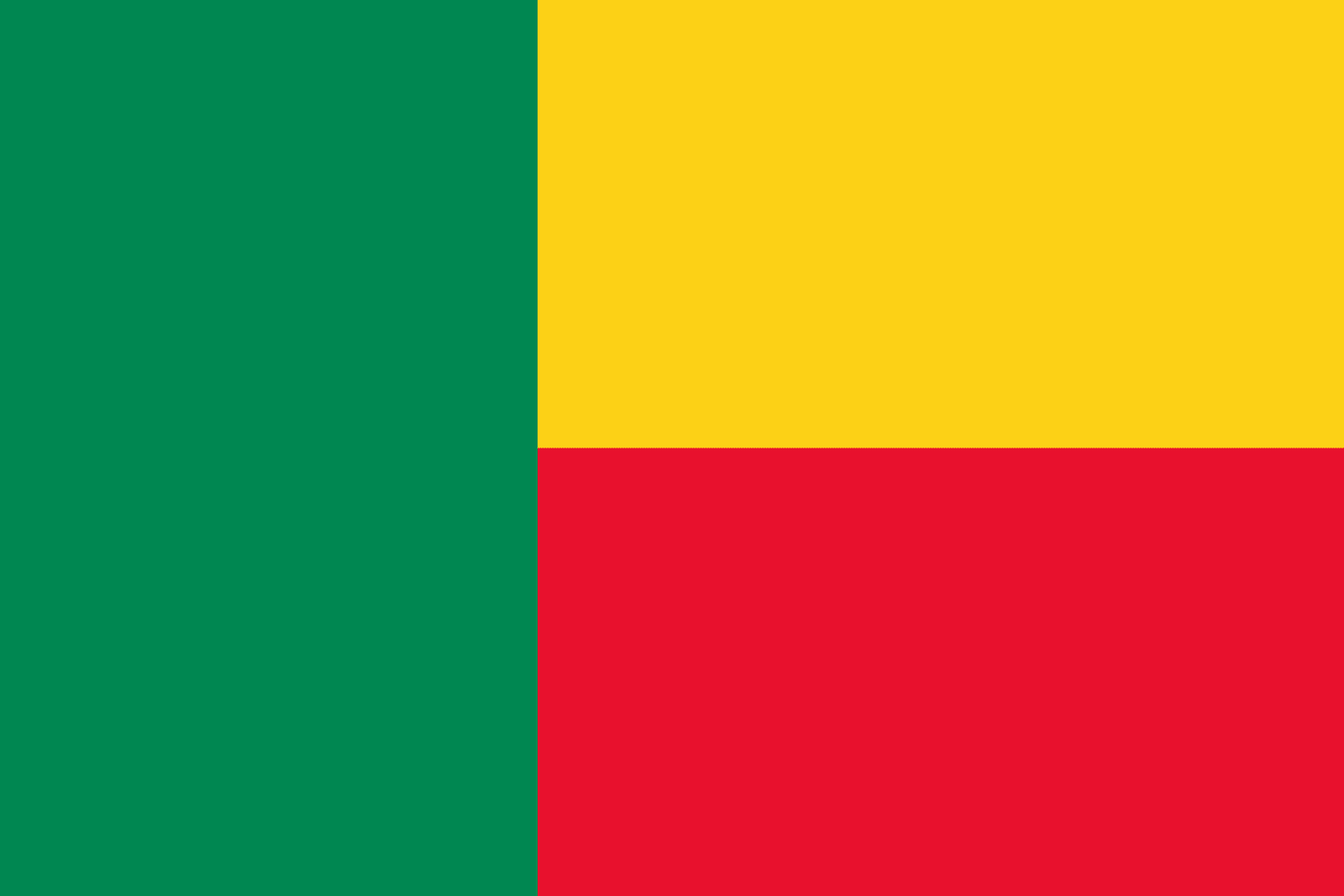
Flag of Benin
| Legal Name | Republic of Benin |
|---|---|
| Flag |
|
| Capital City |
Porto-Novo |
| Total Area | ~114,763 km² |
| Land Area | ~112,622 km² |
| Water Area | ~2,141 km² |
| Population | ~13.5 million |
| Major Cities | Cotonou (~760,000), Porto-Novo (~320,000), Parakou (~250,000), Abomey (~120,000), Djougou (~90,000) |
| Currency | West African CFA franc (XOF) |
| GDP | ~US$17 billion |
| GDP Per Capita | ~US$1,250 (PPP approx. US$3,200) |
About of Benin
Benin is a West African nation situated on the Gulf of Guinea. It is strategically positioned between Togo to the west, Nigeria to the east, Burkina Faso and Niger to the north, and the Atlantic Ocean to the south. With its coastline along the Bight of Benin, the country has historically been a hub for trade, cultural exchange, and regional connectivity.
Porto-Novo serves as the official capital and the seat of government, while Cotonou, located on the coast, functions as the largest city and economic center. The country has a population of approximately 13.5 million, featuring a mix of ethnic and linguistic groups. Benin is recognized internationally as a stable democracy in a region that has historically experienced political volatility. Its location along key maritime routes and shared borders with large economies such as Nigeria enhance its geopolitical and trade significance.
3. Etymology
The name “Benin” is derived from the Bight of Benin, the part of the Gulf of Guinea along the country’s coast. Historically, the term was associated with the Benin Empire, which was centered in present-day Nigeria. The adoption of the name “Benin” for the country in 1975 reflected both geographical identity and the desire to move beyond colonial-era names. Linguistically, it carries regional historical resonance, symbolizing continuity with West African heritage.
4. History
Benin’s history spans millennia. Prehistoric and ancient civilizations thrived in the fertile regions along rivers and savannas. Indigenous groups such as the Fon, Yoruba, Bariba, and Adja developed complex social and political structures.
During the classical and medieval periods, the region was influenced by the powerful Kingdom of Dahomey, known for its centralized administration, trade networks, and military prowess. The Dahomey monarchy played a significant role in regional politics and was involved in trade, including participation in the transatlantic slave trade.
Colonial influence began in the late 19th century when France established control, creating the colony of French Dahomey. Colonial rule reshaped the political and economic landscape, introducing Western education, infrastructure, and administrative systems.
Benin achieved independence from France on 1 August 1960. Post-independence history included political instability, coups, and periods of military governance. In 1975, the country was renamed the Republic of Benin. Since the 1990s, Benin has emerged as a stable multi-party democracy, holding regular elections and experiencing relative political and social stability.
5. Government and Politics
Benin operates as a presidential representative democratic republic. The President serves as both head of state and government and is elected through popular vote. The National Assembly is a unicameral legislature responsible for law-making. The judiciary is independent, guided by civil law principles inherited from the French legal system.
The country is divided into 12 departments, each with administrative authority over local affairs. Benin maintains active foreign relations through membership in the African Union, United Nations, Economic Community of West African States (ECOWAS), and other regional organizations. The Armed Forces of Benin oversee defense, internal security, and participation in peacekeeping operations.
6. Economy
Benin has a developing, agriculture-based economy with increasing diversification into trade and services. Agriculture is central, with cotton being the primary cash crop, along with maize, cassava, yams, and palm products. Manufacturing is limited but includes food processing, textiles, and cement production.
Trade plays a vital role, particularly through the port of Cotonou, which serves as a regional hub for neighboring landlocked countries. Key export partners include the European Union, Nigeria, and other ECOWAS countries. Economic challenges include poverty, infrastructure gaps, and vulnerability to external price shocks. Future growth is tied to regional trade expansion, sustainable agriculture, and investment in energy and infrastructure.
7. Demographics
Benin has a diverse population, with ethnic groups including the Fon (approx. 40%), Yoruba, Bariba, Adja, and other smaller groups. French is the official language, used in government and education, while Indigenous languages remain prevalent in daily life.
Religions include Christianity, Islam, and Vodun (Voodoo), reflecting both historical and cultural traditions. Approximately 40% of the population lives in urban areas, with cities like Cotonou, Porto-Novo, and Parakou serving as economic and administrative centers. Population growth remains moderate, influenced by fertility rates and urban migration.
8. Culture and Society
Benin has a rich cultural heritage, known for traditional music, dance, and festivals. Vodun religious practices are culturally significant and influence art, rituals, and social life. Music styles such as highlife, traditional drumming, and folk music thrive alongside contemporary genres.
National identity emphasizes unity amid diversity, and social customs prioritize community, respect for elders, and family cohesion. Public holidays include Independence Day (1 August) and traditional festivals such as Gaani and Voodoo Day celebrations. Football is the most popular sport, with basketball and athletics also widely practiced.
9. Education and Healthcare
The education system includes primary, secondary, and tertiary levels, with increasing literacy rates over recent decades. The government promotes access to basic education, although rural areas face challenges in infrastructure and resources.
Healthcare is a mix of public and private services. Public health initiatives focus on malaria, maternal and child health, vaccination programs, and infectious disease control. Access to care varies regionally, with urban centers better served than rural communities.
10. Geography and Climate
Benin features coastal plains in the south, transitioning to plateaus, savannas, and forested areas in the central and northern regions. The Atakora Mountains rise in the northwest. Major rivers include the Ouémé and Niger rivers, which support agriculture and transportation.
The climate is tropical, with wet and dry seasons. The south experiences a bimodal rainy season, while the north has a single rainy season. Environmental concerns include soil erosion, deforestation, and coastal vulnerability.
11. Flora and Fauna
Benin hosts a variety of ecosystems, from coastal mangroves to savannas and forests. Native plant species include mahogany, iroko, and baobab trees. Wildlife includes antelopes, monkeys, reptiles, and diverse bird species.
Protected areas like Pendjari National Park and W National Park support conservation and ecotourism, safeguarding biodiversity and promoting sustainable use of natural resources.
Map of Benin
National Flag: Green, yellow, and red vertical stripes symbolizing hope, wealth, and courage.
Coat of Arms: Includes two leopards, a shield with a star, and agricultural symbols.
National Anthem: “L’Aube Nouvelle” (The New Dawn).
National Animals: Leopard and elephant (symbolic).
National Plants: Palm and mahogany trees.
National Flag (Detailed Section)
The flag consists of three vertical bands: green at the hoist, yellow in the center, and red on the fly. Adopted on 1 August 1960 upon independence, the colors are Pan-African, symbolizing the country’s agricultural richness, hope, and courage. The flag is flown on national holidays, government buildings, and during official ceremonies.
Green: Agriculture, forests, and hope.
Yellow: Wealth, natural resources, and light.
Red: Courage, strength, and national unity.
Protocol emphasizes proper display, respect during national ceremonies, and use at half-mast during periods of mourning.
Realted Flags
Flag flying days
| Date | Flag Position | Occasion |
|---|---|---|
| 1 August | Full-mast | Independence Day |
| 1 January | Full-mast | New Year’s Day |
| 21 May | Full-mast | Labor Day |
| National Mourning Days | Half-mast | State funerals or national mourning |