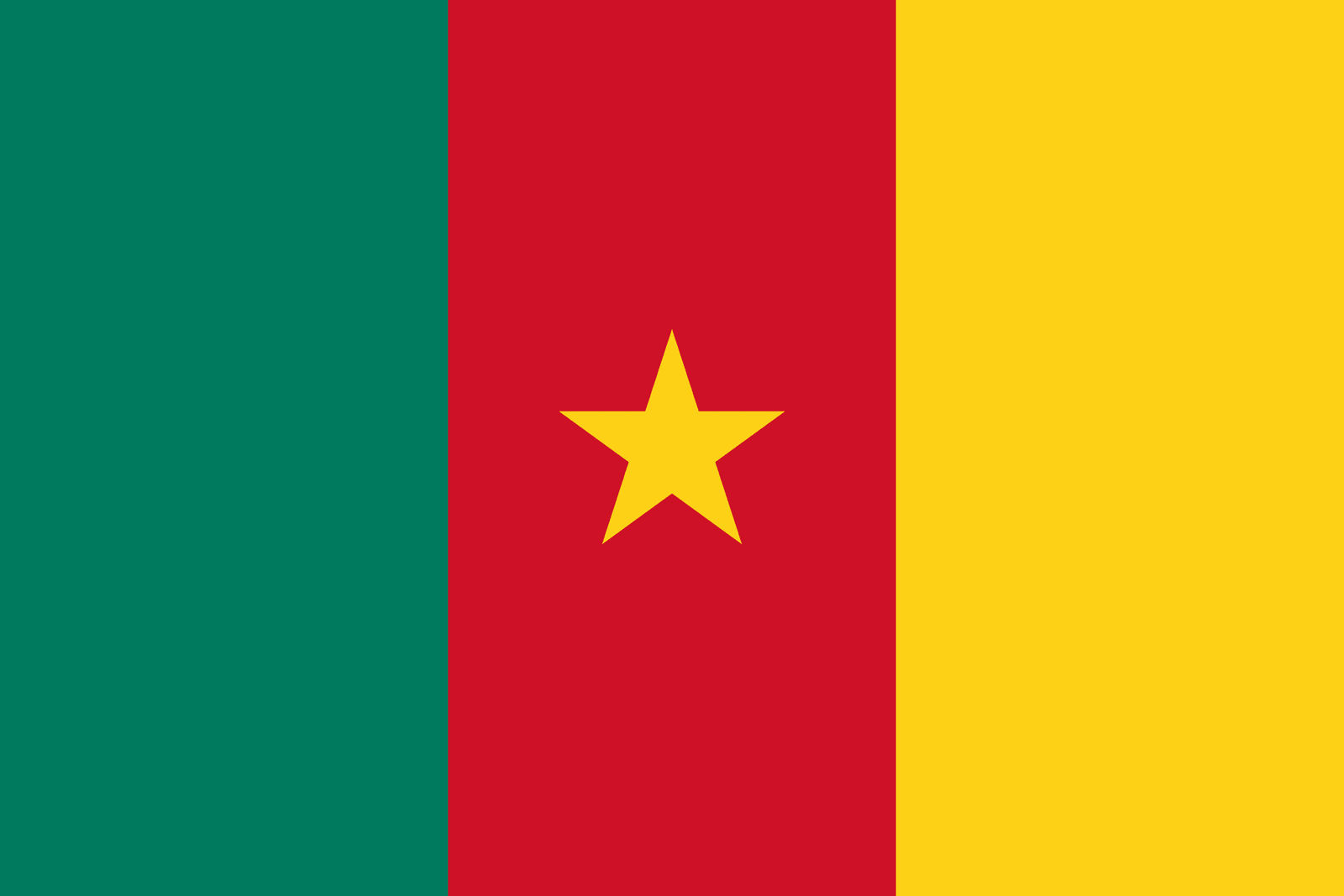
Flag of Cameroon
| Legal Name | Republic of Cameroon |
|---|---|
| Flag |
|
| Capital City |
Yaoundé |
| Total Area | 475,442 km² |
| Land Area | 472,710 km² |
| Water Area | 2,732 km² |
| Population | ~29 million |
| Major Cities | Douala (~3 million), Yaoundé (~2.9 million), Garoua (~400,000), Bamenda (~500,000), Maroua (~300,000) |
| Currency | Central African CFA Franc (XAF) |
| GDP | ~US$40 billion |
| GDP Per Capita | ~US$1,400 |
About of Cameroon
Cameroon is a Central African nation located at the crossroads of West and Central Africa, giving it diverse cultural and ecological landscapes. It stretches from the Gulf of Guinea in the southwest to the Sahelian region in the north, and is known as “Africa in miniature” for its combination of coastlines, deserts, mountains, forests, and savannas.
The country shares land borders with Nigeria to the west, Chad to the northeast, the Central African Republic to the east, and Equatorial Guinea, Gabon, and the Republic of the Congo to the south, with maritime boundaries along the Atlantic Ocean.
Its political capital is Yaoundé, while Douala serves as the economic hub and largest city, housing the principal seaport and a concentration of industry and commerce. Cameroon’s population is highly diverse, comprising hundreds of ethnic groups and languages. The nation is recognized internationally as a stable and strategically located state, playing a significant role in regional diplomacy, African Union affairs, and economic integration initiatives in Central Africa.
3. Etymology
The name “Cameroon” is derived from the Portuguese word “Rio dos Camarões”, meaning “River of Prawns” or “Shrimp River,” referring to the abundance of shrimp found in the Wouri River estuary during early European exploration in the 15th century. Over time, the name evolved from “Camarões” to the modern English and French form, Cameroon.
4. History
Human settlement in Cameroon dates back thousands of years, with archaeological evidence of early civilizations in the Sahelian and forest regions.
Precolonial Period: Indigenous kingdoms and chiefdoms flourished, including the Kingdom of Bamum and the Fang and Duala societies, engaging in agriculture, trade, and cultural development.
European Contact: Portuguese explorers arrived in the 15th century, followed by German colonization in the late 19th century as Kamerun.
Colonial Division: After Germany’s defeat in World War I, the League of Nations mandated the territory to France and Britain, with French Cameroon and British Cameroons administered separately.
Independence: French Cameroon gained independence in 1960, followed by the reunification with British Southern Cameroons in 1961 to form the Federal Republic of Cameroon.
Modern Era: Cameroon became a unitary state in 1972, with ongoing political developments including efforts to balance governance between Anglophone and Francophone regions, economic modernization, and addressing security challenges posed by extremist groups in the northern region.
5. Government and Politics
Cameroon is a unitary republic with a strong presidential system.
Executive: President serves as head of state and government, with authority over defense, foreign policy, and administration; supported by a Prime Minister and Council of Ministers
Legislative: Bicameral Parliament consisting of the National Assembly and Senate
Judiciary: Independent courts guided by civil law and customary law
Administrative Divisions: 10 regions subdivided into divisions and sub-divisions
Foreign Relations: Active in the African Union, UN, Central African Economic and Monetary Community (CEMAC), and regional security initiatives
Defense: Cameroon Armed Forces include army, navy, and air force, focused on territorial defense and combating cross-border insurgency
6. Economy
Cameroon has a developing, resource-driven economy with an emphasis on agriculture, industry, and services.
Major Industries: Oil and gas, agriculture, timber, mining, food processing, construction
Agriculture: Cocoa, coffee, cotton, bananas, maize, yams
Natural Resources: Petroleum, bauxite, cobalt, iron ore, timber, hydropower potential
Trade Partners: European Union, China, Nigeria, United States, other African nations
Challenges: Dependence on primary commodities, infrastructure deficits, regional instability
Outlook: Efforts to diversify the economy, attract investment, and develop manufacturing and renewable energy sectors
7. Demographics
Cameroon’s population is ethnically and linguistically diverse:
Ethnic Groups: Over 250 ethnic groups, including Bantu, Semi-Bantu, and Sudanic peoples
Languages: French and English (official), over 250 indigenous languages spoken regionally
Religions: Christianity (majority), Islam (predominantly in the north), traditional African religions
Urban vs Rural: Approximately 57% urban, 43% rural
Population Growth: Around 2.6% per year, driven by high fertility and improving healthcare
8. Culture and Society
Cameroonian culture is rich and multifaceted, reflecting its diverse ethnic composition.
Arts and Music: Traditional music, Makossa, Bikutsi, literature, and modern popular culture
Cuisine: Fufu, Ndolé, grilled fish, plantains, maize dishes, reflecting regional diversity
Social Norms: Respect for elders, communal life, traditional ceremonies, and festivals
Festivals: Ngondo Festival, Bamum Cultural Week, Independence Day (20 May)
Sports: Football (soccer) dominates; basketball and athletics are popular
9. Education and Healthcare
Cameroon operates a bilingual education system, with French and English as mediums of instruction. Education is structured into primary, secondary, and tertiary levels, with universities such as University of Yaoundé.
Healthcare includes public hospitals and regional clinics, with challenges including malaria, HIV/AIDS, maternal health, and rural healthcare access. Improvements in vaccination and health infrastructure continue.
10. Geography and Climate
Cameroon’s geography is diverse:
Physical Features: Coastal plains, central plateaus, western highlands (Cameroon Mountains), northern savannas, and tropical forests
Climate Zones: Equatorial in the south, tropical in the center, semi-arid in the north
Natural Hazards: Seasonal flooding, volcanic activity (Mount Cameroon), landslides, drought in northern regions
Environmental Concerns: Deforestation, desertification in the north, loss of biodiversity, and sustainable resource management
11. Flora and Fauna
Cameroon is ecologically diverse, home to dense rainforests, savannas, and wetlands.
Flora: Teak, mahogany, ebony, raffia palms, and a variety of tropical hardwoods
Wildlife: Gorillas, chimpanzees, elephants, hippos, lions, antelopes, and numerous bird species
National Parks: Waza, Dja Faunal Reserve, Lobéké, and Bouba Njida, dedicated to wildlife conservation and eco-tourism
Map of Cameroon
National Flag: Green, red, and yellow vertical stripes with a central star
Coat of Arms: Features a lion and a unicorn, a shield, and the motto “Peace, Work, Fatherland”
National Anthem: “O Cameroun, Berceau de nos Ancêtres”
National Animals: Lion (symbol of strength), Elephant
National Plants: Oil palm, diverse indigenous flora
Monuments: Reunification Monument in Yaoundé, Mount Cameroon
National Flag (Detailed Section)
The Cameroon flag, adopted in 1975, consists of three vertical stripes: green, red, and yellow, with a yellow five-pointed star in the center.
Symbolism: Green represents forests and the southern regions, red symbolizes unity and independence, yellow reflects the savannas and the northern regions, and the central star represents national unity.
Usage: Flown on public buildings, schools, and during national celebrations
Protocol: Treated with respect, half-mast for mourning, full-mast for celebrations
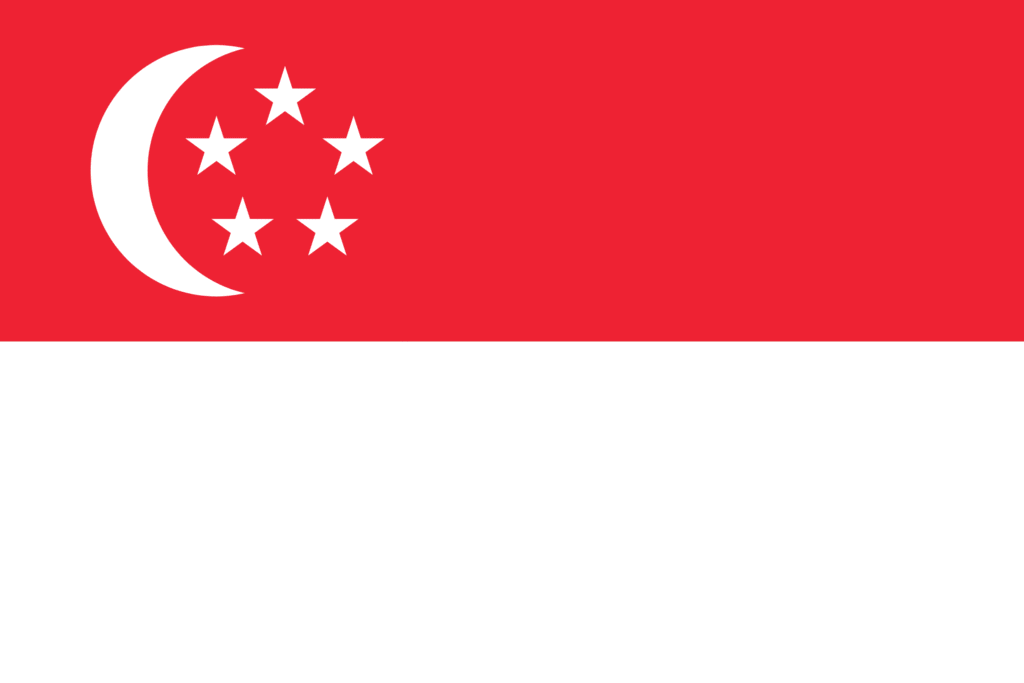
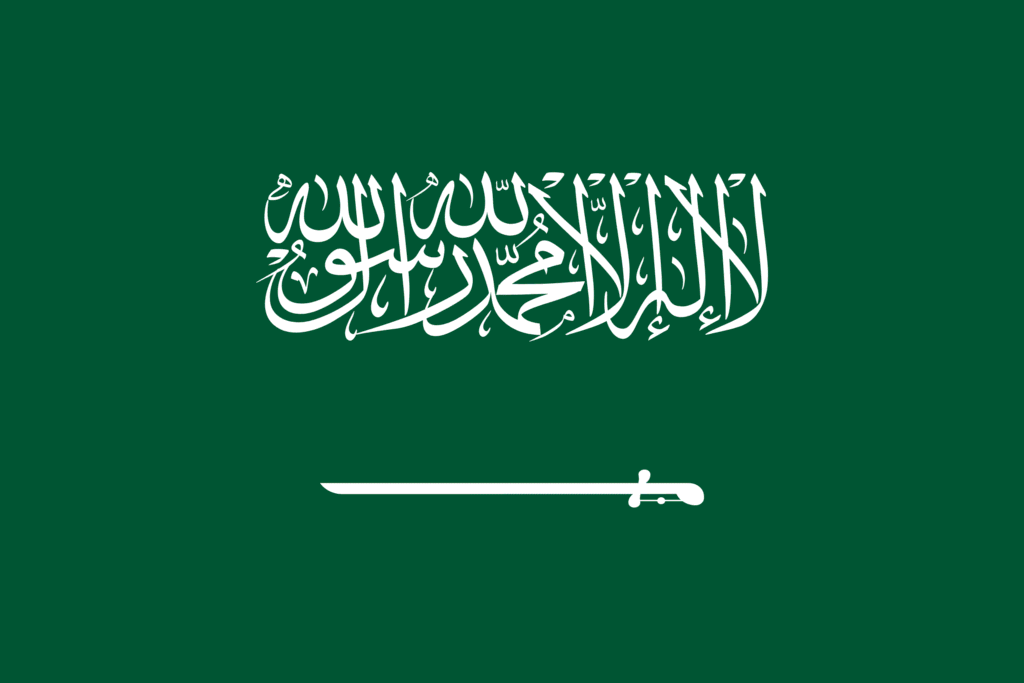
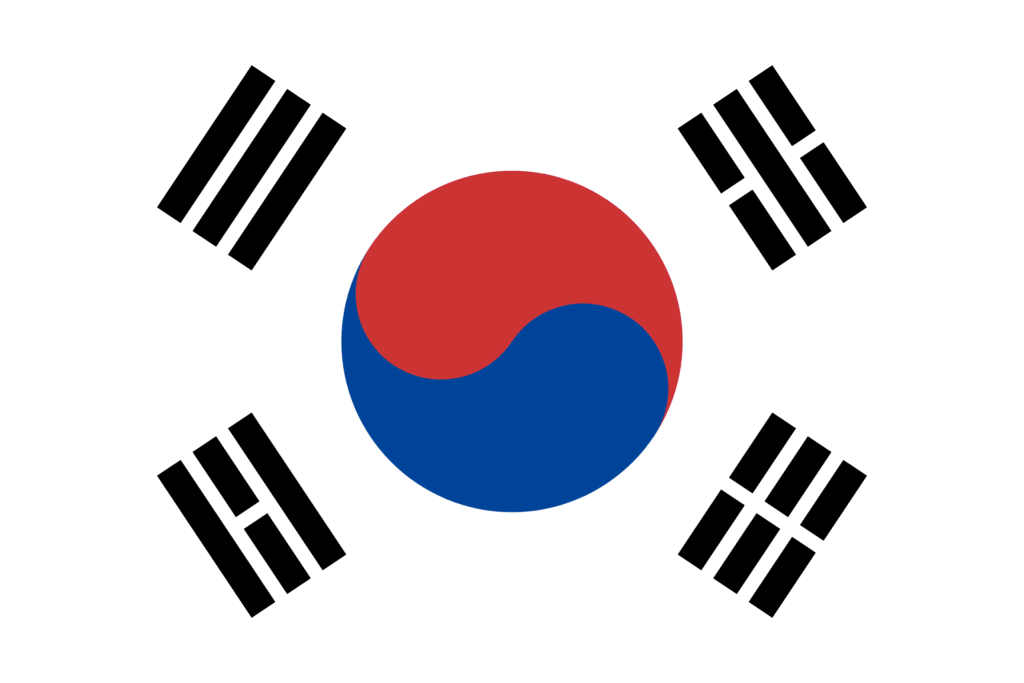
Realted Flags
Flag flying days
| Date | Flag Position | Occasion |
|---|---|---|
| 20 May | Full-mast | National Day (Independence Day) |
| 1 January | Full-mast | New Year |
| State mourning | Half-mast | National tragedies or death of national leaders |
| 11 November | Half-mast | Remembrance and memorial observances |
| Public holidays | Full-mast | Regional and cultural celebrations |