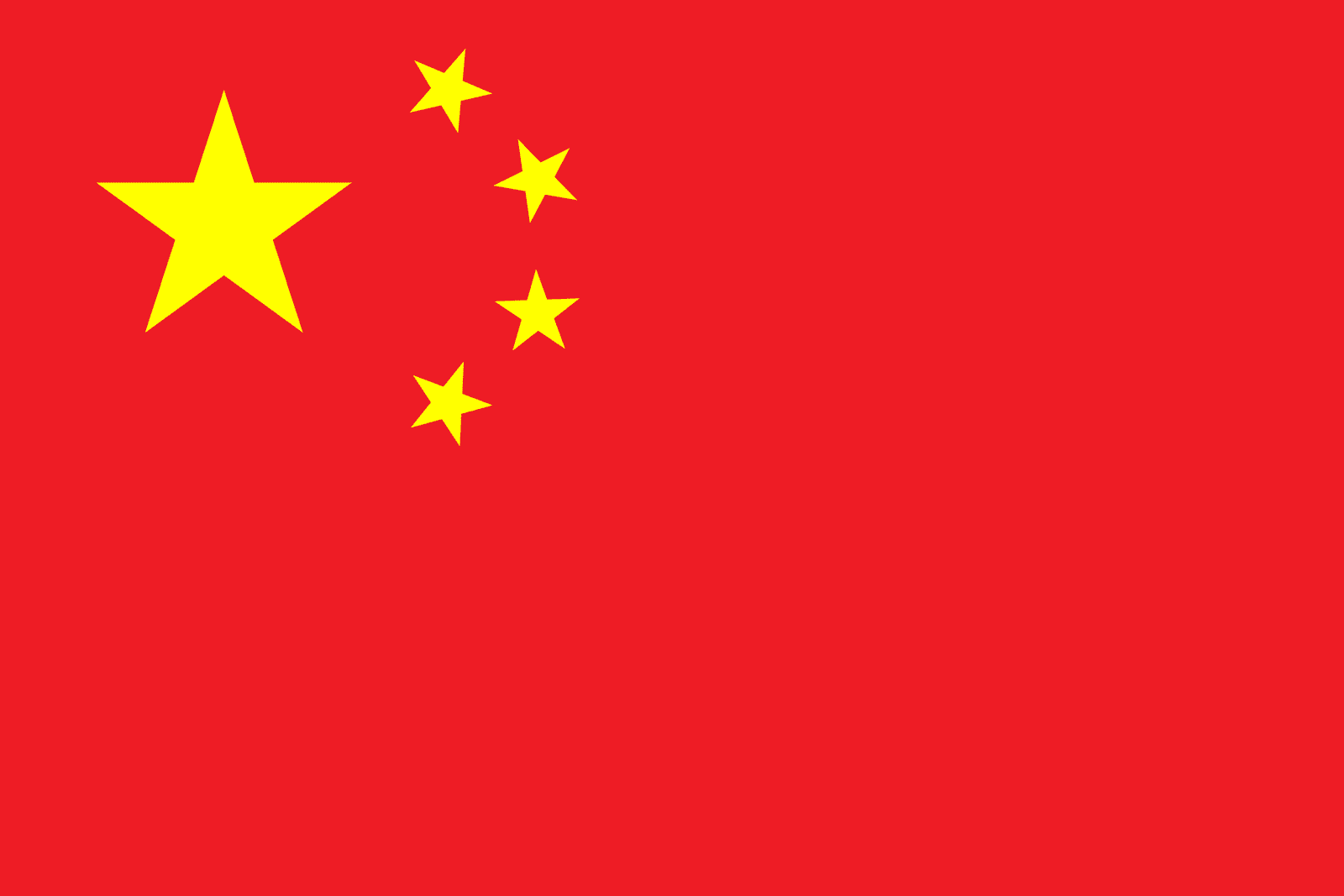
Flag of China
| Legal Name | People’s Republic of China |
|---|---|
| Flag |
|
| Capital City |
Shanghai |
| Total Area | ~9,596,961 km² |
| Land Area | ~9,326,410 km² |
| Water Area | ~270,550 km² |
| Population | ~1.41 billion |
| Major Cities | Shanghai (~24.8M), Beijing (~21.9M), Chongqing (~32M municipality), Guangzhou (~18.7M), Shenzhen (~17.8M), Chengdu (~21M), Tianjin (~13.6M) |
| Currency | Renminbi (Yuan, CNY) |
| GDP | ~USD 17.7 trillion |
| GDP Per Capita | ~USD 12,500 (nominal) |
About of China
China is located in East Asia and is the world’s most populous country and one of its largest by land area. It occupies a central position in the Asian continent, stretching from the Pacific coastline in the east to the high plateaus of Central Asia in the west. Its vast territory spans multiple climatic zones and landscapes, ranging from fertile river valleys and coastal plains to deserts, mountains, and high-altitude plateaus.
China shares land borders with 14 countries, including Russia, Mongolia, India, Pakistan, Vietnam, and North Korea, making it one of the most land-connected nations globally. It also has extensive maritime boundaries along the Yellow Sea, East China Sea, and South China Sea. Beijing serves as the political and cultural capital, while Shanghai stands as the largest city and a global financial hub.
The country’s population is ethnically diverse, though the Han Chinese form a substantial majority. China is officially recognized as a sovereign state governed by the Communist Party of China and holds a permanent seat on the United Nations Security Council. It is a leading global actor in international trade, manufacturing, diplomacy, and geopolitics, with significant influence in Asia and beyond.
Strategically, China plays a central role in global supply chains, regional security in East Asia, and international institutions. Its economic scale, military capacity, and diplomatic reach make it one of the most influential nations in the contemporary world order.
Etymology
The name “China” is widely believed to derive from the Qin (pronounced “Chin”) dynasty, which unified the region in the 3rd century BCE. The term entered European languages through Persian and Sanskrit intermediaries, where similar forms were used to describe the land to the east.
In Chinese, the country is called “Zhōngguó” (中国), meaning “Middle Kingdom” or “Central State.” This name reflects the ancient Chinese worldview that regarded their civilization as the cultural center of the known world. Over time, the external name “China” became standardized internationally, while “Zhōngguó” remains the primary self-designation.
History
Human settlement in China dates back hundreds of thousands of years, with early hominid fossils and Neolithic cultures such as Yangshao and Longshan laying the foundations for agriculture and settled society. Early Chinese civilization emerged along the Yellow River, leading to the formation of the Shang and Zhou dynasties, which developed early writing, bronze technology, and political systems.
The Qin dynasty (221–206 BCE) marked China’s first unification, standardizing laws, currency, and measurements. It was followed by the Han dynasty, a formative era that shaped Chinese identity, bureaucracy, and trade routes such as the Silk Road. Subsequent centuries saw cycles of unity and division under powerful dynasties including the Tang, Song, Yuan, Ming, and Qing.
During the 19th century, China faced internal decline and external pressure from Western powers and Japan, resulting in territorial losses and social upheaval. The Qing dynasty collapsed in 1911, giving way to the Republic of China. After decades of conflict, including civil war and invasion during World War II, the Communist Party established the People’s Republic of China in 1949.
Post-1949 history has included major political and economic transformations, from early socialist campaigns to market-oriented reforms initiated in the late 1970s. In the 21st century, China has emerged as a global economic powerhouse, while continuing to navigate complex domestic and international challenges.
Government and Politics
China is a socialist state governed under a single-party system led by the Communist Party of China (CPC). The Constitution of the People’s Republic of China defines the country as a people’s democratic dictatorship guided by socialist principles.
Executive authority is exercised by the State Council, headed by the Premier. Legislative power rests with the National People’s Congress, the highest state authority. The judiciary operates through the Supreme People’s Court and subordinate courts, functioning under the broader framework of state authority.
Administratively, China is divided into provinces, autonomous regions, municipalities directly under the central government, and special administrative regions. In foreign affairs, China maintains diplomatic relations with most countries and is a member of major international organizations, including the United Nations, World Trade Organization, G20, and BRICS.
China maintains one of the world’s largest armed forces, the People’s Liberation Army, responsible for national defense, internal security support, and strategic deterrence.
Economy
China is classified as an upper-middle-income, emerging economy and is the world’s second-largest economy by nominal GDP. It has undergone rapid industrialization and urbanization, transitioning from an agrarian economy to a global manufacturing and technology leader.
Major industries include manufacturing, electronics, automotive production, steel, energy, and increasingly high-tech sectors such as telecommunications, renewable energy, and artificial intelligence. Agriculture remains significant, producing rice, wheat, corn, and pork for domestic consumption.
China is rich in natural resources, including coal, rare earth elements, and various metals. It is a leading exporter of manufactured goods and maintains extensive trade relationships with Asia, Europe, Africa, and the Americas. Key economic challenges include demographic shifts, regional inequality, environmental sustainability, and balancing state control with market forces.
Demographics
China’s population is predominantly Han Chinese, with 55 officially recognized ethnic minority groups such as Zhuang, Hui, Uyghur, Tibetan, and Mongol communities. Mandarin Chinese is the official language, while numerous regional languages and dialects are widely spoken.
Religious practices include Buddhism, Taoism, Islam, Christianity, and traditional folk beliefs, alongside a significant non-religious population. China is highly urbanized, with over 65% of the population living in cities. Population growth has slowed significantly, with recent trends showing aging demographics and declining birth rates.
Culture and Society
Chinese culture is one of the world’s oldest continuous civilizations, shaped by Confucianism, Taoism, and Buddhism. Values such as family, education, social harmony, and respect for tradition play a central role in society.
China has a rich artistic heritage, including calligraphy, painting, poetry, opera, and contemporary cinema. Its cuisine is globally influential, with regional styles such as Sichuan, Cantonese, and Shandong cuisine. Major festivals include the Spring Festival (Chinese New Year), Mid-Autumn Festival, and Dragon Boat Festival.
Sports such as table tennis, badminton, basketball, and increasingly football are popular, alongside traditional martial arts.
Education and Healthcare
China operates a centralized education system with compulsory schooling through junior secondary level. Literacy rates exceed 96%, and the country hosts some of the world’s largest universities and research institutions.
The healthcare system combines public and private providers, with significant improvements in life expectancy and disease control over recent decades. Challenges remain in rural healthcare access, aging populations, and public health management.
Geography and Climate
China’s geography is highly diverse, featuring the Himalayas, Tibetan Plateau, major river systems such as the Yangtze and Yellow Rivers, vast plains, deserts like the Gobi, and extensive coastlines. The climate ranges from tropical in the south to subarctic in the north, with monsoon systems influencing weather patterns.
Natural hazards include earthquakes, floods, droughts, and typhoons. Environmental concerns include air and water pollution, desertification, and climate change impacts.
Flora and Fauna
China is one of the world’s most biodiverse countries, home to iconic species such as the giant panda, snow leopard, and golden monkey. Its varied ecosystems support a wide range of plant species, many of which are endemic.
The country has established numerous national parks and protected areas to conserve biodiversity, including large-scale ecological restoration and wildlife protection programs.
Map of China
China’s national flag features a red background symbolizing revolution, with five yellow stars representing unity under the Communist Party. The national emblem includes Tiananmen Gate, wheat, and gears symbolizing people and industry. The national anthem, “March of the Volunteers,” reflects themes of unity and resistance. The giant panda is widely regarded as a national animal and cultural symbol.
National Flag (Detailed Section)
The national flag of China consists of a red field with one large yellow star near the hoist and four smaller stars arranged in an arc. Adopted in 1949, the design reflects revolutionary heritage and national unity. Red symbolizes the revolution, while the stars represent the unity of the Chinese people under the leadership of the Communist Party.
The flag is flown on government buildings, public institutions, and during national celebrations. Specific regulations govern its display to ensure respectful and standardized use.
Realted Flags

Flag flying days
| Date | Flag Position | Occasion |
|---|---|---|
| January 1 | Full-mast | New Year’s Day |
| May 1 | Full-mast | Labor Day |
| October 1 | Full-mast | National Day |
| National Mourning Days (as declared) | Half-mast | State mourning occasions |