Flag of Dominican Republic
| Legal Name | Dominican Republic |
|---|---|
| Flag |
|
| Capital City |
Santo Domingo |
| Total Area | 48,671 |
| Land Area | 48,320 |
| Water Area | 351 |
| Population | ~11.1 million |
| Major Cities | Santo Domingo (~3.3 million), Santiago (~1.2 million), La Romana (~250,000), San Pedro de Macorís (~200,000), Puerto Plata (~170,000) |
| Currency | Dominican Peso (DOP) |
| GDP | ~USD 148 billion |
| GDP Per Capita | ~USD 13,300 (PPP) |
About of Dominican Republic
The Dominican Republic occupies the eastern two-thirds of the island of Hispaniola in the Caribbean, sharing its western border with Haiti. Its strategic location places it within the Greater Antilles, flanked by the Atlantic Ocean to the north and the Caribbean Sea to the south. The country’s landscape is highly diverse, with mountains, fertile valleys, and extensive coastlines that support agriculture, tourism, and maritime activities.
The capital, Santo Domingo, is the largest urban center and the economic and cultural hub of the nation. Other major cities like Santiago and La Romana play important roles in industry, commerce, and tourism. The population is predominantly urban, with nearly 80% living in cities or towns. The Dominican Republic is internationally recognized as a sovereign nation, actively participating in regional organizations such as CARICOM, the Organization of American States, and the United Nations.
Strategically, the Dominican Republic holds a critical position in Caribbean trade and maritime routes. Its tourism sector, economic development, and role in regional diplomacy enhance its geopolitical importance in both the Caribbean and Latin American spheres.
Etymology
The name “Dominican Republic” derives from the capital’s founding by Bartholomew Columbus in 1498, named “Santo Domingo” in honor of Saint Dominic. The term “Dominican” became associated with the country’s inhabitants, eventually evolving into the official state name. The island itself was originally called “Hispaniola” by Christopher Columbus, reflecting its Spanish colonial heritage.
History
Human habitation in the Dominican Republic dates back over 5,000 years, primarily by the Taíno people, who developed sophisticated agricultural and social systems. The arrival of Christopher Columbus in 1492 marked the beginning of European colonization. Spain established Santo Domingo as the first permanent European settlement in the Americas in 1498.
During the colonial period, the island underwent periods of Spanish and French control, with sugar plantations and African slave labor shaping its economy and society. In 1821, the Dominican Republic declared independence from Spain, though it was briefly annexed by Haiti until achieving lasting independence in 1844 under Juan Pablo Duarte and the founding of the Dominican Republic.
The 20th century was marked by political instability, including the dictatorship of Rafael Trujillo (1930–1961) and subsequent civil strife. Democratic governance was re-established in the late 20th century, with economic liberalization and modernization promoting tourism, services, and international trade.
Government and Politics
The Dominican Republic is a representative democracy with a presidential system. The president serves as both head of state and government, elected for a five-year term. The legislative branch is bicameral, consisting of the Senate and the Chamber of Deputies, while the judiciary operates independently with the Supreme Court as the highest authority.
The country is divided into 31 provinces and the National District, which includes Santo Domingo. Foreign relations emphasize regional cooperation, trade partnerships, and international diplomacy. The military is tasked with national defense, disaster response, and law enforcement support, while remaining subordinate to civilian governance.
Economy
Classified as an emerging economy, the Dominican Republic is one of the fastest-growing in the Caribbean. Its economy relies heavily on services, tourism, free-trade zones, and remittances. Agriculture remains vital, producing sugarcane, coffee, cocoa, and tobacco. Manufacturing includes textiles, footwear, and food processing.
Natural resources are limited but include gold, nickel, and limestone. Main trade partners are the United States, Haiti, China, and the European Union. Economic challenges include income inequality, informal labor markets, and vulnerability to climate-related disasters. Future growth prospects focus on diversifying industries, enhancing infrastructure, and strengthening tourism.
Demographics
The Dominican Republic has a population of approximately 11.1 million. The majority are of mixed European and African descent, with smaller indigenous, European, and Arab communities. Spanish is the official language, and Dominican Creole and English are also spoken in certain regions.
The population is predominantly Christian, mainly Roman Catholic, with Protestant and evangelical communities. Urbanization is high, with major cities absorbing a significant portion of the population. Population growth remains moderate, influenced by migration, birth rates, and urban development.
Culture and Society
Dominican culture blends Taíno, African, and European influences. National identity emphasizes music, dance, religion, and communal traditions. Merengue and bachata music are internationally recognized, while visual arts and literature reflect historical narratives and social themes.
Cuisine centers on rice, beans, plantains, meats, and seafood. Social norms prioritize family networks, hospitality, and communal festivities. National holidays commemorate independence, religious celebrations, and cultural events. Baseball is the most popular sport, alongside basketball, volleyball, and traditional games.
Education and Healthcare
Education is structured into primary, secondary, and tertiary levels, with literacy rates above 90%. Public and private universities provide professional and technical training, while vocational education supports emerging industries.
Healthcare services include public hospitals and private clinics. Key public health challenges include non-communicable diseases, maternal and child health, and access disparities. National programs emphasize vaccination, disease prevention, and health education.
Geography and Climate
The Dominican Republic is geographically diverse, featuring the Cordillera Central mountains, fertile Cibao Valley, coastal plains, and numerous rivers including the Yaque del Norte and Ozama. The country has tropical and semi-arid climates, with a wet season from May to November and a dry season from December to April.
Natural hazards include hurricanes, flooding, landslides, and earthquakes. Environmental concerns center on deforestation, coastal erosion, and water management. Conservation initiatives protect forests, wetlands, and coral reefs.
Flora and Fauna
The country hosts rich biodiversity, including endemic plants and wildlife. Rainforests, mangroves, and coastal ecosystems support birds, reptiles, amphibians, and mammals. National parks, such as Parque Nacional Los Haitises and Jaragua National Park, conserve habitats and promote ecotourism.
Map of Dominican Republic
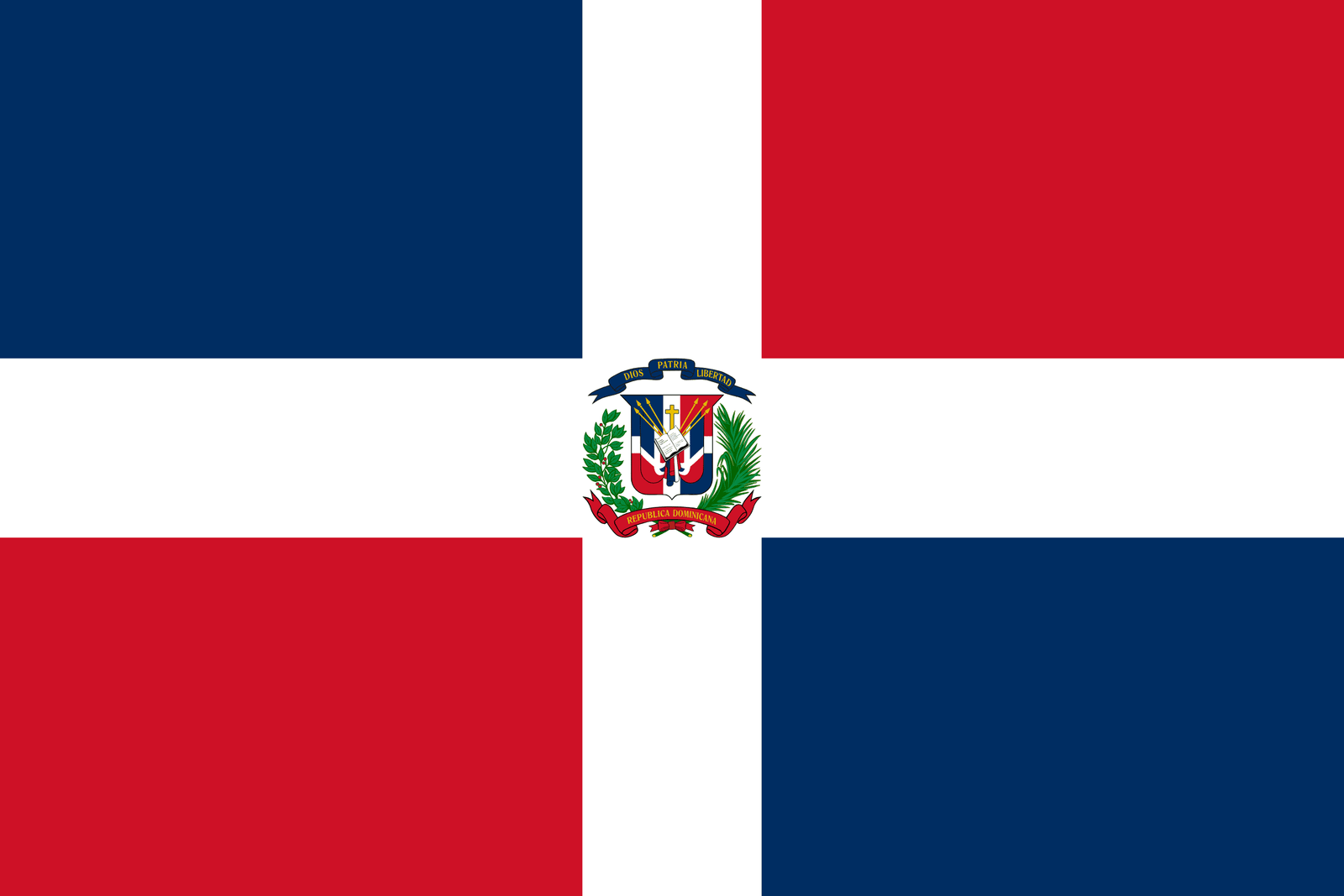
The national flag features a white cross dividing the field into blue and red rectangles, with the coat of arms at the center. The coat of arms includes a Bible, cross, spears, and the national motto “Dios, Patria, Libertad” (“God, Fatherland, Liberty”). The national anthem, Himno Nacional, celebrates independence and national unity. The palm tree, cigua palmera, and the palmchat bird serve as national plant and bird symbols, respectively.
National Flag (Detailed Section)
The flag’s design includes a white cross for unity and peace, blue rectangles symbolizing liberty, and red rectangles representing the blood of heroes. Adopted in 1844 after independence, the coat of arms reinforces national identity with religious and historical elements.
Flag protocol includes displaying it on government buildings, schools, and during public ceremonies. Respect for the flag is mandated during national holidays and official events.
Realted Flags
Flag flying days
| Date | Flag Position | Occasion or Reason |
|---|---|---|
| February 27 | Full-mast | Independence Day |
| August 16 | Full-mast | Restoration Day |
| National Mourning Days | Half-mast | Official mourning for national tragedies |
| November 6 | Full-mast | Constitution Day |