Flag of DP of the Congo
| Legal Name | Democratic Republic of the Congo |
|---|---|
| Flag |
|
| Capital City |
Kinshasa |
| Total Area | 2,344,858 |
| Land Area | 2,267,048 |
| Water Area | 77,810 |
| Population | ~104 million |
| Major Cities | Kinshasa (~15 million), Lubumbashi (~2.3 million), Mbuji-Mayi (~2 million), Kisangani (~1.3 million), Kananga (~1.2 million) |
| Currency | Congolese Franc (CDF) |
| GDP | ~USD 60 billion |
| GDP Per Capita | ~USD 580 (nominal) |
About of DP of the Congo
The Democratic Republic of the Congo (DR Congo) is a vast country located in Central Africa, covering over 2.3 million square kilometers, making it the second-largest nation on the continent. DR Congo is strategically positioned, connecting Central and Southern Africa, with access to the Atlantic Ocean via a narrow outlet along the Congo River. Its location provides rich biodiversity, vast mineral wealth, and critical waterways that support both domestic transport and regional trade.
DR Congo shares borders with nine countries: Angola, Burundi, Central African Republic, Republic of the Congo, Rwanda, South Sudan, Tanzania, Uganda, and Zambia. Its maritime access is limited but strategically important for regional commerce. Kinshasa, the capital and largest city, is a major cultural, political, and economic hub, while other urban centers such as Lubumbashi and Mbuji-Mayi serve as industrial and mining centers.
The country has a highly diverse population, composed of hundreds of ethnic groups and languages. Despite its wealth of natural resources, DR Congo faces significant challenges including political instability, regional conflicts, and infrastructure deficits. Internationally, it is recognized as a sovereign member of the United Nations and African Union and plays a critical role in regional security and natural resource supply chains.
Etymology
The name “Congo” originates from the historical Kingdom of Kongo, which existed in the region during the 14th to 19th centuries. The kingdom’s name derives from the Bakongo people, one of the dominant ethnic groups in the area. “Democratic Republic of the Congo” emphasizes the country’s republican governance structure following independence, distinguishing it from its neighbor, the Republic of the Congo. Over time, the name has evolved to reflect political changes, especially during the Mobutu era when it was known as Zaire (1971–1997).
History
Human settlement in DR Congo dates back tens of thousands of years, with archaeological evidence of early hunter-gatherer societies and Iron Age civilizations. By the first millennium CE, organized kingdoms such as the Kongo, Luba, and Lunda had emerged, establishing trade networks and sophisticated social systems.
In the late 19th century, the Congo Basin was colonized by Belgium under King Leopold II, whose regime was marked by extreme exploitation and human rights abuses. In 1908, it became the Belgian Congo, transitioning to a formal colonial administration until independence in 1960. Patrice Lumumba became the first Prime Minister, but political turmoil, coupled with Cold War interference, led to a series of coups and conflicts.
Mobutu Sese Seko seized power in 1965, renaming the country Zaire and ruling as an authoritarian regime until 1997. The First and Second Congo Wars (1996–2003) devastated the country but eventually led to the current democratic framework. Today, DR Congo is rebuilding its institutions while managing internal conflicts and harnessing its natural resources for development.
Government and Politics
DR Congo is a semi-presidential republic with a president serving as head of state and a prime minister as head of government. The legislative branch is bicameral, consisting of the National Assembly and Senate. The judiciary operates independently, with the Constitutional Court overseeing constitutional matters.
Administratively, the country is divided into 26 provinces. Foreign relations focus on regional cooperation in Central Africa, participation in the African Union, and involvement in UN peacekeeping initiatives. The Armed Forces of the Democratic Republic of the Congo are tasked with national defense, counterinsurgency, and participation in regional security operations, though they face challenges in capacity and cohesion.
Economy
DR Congo is classified as a developing economy with enormous natural resource potential. Its economy is dominated by mining, agriculture, and services. The country possesses vast deposits of cobalt, copper, diamonds, gold, and coltan, making it a critical supplier for global electronics and industrial industries. Agriculture employs a large portion of the population, producing cassava, maize, bananas, and palm oil.
Manufacturing is limited, with most production concentrated in urban centers, while the service sector, including telecommunications and finance, is expanding. Major trade partners include China, Belgium, South Africa, and the United States. Economic challenges include political instability, inadequate infrastructure, and corruption, but there is potential for growth through resource development and investment in energy and transport.
Demographics
DR Congo has a population of approximately 104 million, making it the fourth most populous country in Africa. The largest ethnic groups include the Bantu peoples, with numerous sub-groups such as the Luba, Kongo, Mongo, and Tutsi. French is the official language, while Lingala, Swahili, Kikongo, and Tshiluba are widely spoken.
The majority of the population identifies as Christian, predominantly Roman Catholic or Protestant, with small Muslim and indigenous religious communities. Urbanization is increasing, with Kinshasa, Lubumbashi, and Mbuji-Mayi as the largest cities. Population growth remains high, creating both opportunities and pressures on education, healthcare, and infrastructure.
Culture and Society
Cultural life in DR Congo reflects its ethnic diversity, rich oral traditions, music, dance, and art. Congolese music genres, such as soukous and rumba, have achieved international acclaim. Traditional crafts, storytelling, and ceremonial practices remain integral to social identity.
Cuisine includes staples like cassava, plantains, and maize, complemented by meats, fish, and vegetables. Social norms are community-oriented, with extended family networks playing a central role. Public holidays commemorate independence, national heroes, and cultural heritage. Football is the most popular sport, alongside basketball and traditional games.
Education and Healthcare
DR Congo offers primary, secondary, and tertiary education, though access is uneven, particularly in rural areas. Literacy rates are improving but remain below global averages. Higher education institutions, including the University of Kinshasa, provide opportunities for skilled workforce development.
Healthcare is delivered through public and private systems, but quality and accessibility are challenged by infrastructure deficits and ongoing conflicts. Major public health concerns include infectious diseases, maternal and child mortality, and malnutrition. International aid supports vaccination, malaria control, and HIV/AIDS programs.
Geography and Climate
DR Congo’s terrain includes dense rainforests, savannas, mountains, and the vast Congo River Basin, which is central to transport and hydropower. Major rivers include the Congo, Kasai, and Lualaba. The country experiences equatorial and tropical climates, with high rainfall in the rainforest and more seasonal rainfall in southern regions.
Natural hazards include flooding, landslides, and volcanic activity in eastern provinces. Environmental concerns include deforestation, habitat loss, and mining-related pollution. Conservation initiatives aim to protect rainforests, wetlands, and endangered species.
Flora and Fauna
The country is home to unparalleled biodiversity, with species such as forest elephants, lowland gorillas, okapis, and numerous primates. Rainforests are rich in hardwoods, medicinal plants, and unique flora. National parks, including Virunga and Salonga, protect wildlife and ecosystems, supporting both conservation and ecotourism efforts
Map of DP of the Congo
Key national symbols include the flag, coat of arms, and the national anthem Debout Congolais (“Arise, Congolese”). The okapi, a rare forest-dwelling mammal, symbolizes the country’s unique biodiversity. Cultural heritage sites, monuments, and traditional music reflect the nation’s identity.
National Flag (Detailed Section)
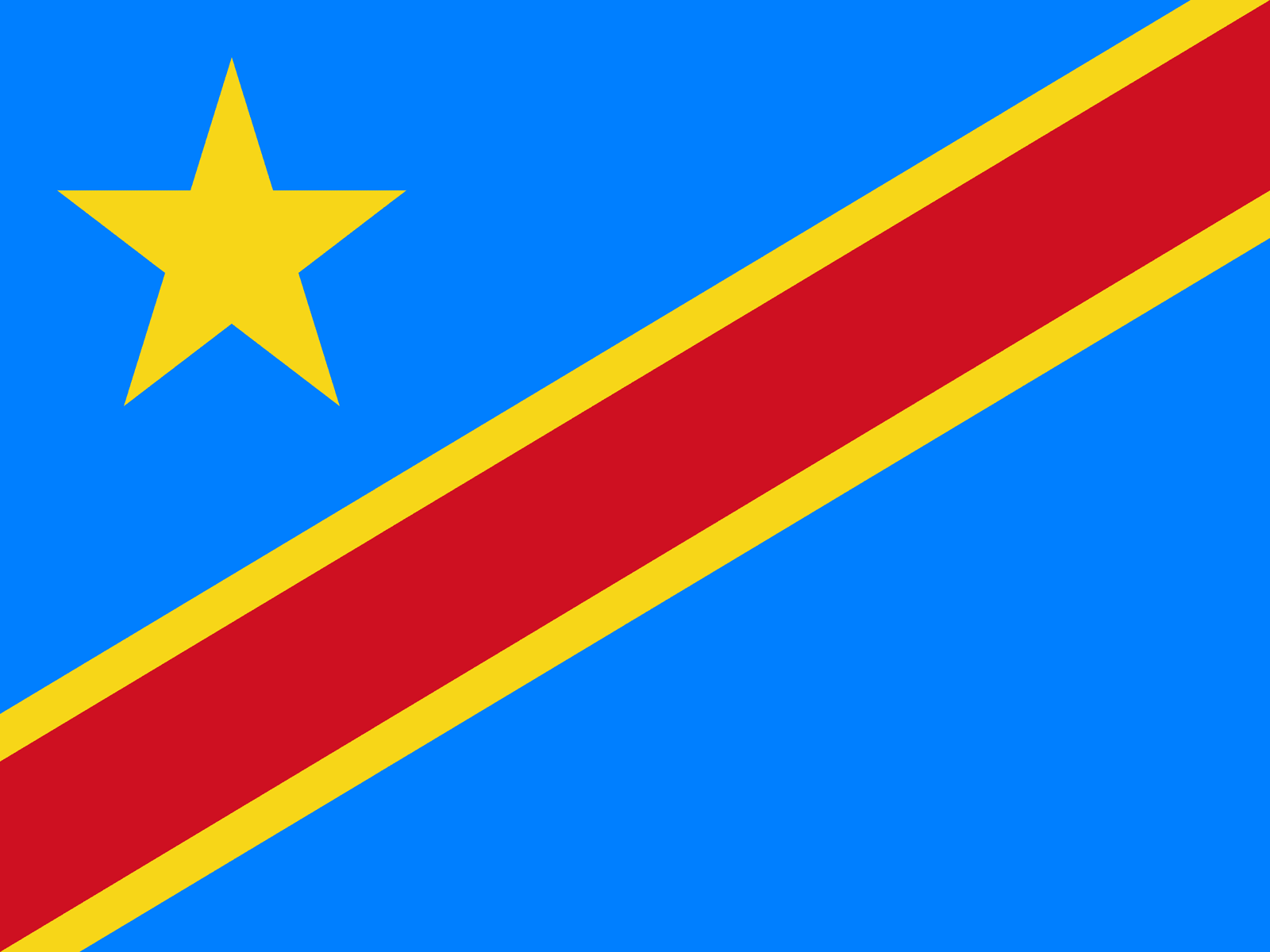
The flag consists of a sky-blue field, symbolizing peace and hope, with a yellow five-pointed star representing unity and a red diagonal stripe edged in yellow symbolizing the country’s struggle for independence and the wealth of its land. Adopted in 2006, the flag reflects both national unity and historical resilience.
The flag is used in government buildings, schools, and public ceremonies. Protocol mandates raising the flag on independence day, national holidays, and international events.
Flag flying days
| Date | Flag Position | Occasion or Reason |
|---|---|---|
| June 30 | Full-mast | Independence Day (from Belgium, 1960) |
| January 4 | Full-mast | Day of the Armed Forces |
| National Mourning Days | Half-mast | Officially declared mourning for national tragedies |
| July 1 | Full-mast | National Heroes’ Day |