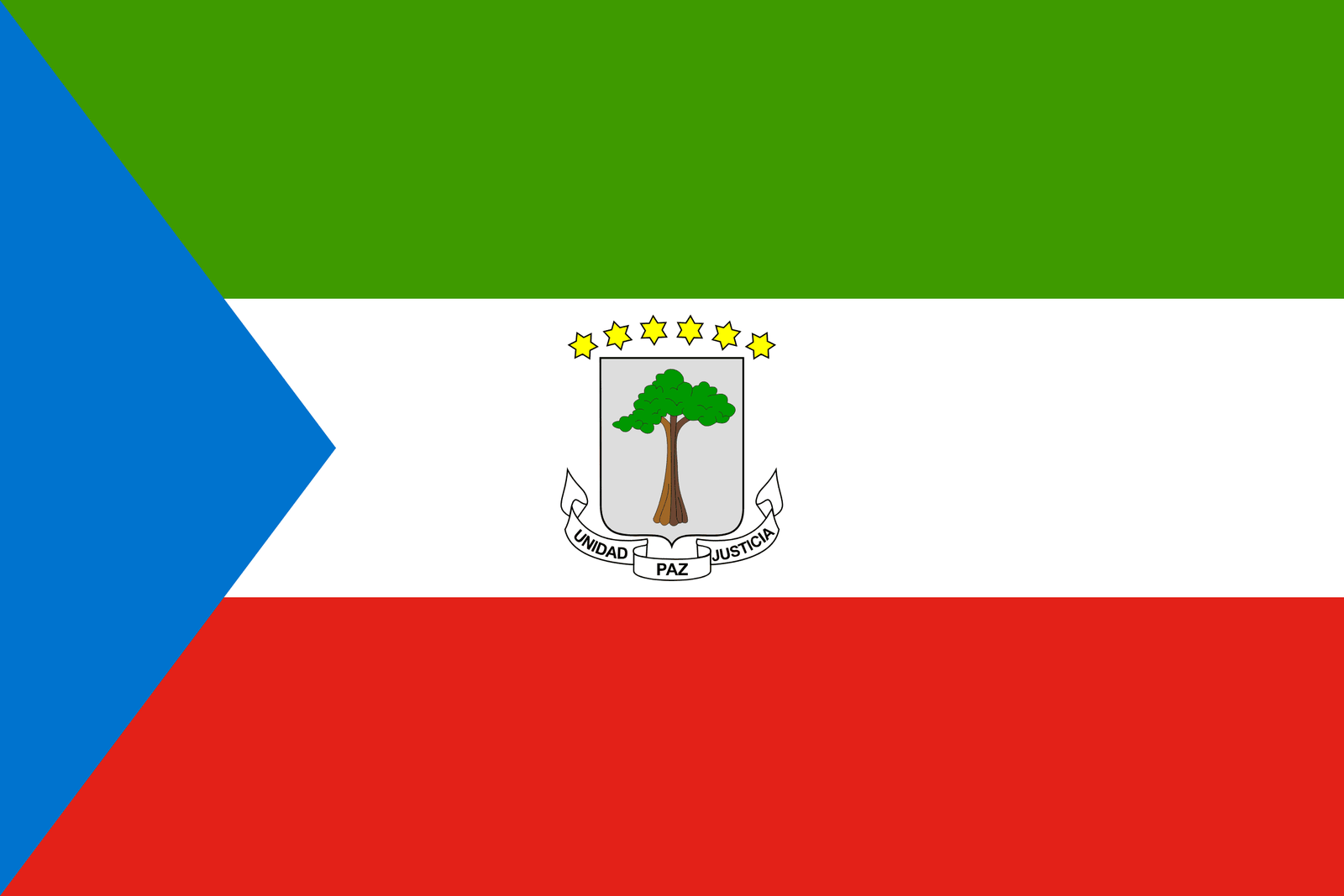
Flag of Equatorial Guinea
| Legal Name | Republic of Equatorial Guinea |
|---|---|
| Flag |
|
| Capital City |
Malabo |
| Total Area | 28,051 |
| Land Area | 26,000 |
| Water Area | 2,051 |
| Population | ~1.6 million |
| Major Cities | Malabo (~187,000), Bata (~250,000), Ebebiyin (~36,000), Luba (~26,000) |
| Currency | Central African CFA franc (XAF) |
| GDP | ~USD 13 billion |
| GDP Per Capita | ~USD 15,600 (PPP) |
About of Equatorial Guinea
Equatorial Guinea is a Central African country situated on the west coast of Africa, with mainland territory (Río Muni) and several islands, including Bioko, where the capital Malabo is located. It borders Cameroon to the north, Gabon to the south and east, and has a western coastline along the Gulf of Guinea. The nation is strategically positioned near major maritime shipping routes, with access to the Atlantic Ocean.
Malabo, on Bioko Island, serves as the political and administrative center, while Bata, on the mainland, functions as the largest commercial and industrial hub. Despite its small population, the country has significant international recognition, primarily due to its oil reserves and strategic Gulf of Guinea location, which contributes to regional energy security and maritime influence.
Etymology
The name “Equatorial Guinea” reflects its geographic location near the Equator and its historical connection to Spain, which colonized the area. “Guinea” is derived from the Portuguese term for the African coast south of the Sahara. The combination signifies the country’s position along the equatorial line and its colonial heritage.
History
Prehistoric and Ancient Civilizations
Evidence of human settlement in Equatorial Guinea dates back thousands of years, with early Bantu migrations shaping the demographic and linguistic composition of the region.
Classical and Medieval Periods
Indigenous Bantu kingdoms and clans governed local affairs, establishing trade networks along the coast and with neighboring African territories.
Colonial Rule
Portugal and later Spain exerted influence along the coast from the 15th century. Spain formally claimed the territory in 1778, establishing it as Spanish Guinea. The colonial period saw limited European settlement, missionary activity, and small-scale trade.
Independence Movement
Nationalist movements gained momentum in the 20th century, advocating for self-determination. Equatorial Guinea achieved independence from Spain on October 12, 1968, with Francisco Macías Nguema becoming the first president.
Post-Independence and Modern Developments
The early years were marked by dictatorship under Macías Nguema, followed by a coup in 1979 led by Teodoro Obiang Nguema Mbasogo, who remains president. Discovery of oil in the 1990s transformed the economy, although wealth distribution remains uneven. Political reforms have been limited, and human rights issues continue to affect international relations.
Government and Politics
Equatorial Guinea is a presidential republic with a highly centralized executive branch. The president serves as both head of state and government. The constitution, adopted in 1991 and amended several times, establishes a unicameral legislature (Chamber of Deputies) and a judiciary under the Constitutional Court. The country is divided into eight provinces, each overseen by appointed governors.
Equatorial Guinea maintains diplomatic relations globally and is a member of the African Union, United Nations, and Central African Economic and Monetary Community (CEMAC). Defense forces are modest in size but play a central role in maintaining internal security.
Economy
Equatorial Guinea is classified as an upper-middle-income developing nation. Its economy is dominated by oil and natural gas production, which accounts for the majority of exports and government revenue. Agriculture and forestry remain significant for domestic consumption, producing cocoa, coffee, cassava, and yams. Manufacturing is minimal, primarily focused on food processing and construction materials.
Key trade partners include Spain, China, the United States, and other African nations. Economic challenges include high dependency on oil, limited diversification, and unequal wealth distribution. The government aims to expand infrastructure, agriculture, and services to reduce oil dependency.
Demographics
The population is ethnically diverse, comprising Fang (~85% of mainland), Bubi (Bioko Island), Ndowe, and other smaller groups. Spanish is the official language, alongside French and Portuguese for international relations, while local languages such as Fang and Bubi are widely spoken.
Christianity, particularly Roman Catholicism, dominates religious life, with small Protestant and indigenous faith communities. Approximately 75% of the population lives in urban areas, with Malabo and Bata being primary centers.
Culture and Society
Equatorial Guinea’s culture is a blend of indigenous Bantu traditions and Spanish colonial influence. Social life emphasizes family, community cohesion, and respect for elders. Traditional music, dance, and crafts are integral to ceremonies and festivals. Cuisine reflects local agriculture, seafood, and Spanish culinary heritage.
National celebrations include Independence Day (October 12) and various religious festivals. Football and basketball are popular sports, while cultural expressions such as storytelling, traditional ceremonies, and music maintain the nation’s rich heritage.
Education and Healthcare
Education is free and compulsory at the primary level. Literacy rates are moderate, and tertiary institutions are concentrated in urban centers. Healthcare is provided through public hospitals and clinics, though accessibility is limited in rural areas. Public health efforts focus on malaria, HIV/AIDS, maternal and child health, and sanitation.
Geography and Climate
Equatorial Guinea comprises mainland and island territories, featuring coastal plains, volcanic highlands, dense forests, and river systems such as the Benito River. Bioko Island contains the volcanic Pico Basile, while the mainland features tropical rainforests.
The climate is equatorial, with high humidity, consistent temperatures, and significant rainfall. Seasons are divided into wet and dry periods, with the heaviest rains between March and October. Natural hazards include flooding, volcanic activity on Bioko, and occasional tropical storms. Environmental concerns include deforestation, wildlife habitat loss, and coastal erosion.
Flora and Fauna
Equatorial Guinea hosts diverse ecosystems, including lowland rainforests, mangroves, and coral reefs. Native flora includes mahogany, iroko, ebony, and various endemic orchids. Fauna includes primates (chimpanzees, gorillas), forest antelopes, bats, and a rich bird population. Conservation efforts focus on Monte Alén National Park and Altos de Nsork National Park, protecting biodiversity and endangered species.
Map of Equatorial Guinea
The national flag features horizontal green, white, and red stripes with a blue triangle at the hoist, symbolizing the nation’s geographic, historical, and cultural identity. The coat of arms displays a silk-cotton tree with six stars representing the country’s provinces. The national anthem, Caminemos con Fé, emphasizes unity and progress. Key national symbols reinforce sovereignty, natural wealth, and historical resilience.
National Flag (Detailed Section)
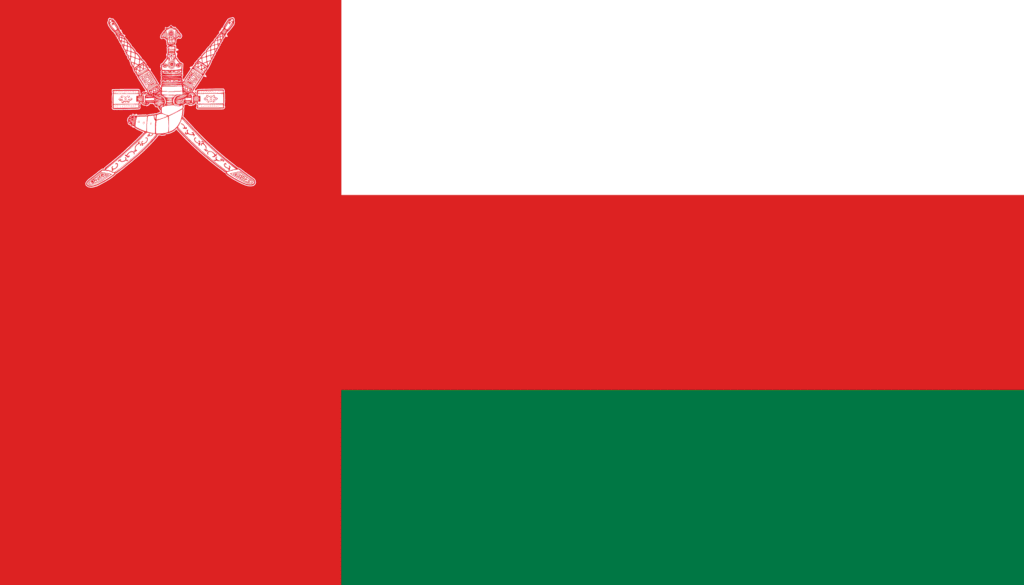
The flag’s green represents the natural resources and jungles, white symbolizes peace, red signifies independence struggles, and blue reflects the sea and islands. Adopted in 1968, shortly after independence, it incorporates the coat of arms for official use. Protocol requires display on government buildings, public holidays, and national ceremonies, with half-mast reserved for mourning or commemorative events.
Realted Flags
Flag flying days
| Date | Flag Position | Occasion or Reason |
|---|---|---|
| October 12 | Full-mast | Independence Day |
| March 23 | Full-mast | National Day of Heroes |
| National Mourning Days | Half-mast | Deaths of significant leaders or national tragedies |
| August 3 | Full-mast | Constitution Day |