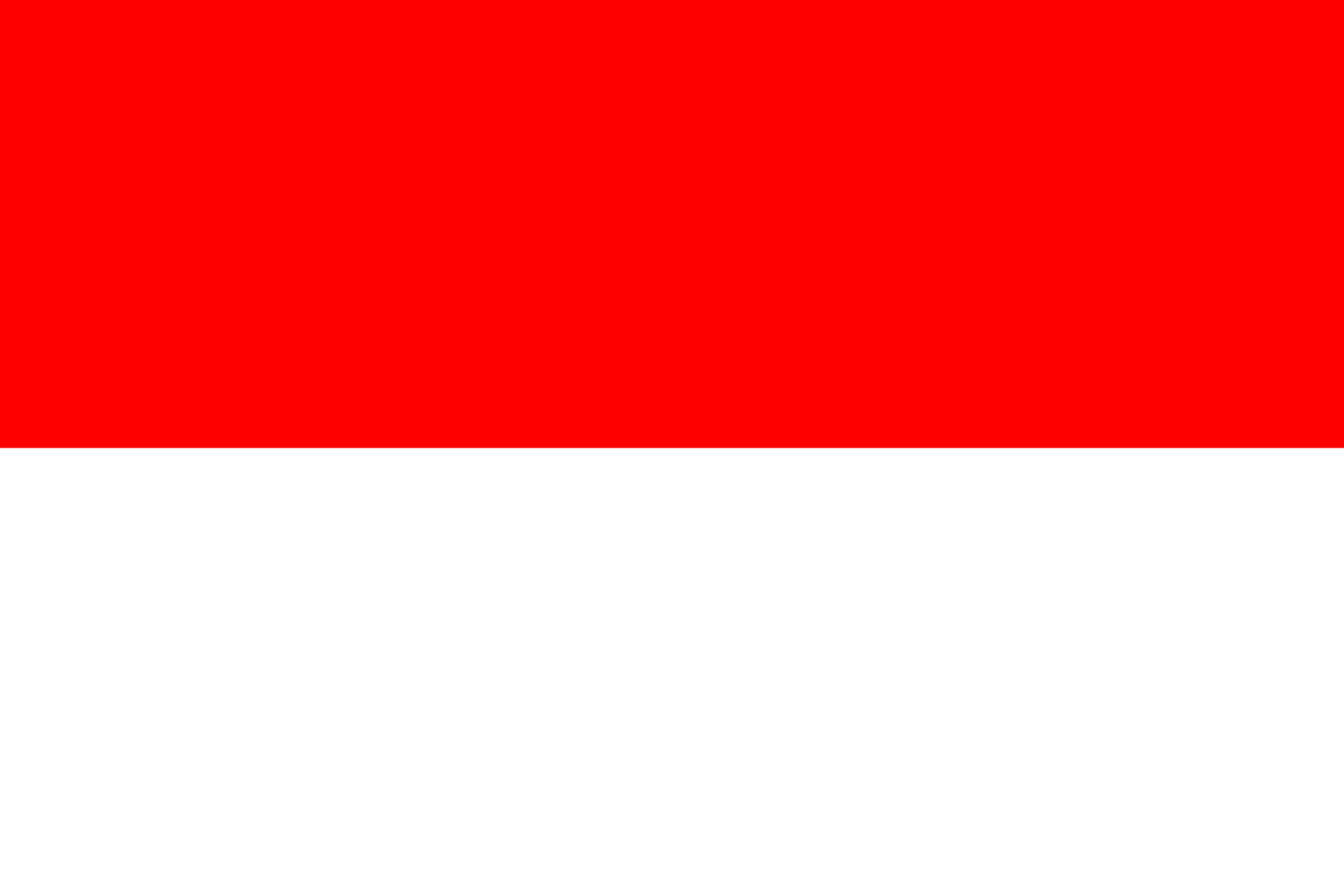
Flag of Indonesia
| Legal Name | Republic of Indonesia (Republik Indonesia) |
|---|---|
| Flag |
|
| Capital City |
Jakarta |
| Total Area | Approximately 1,904,569 km² |
| Land Area | Approximately 1,811,570 km² |
| Water Area | Approximately 92,999 km² |
| Population | Approximately 276 million |
| Major Cities | Jakarta (10.5 million), Surabaya (3.1 million), Bandung (2.5 million), Medan (2.2 million), Bekasi (2 million) |
| Currency | Indonesian Rupiah (IDR) |
| GDP | Approximately USD 1.3 trillion |
| GDP Per Capita | Approximately USD 4,700 (Nominal) |
About of Indonesia
Indonesia is a Southeast Asian archipelago, the world’s largest island nation, spanning over 17,000 islands between the Indian and Pacific Oceans. Strategically positioned along key maritime routes, it serves as a bridge between Asia and Oceania. The nation’s geography encompasses volcanic mountains, dense rainforests, extensive coastlines, and rich marine ecosystems.
Indonesia shares land borders with Papua New Guinea, East Timor, and Malaysia, and maritime boundaries with Singapore, the Philippines, Australia, and India. Jakarta, located on Java Island, is both the capital and the largest urban center, forming the core of the nation’s economic, political, and cultural life.
With a population exceeding 275 million, Indonesia is the fourth most populous country in the world. It is internationally recognized as a founding member of ASEAN, a G20 member, and a significant regional player in economic, political, and environmental affairs. Its strategic maritime location and abundant natural resources make it geopolitically significant in the Indo-Pacific region.
Etymology
The name “Indonesia” derives from the Greek words Indos (India) and nesos (islands), collectively meaning “Indian islands.” The term gained usage during the 19th century among European scholars to describe the archipelago. Over time, it evolved into the official national designation, emphasizing unity across its diverse islands and ethnic groups.
History
Prehistoric and Ancient Civilizations
Human habitation in Indonesia dates back over 1.5 million years, evidenced by Homo erectus fossils in Java. Early societies practiced hunting, gathering, and farming, forming small communities along fertile river valleys and coasts.
Classical and Medieval Periods
From the 1st century CE, Indianized kingdoms influenced culture, religion, and trade. Notable kingdoms included Srivijaya (7th–13th centuries) and Majapahit (13th–16th centuries), which facilitated regional commerce and spread Hinduism and Buddhism. Islam arrived around the 13th century, gradually becoming the dominant religion.
Colonial and Imperial Rule
Portuguese traders arrived in the early 16th century, followed by the Dutch, who established the Dutch East India Company and later formal colonial administration. Dutch rule centralized the economy around spice trade and introduced plantation agriculture. Indigenous resistance persisted through local uprisings.
Independence Movement
Nationalist movements emerged in the early 20th century. Following Japanese occupation during World War II, Indonesia declared independence on August 17, 1945, led by Sukarno and Mohammad Hatta. A four-year diplomatic and armed struggle against Dutch attempts to reassert control culminated in recognition of independence in 1949.
Post-Independence and Modern Developments
The early republic faced political instability, leading to Sukarno’s “Guided Democracy” and subsequent Suharto’s New Order regime. Democratic reforms in 1998 followed Suharto’s resignation, establishing a stable parliamentary democracy. Modern Indonesia emphasizes decentralization, economic development, and regional integration.
Government and Politics
Indonesia is a presidential republic with a multiparty system and representative democracy. The Constitution of 1945 provides the legal framework. Executive authority resides with the President, who is both head of state and government. Legislative power is vested in the People’s Consultative Assembly, comprising the Regional Representative Council and the People’s Representative Council. The judiciary is independent, with the Supreme Court at its apex.
Administratively, Indonesia is divided into 38 provinces, each governed by a governor. Indonesia maintains active foreign relations, emphasizing ASEAN collaboration, UN engagement, and strategic partnerships with major global powers. The military, known as Tentara Nasional Indonesia (TNI), oversees defense, disaster response, and peacekeeping operations.
Economy
Indonesia is classified as an emerging market and the largest economy in Southeast Asia. Major sectors include manufacturing, agriculture, mining, and services. Agriculture produces palm oil, rice, coffee, and rubber, while manufacturing encompasses electronics, textiles, and automotive components. Tourism, shipping, and finance are significant contributors.
Indonesia possesses vast natural resources, including petroleum, natural gas, coal, tin, copper, gold, and fertile agricultural land. Key trade partners include China, the United States, Japan, Singapore, and the EU. Economic challenges include inequality, infrastructure development, and environmental sustainability. Future prospects focus on digitalization, renewable energy, and industrial diversification.
Demographics
Indonesia’s population is ethnically and culturally diverse, comprising over 300 ethnic groups. The Javanese represent the largest group, followed by Sundanese, Malay, and others. Bahasa Indonesia is the official language, while hundreds of regional languages are spoken. The majority religion is Islam, with Christianity, Hinduism, and Buddhism also practiced.
Urbanization is rising, with approximately 57% of the population living in cities. Population growth remains moderate, influenced by declining fertility rates and urban migration.
Culture and Society
Indonesian culture is marked by rich traditions, arts, and religions. Music, dance, and crafts vary regionally, reflecting indigenous, Indian, Arab, and European influences. Wayang kulit (shadow puppetry), gamelan orchestras, and batik textiles exemplify cultural expression.
Social norms emphasize community, family, and respect for elders. Festivals such as Idul Fitri, Nyepi, and Waisak are widely observed. Sports like badminton, soccer, and martial arts have national prominence.
Education and Healthcare
Education is compulsory for nine years, with increasing focus on secondary and tertiary education. Prominent universities include the University of Indonesia, Gadjah Mada University, and Bandung Institute of Technology.
Healthcare is delivered through a combination of public and private systems. National health insurance provides access to medical care, though challenges include uneven distribution, infrastructure gaps, and emerging health threats.
Geography and Climate
Indonesia’s physical geography includes volcanic mountains, tropical rainforests, extensive rivers, and thousands of islands. Key islands include Java, Sumatra, Borneo (Kalimantan), Sulawesi, and New Guinea (Papua). The nation has extensive coastlines and marine biodiversity.
Indonesia experiences a tropical climate with wet and dry seasons. The region is prone to natural hazards, including earthquakes, volcanic eruptions, tsunamis, and floods. Environmental concerns focus on deforestation, habitat loss, and marine ecosystem protection.
Flora and Fauna
Indonesia is one of the world’s most biodiverse nations. Rainforests support native species such as orangutans, tigers, Komodo dragons, and numerous bird and plant species. Conservation areas, including national parks like Komodo and Gunung Leuser, safeguard ecosystems and endangered species.
Map of Indonesia
Indonesia’s national flag, known as Sang Saka Merah Putih, the Garuda Pancasila emblem, and the national anthem Indonesia Raya symbolize independence, unity, and national identity. Monuments like Borobudur, Prambanan, and the National Monument in Jakarta are national icons.
National Flag (Detailed Section)
The flag has two horizontal bands: red on top, symbolizing courage, and white below, representing purity. It has origins in the Majapahit Empire banner and was adopted as the national flag upon independence in 1945. The flag is flown on official buildings, public holidays, and national events according to strict protocols.
Realted Flags
| Date | Flag Position | Occasion or Reason |
|---|
| August 17 | Full-mast | Independence Day |
| November 10 | Full-mast | Heroes’ Day commemoration |
| National mourning days | Half-mast | Death of national leaders or official mourning |
| Other national holidays | Full-mast | Public celebrations and government events |