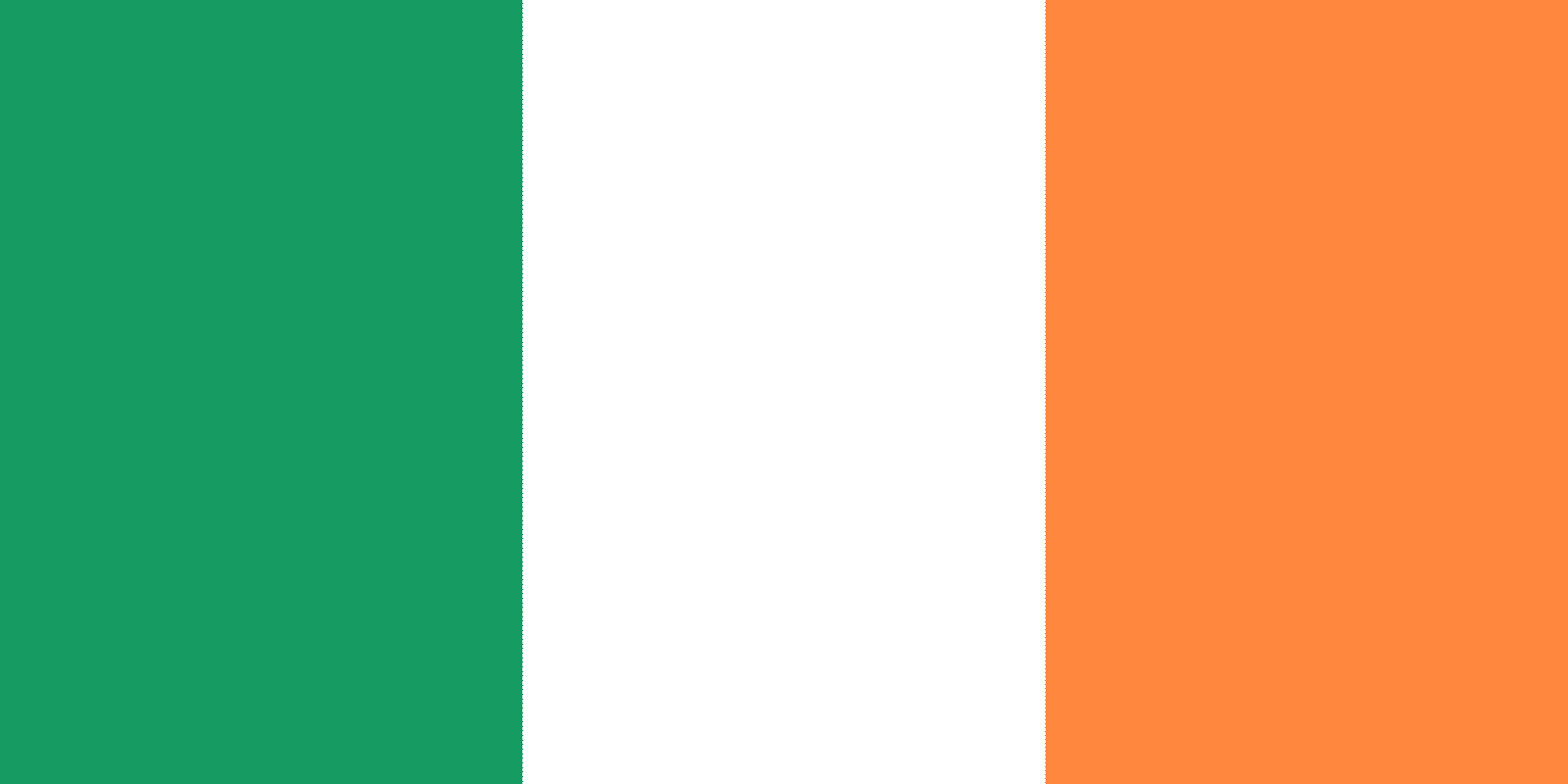
Flag of Ireland
| Legal Name | Ireland (Éire) |
|---|---|
| Flag |
|
| Capital City |
Dublin |
| Total Area | Approximately 70,273 km² |
| Land Area | Approximately 68,890 km² |
| Water Area | Approximately 1,383 km² |
| Population | Approximately 5.2 million |
| Major Cities | Dublin (1.3 million), Cork (210,000), Limerick (105,000), Galway (80,000), Waterford (53,000) |
| Currency | Euro (EUR) |
| GDP | Approximately USD 550 billion |
| GDP Per Capita | Approximately USD 105,000 (adjusted for PPP) |
About of Ireland
Ireland is an island nation located in northwestern Europe, occupying most of the island of Ireland and sharing a border with Northern Ireland, which is part of the United Kingdom. It is surrounded by the Atlantic Ocean to the west, the Celtic Sea to the south, and the Irish Sea to the east, giving it a maritime climate and strategic access to European trade routes.
Dublin, situated on the east coast, serves as the capital and largest city. It functions as Ireland’s cultural, economic, and political hub. Other major urban centers, such as Cork, Limerick, and Galway, contribute significantly to industry, education, and tourism.
With a population of over 5 million, Ireland has a largely urbanized and highly educated society. The nation is internationally recognized as a stable parliamentary democracy and a member of the European Union, the United Nations, and other global organizations. Its geopolitical importance derives from its strategic location, EU membership, and role in global finance and technology sectors.
Etymology
The name “Ireland” derives from the Old Irish term Ériu, a goddess in early Irish mythology, combined with land, signifying the territory of Ériu. The Latinized form, Hibernia, was used during the Roman era. Over centuries, the modern English name “Ireland” emerged, preserving both its historical and mythological roots.
History
Prehistoric and Ancient Civilizations
Human settlement in Ireland dates back to approximately 10,000 BCE, with Mesolithic hunter-gatherers. Neolithic communities built megalithic structures such as Newgrange and monuments across the island. The Celts arrived around 500 BCE, establishing tribal kingdoms and influencing language, art, and religion.
Classical and Medieval Periods
From the 5th century CE, Christian missionaries, notably St. Patrick, brought Christianity to Ireland, creating monasteries that became centers of learning and culture. Ireland remained divided into small kingdoms, with frequent internal conflicts but enduring cultural growth.
Viking and Norman Influence
From the 8th to 11th centuries, Vikings established coastal settlements and trade networks. In 1169, Norman forces invaded, gradually integrating Ireland into feudal Europe, introducing castles, new laws, and urban centers.
British Rule
From the 16th century, Ireland experienced increasing English control, culminating in the formation of the Kingdom of Ireland under English sovereignty. This period involved plantation settlements, religious suppression, and major famines, most notably the Great Famine of 1845–1852, which caused massive population decline through starvation and emigration.
Independence Movement
Irish nationalist movements in the 19th and early 20th centuries sought autonomy from Britain. The 1916 Easter Rising marked a turning point, followed by the War of Independence (1919–1921). The Anglo-Irish Treaty established the Irish Free State in 1922, which became the Republic of Ireland in 1949.
Modern Developments
Post-independence, Ireland experienced economic modernization, joining the European Economic Community (now the EU) in 1973. The nation transitioned from an agrarian society to a technology-driven, high-income economy while maintaining cultural heritage and social reforms.
Government and Politics
Ireland is a parliamentary republic with a representative democracy. The Constitution of 1937 establishes the legal framework. The President serves as ceremonial head of state, while executive authority lies with the Taoiseach (Prime Minister) and the Council of Ministers.
The bicameral legislature consists of Dáil Éireann (House of Representatives) and Seanad Éireann (Senate). The judiciary is independent, with the Supreme Court serving as the highest judicial authority.
Ireland is divided into 26 counties, each with administrative responsibilities. The country maintains active foreign relations, emphasizing EU engagement, global diplomacy, and peaceful conflict resolution. Defense relies on the Irish Defence Forces, primarily focused on neutrality, disaster response, and peacekeeping.
Economy
Ireland is a developed, high-income economy with a strong focus on technology, pharmaceuticals, finance, and international trade. Multinational corporations are heavily invested, leveraging Ireland’s EU membership and favorable business climate.
Agriculture produces beef, dairy, and cereals, while manufacturing emphasizes electronics, medical devices, and software. Tourism is vital, highlighting Ireland’s natural landscapes, historic sites, and cultural festivals.
Trade partners include the EU, the United States, and the United Kingdom. Challenges include housing shortages, regional economic disparities, and vulnerability to global economic shifts. Long-term prospects are bolstered by technology, innovation, and a highly skilled workforce.
Demographics
Ireland’s population is predominantly of Irish ethnic origin, with growing diversity from EU and non-EU immigration. The official languages are Irish (Gaeilge) and English, with English predominating in daily life. The population is mostly Roman Catholic, with growing secular and other religious communities.
Approximately 63% of the population is urban, with Dublin being the largest metropolitan area. Population growth is moderate, supported by immigration and improving birth rates.
Culture and Society
Irish culture is rich in folklore, literature, music, and visual arts. National identity emphasizes language, history, and shared traditions. Renowned writers such as James Joyce, W.B. Yeats, and Seamus Heaney reflect Ireland’s literary heritage.
Traditional music, dance, and festivals, such as St. Patrick’s Day, are central to social life. Cuisine focuses on fresh, local ingredients with dishes like Irish stew and soda bread. Sports such as Gaelic football, hurling, and rugby are widely followed.
Education and Healthcare
Education is free and compulsory between ages 6 and 16, with strong emphasis on secondary and tertiary education. Universities, including Trinity College Dublin and University College Dublin, enjoy global recognition.
Healthcare is delivered through the public Health Service Executive, complemented by private providers. Ireland maintains high life expectancy and quality care, though challenges include increasing demand and resource allocation.
Geography and Climate
Ireland features rolling plains, low mountains, and extensive coastlines with cliffs and bays. Major rivers include the Shannon and the Liffey, and lakes such as Lough Neagh support biodiversity.
The climate is temperate maritime, with mild winters, cool summers, and frequent rainfall. Natural hazards include storms and occasional flooding. Environmental concerns focus on land management, coastal protection, and sustainability.
Flora and Fauna
Ireland hosts diverse ecosystems with native species such as oak, ash, and yew trees. Wildlife includes red deer, foxes, badgers, and numerous bird species. Conservation efforts include national parks like Killarney and protected wetlands supporting biodiversity.
Map of Ireland
Ireland’s national symbols emphasize heritage, independence, and unity. The tricolor flag, harp emblem, and national anthem Amhrán na bhFiann represent sovereignty. National monuments include the Rock of Cashel, Newgrange, and Cliffs of Moher.
National Flag (Detailed Section)
The Irish flag consists of three vertical bands: green, white, and orange. Green represents the Gaelic tradition, orange symbolizes the Protestant community, and white signifies peace and unity between the two. Adopted in the 19th century, it became the official flag in 1937.
The flag is flown on public buildings and during national holidays following formal protocols.
Realted Flags
Flag flying days
| Date | Flag Position | Occasion or Reason |
|---|
| March 17 | Full-mast | St. Patrick’s Day |
| April 24 | Full-mast | National Day of Remembrance for the Easter Rising |
| June 21 | Full-mast | National Heritage Day / Summer Solstice commemorations |
| Days of national mourning | Half-mast | Official periods of mourning |