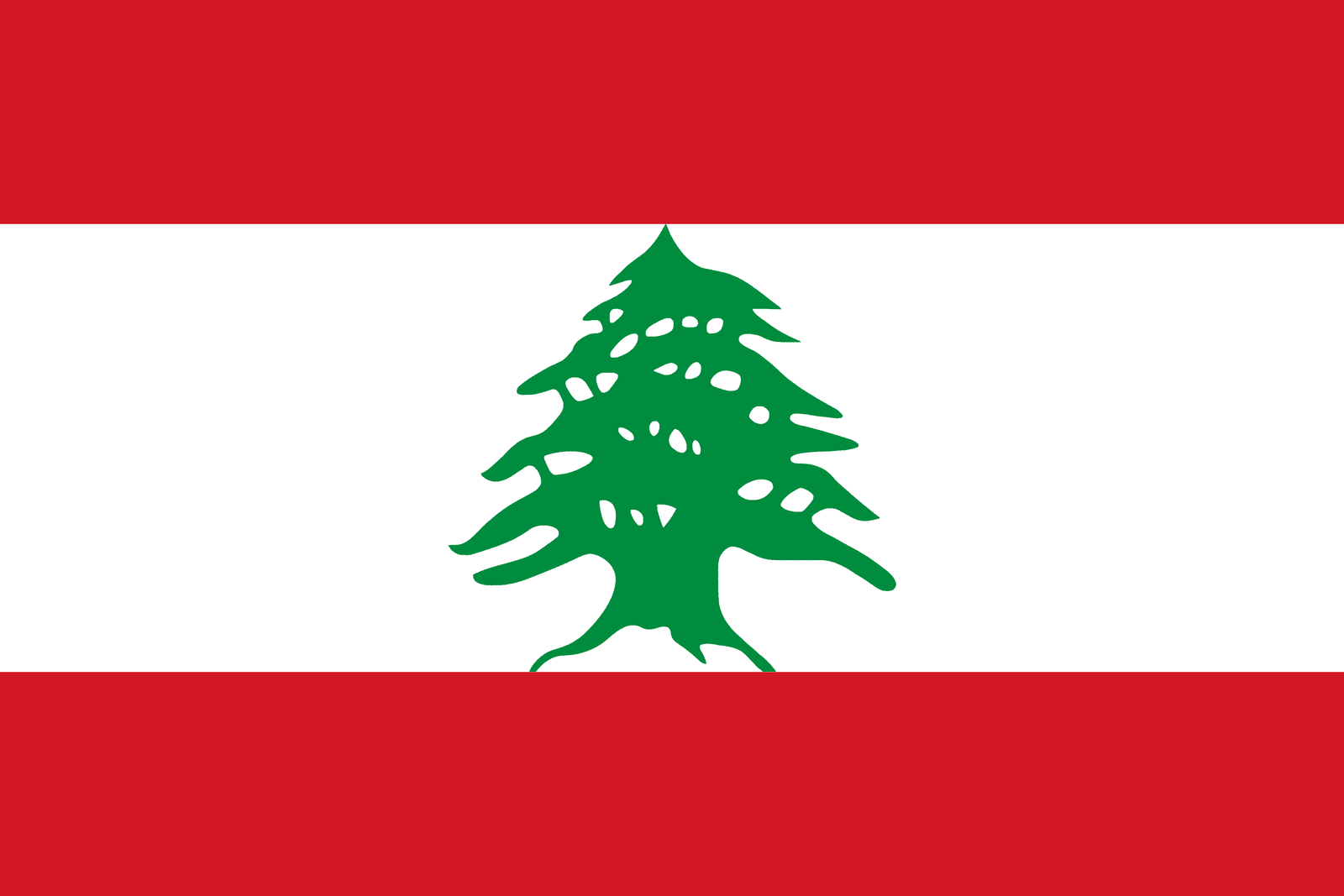
Flag of Lebanon
| Legal Name | Lebanese Republic |
|---|---|
| Flag |
|
| Capital City |
Beirut |
| Total Area | 10,452 km² |
| Land Area | 10,230 km² |
| Water Area | Approximately 222 km² |
| Population | Approximately 5.5–5.7 million |
| Major Cities | Beirut (2.4 million metro), Tripoli (800,000 metro), Sidon (300,000), Tyre (200,000), Zahle (150,000) |
| Currency | Lebanese Pound (LBP) |
| GDP | Approximately USD 18–20 billion |
| GDP Per Capita | Approximately USD 3,000–3,500 (Nominal) |
About of Lebanon
Lebanon is a small but historically significant country located on the eastern coast of the Mediterranean Sea in Western Asia. It forms part of the Levant region and has long served as a cultural and commercial crossroads between the Mediterranean world and the Middle East. Despite its limited size, Lebanon possesses remarkable geographic, cultural, and religious diversity.
The country shares land borders with Syria to the north and east and Israel to the south, while its western boundary opens onto the Mediterranean Sea. Beirut, the capital and largest city, functions as Lebanon’s political, economic, and cultural center. Other major urban centers include Tripoli in the north, Sidon and Tyre in the south, and Zahle in the fertile Bekaa Valley.
Lebanon’s population is highly diverse, characterized by a complex mix of religious communities, ethnic backgrounds, and cultural traditions. The country is internationally recognized as a sovereign republic and is a founding member of the United Nations and the Arab League. Its strategic location along key regional fault lines has made it geopolitically important, often placing it at the center of broader Middle Eastern dynamics.
Etymology
The name “Lebanon” derives from the ancient Semitic root lbn, meaning “white,” a reference to the snow-capped peaks of the Mount Lebanon range. The name appears in some of the earliest known written records, including ancient Mesopotamian and Egyptian texts. Over thousands of years, the name remained largely unchanged, reflecting the enduring geographic identity of the region.
History
Prehistoric and Ancient Periods
Lebanon has been inhabited since prehistoric times. By the third millennium BCE, it was home to the Phoenicians, a maritime civilization renowned for trade, shipbuilding, and the development of one of the earliest alphabets.
Classical Antiquity
Phoenician city-states such as Byblos, Sidon, and Tyre flourished and later came under Assyrian, Babylonian, Persian, Greek, and Roman rule. Under Rome, the region prospered, leaving behind monumental architecture, including the temples of Baalbek.
Medieval Period
Following the spread of Christianity and later Islam, Lebanon passed through Byzantine and Arab rule. The region later came under Crusader control before being incorporated into the Mamluk Sultanate and subsequently the Ottoman Empire.
Ottoman and Colonial Era
Lebanon remained part of the Ottoman Empire from the 16th century until World War I. After the war, it became a French Mandate under the League of Nations, shaping modern administrative and political institutions.
Independence and Post-Independence
Lebanon gained independence in 1943. Its early decades were marked by relative prosperity, but political tensions culminated in a prolonged civil war from 1975 to 1990.
Modern Developments
Following the civil war, Lebanon underwent reconstruction but continued to face political instability, regional conflicts, and economic challenges. In recent years, the country has experienced severe financial crises, political deadlock, and social pressures, while ongoing efforts seek reform and recovery.
Government and Politics
Lebanon is a parliamentary republic with a unique confessional political system that allocates political power among religious communities. The President, Prime Minister, and Speaker of Parliament are drawn from different religious groups under constitutional convention.
The Constitution, adopted in 1926 and amended multiple times, establishes a separation of powers among the executive, legislative, and judicial branches. The Parliament is unicameral, while the judiciary operates independently through civil and religious courts.
Administratively, Lebanon is divided into governorates and districts. The country maintains diplomatic relations worldwide and is a member of the United Nations, Arab League, and various international organizations. The Lebanese Armed Forces serve as the national defense institution, focusing on territorial defense and internal security.
Economy
Lebanon traditionally functioned as a service-oriented economy, with banking, tourism, education, and trade playing major roles. It is generally classified as a developing economy with a historically strong private sector.
Agriculture contributes modestly, with olives, citrus fruits, grapes, and tobacco among key products. Manufacturing includes food processing, pharmaceuticals, and light industry. Natural resources are limited, though offshore energy exploration has gained attention.
The economy has faced severe challenges, including currency devaluation, public debt, banking sector collapse, and high unemployment. Long-term recovery depends on structural reforms, political stability, and renewed investor confidence.
Demographics
Lebanon’s population is characterized by religious and cultural diversity, including Muslim and Christian communities of various denominations. Arabic is the official language, while French and English are widely used in education and business.
The population is highly urbanized, with most residents living in cities and coastal areas. Population growth is modest, influenced by emigration and regional displacement dynamics.
Culture and Society
Lebanese culture reflects centuries of interaction between East and West. Strong family ties, hospitality, and community life are central social values. The country is known for its vibrant arts scene, music, literature, and cinema.
Cuisine is internationally celebrated, featuring dishes such as hummus, tabbouleh, kibbeh, and mezze. Festivals, religious holidays, and cultural events play an important role in public life. Football and basketball are popular sports, alongside traditional recreational activities.
Education and Healthcare
Lebanon has a long tradition of education and hosts some of the region’s most respected universities. Literacy rates are relatively high, and multilingual education is common.
The healthcare system includes both public and private providers. While medical expertise is strong, access and affordability have become challenges due to economic constraints. Public health efforts continue to address chronic disease management and healthcare system sustainability.
Geography and Climate
Lebanon’s geography is diverse, featuring a narrow coastal plain, the Mount Lebanon range, the Bekaa Valley, and the Anti-Lebanon Mountains. Rivers are generally short but vital for agriculture.
The climate is Mediterranean, with hot, dry summers and mild, wet winters along the coast, while mountainous areas experience colder temperatures and snowfall. Natural hazards include earthquakes, landslides, and seasonal flooding. Environmental concerns include deforestation, water management, and pollution.
Flora and Fauna
Lebanon hosts rich biodiversity relative to its size. Forests once dominated by cedar trees are now protected and symbolically important. Native flora includes pine, oak, and juniper species.
Wildlife includes birds, small mammals, and reptiles adapted to mountainous and coastal environments. Nature reserves and conservation initiatives aim to preserve remaining ecosystems and promote sustainable land use.
Map of Lebanon
Lebanon’s national symbols emphasize resilience, heritage, and unity. The cedar tree stands as the most enduring symbol, representing strength and continuity across millennia.
National Flag (Detailed Section)
The Lebanese flag consists of two red horizontal bands enclosing a wider white band, with a green cedar tree centered. The red symbolizes sacrifice and struggle, the white represents peace and snow, and the cedar signifies eternity and resilience. Officially adopted in 1943, the flag is flown on public buildings, during national holidays, and at international events in accordance with national protocol.
Flag flying days
| Date | Flag Position | Occasion or Reason |
|---|---|---|
| November 22 | Full-mast | Independence Day |
| May 1 | Full-mast | Labor Day |
| National holidays | Full-mast | Official celebrations |
| National mourning periods | Half-mast | Declared days of mourning |