Flag of Libya
| Legal Name | State of Libya |
|---|---|
| Flag |
|
| Capital City |
Tripoli |
| Total Area | 1,759,541 km² |
| Land Area | 1,759,541 km² |
| Water Area | Negligible inland water |
| Population | Approximately 7 million |
| Major Cities | Tripoli (1,165,000), Benghazi (700,000), Misrata (450,000), Bayda (210,000), Zawiya (200,000) |
| Currency | Libyan Dinar (LYD) |
| GDP | Approximately USD 50 billion |
| GDP Per Capita | Approximately USD 7,100 |
About of Libya
Libya is a vast country in North Africa, occupying a strategic position along the southern Mediterranean coast. It is geographically divided into three historical regions: Tripolitania in the northwest, Cyrenaica in the east, and Fezzan in the southwest. The country is largely desert, dominated by the Sahara, with a narrow Mediterranean coastal strip that supports most of its population and economic activity.
Libya shares borders with Egypt to the east, Sudan to the southeast, Chad and Niger to the south, and Algeria and Tunisia to the west. Its 1,770 km Mediterranean coastline facilitates trade and maritime access. Tripoli, the capital and largest city, is a political, economic, and cultural hub, while Benghazi serves as a major commercial and industrial center.
Libya is internationally recognized as a sovereign state with membership in the United Nations and the African Union. Its location at the crossroads of Africa and the Mediterranean, combined with its vast oil reserves, gives it significant geopolitical and economic importance. However, internal conflict, political instability, and security challenges have affected its global integration and development.
Etymology
The name “Libya” derives from the ancient Greek Libúē, used to describe the region west of the Nile. Historically, it referred broadly to North Africa outside Egypt. During the colonial and modern periods, the name was retained to designate the unified territory of the three historic regions under Italian rule and subsequent independence. The etymology emphasizes its continuity as a recognized regional identity over millennia.
History
Prehistoric and Ancient Civilizations
Libya has been inhabited for tens of thousands of years, with evidence of prehistoric rock art in the Fezzan region and early Neolithic settlements. Indigenous Berber tribes established the earliest cultural foundations.
Classical and Medieval Periods
The Phoenicians and Greeks established trading posts along the coast, notably in Cyrenaica. Carthage and later Rome incorporated parts of the region into their empires, with Roman cities such as Leptis Magna and Sabratha flourishing. During the early Islamic period, Arab conquests introduced Islam and Arabic culture, shaping Libya’s religious and linguistic identity.
Major Empires and Dynasties
Libya became part of the Ottoman Empire in the 16th century, administered through provincial structures. Ottoman rule lasted until the early 20th century, with local autonomy exercised by tribal and regional authorities.
Colonial Rule
Italy invaded and annexed Libya in 1911, establishing colonies in Tripolitania, Cyrenaica, and Fezzan. Italian administration introduced infrastructure and modern urbanization but faced persistent resistance, particularly from Cyrenaica.
Independence Movement
Libya gained independence on December 24, 1951, as the United Kingdom of Libya under King Idris I, the first independent postcolonial African state to achieve sovereignty through negotiation rather than revolution.
Key Post-Independence Events
In 1969, a military coup led by Muammar Gaddafi overthrew the monarchy, establishing the Libyan Arab Republic. Gaddafi’s rule introduced socialism, pan-Arabism, and authoritarian governance, accompanied by oil nationalization. The 2011 uprising led to the toppling of Gaddafi, resulting in political fragmentation, civil conflict, and ongoing instability.
Modern Political Developments
Post-2011 Libya has experienced rival administrations, intermittent conflict, and challenges in unifying national institutions. International efforts continue to support stabilization, elections, and reconstruction, though security and governance remain precarious.
Government and Politics
Libya is officially a unitary state with a transitional government following the 2011 revolution. Its constitution and legal framework are evolving, with interim arrangements attempting to balance power between competing factions.
The executive branch is led by a Prime Minister heading the Government of National Unity, while the House of Representatives serves as the legislative body. The judiciary is independent but constrained by political instability. The country is divided into districts (shabiyat) for local governance.
Libya maintains foreign relations primarily through the United Nations, African Union, Arab League, and Mediterranean partnerships. Defense relies on fragmented military groups aligned with regional authorities, with no unified national army post-2011.
Economy
Libya is classified as an upper-middle-income country with an economy heavily dependent on oil and gas, which account for over 95% of exports and 60% of GDP. Other sectors include construction, agriculture (limited due to arid conditions), and services.
Key challenges include infrastructure degradation, political instability, and reliance on hydrocarbon revenues. Trade partners include European Union nations, China, and regional neighbors. Economic recovery depends on political stabilization, diversification, and international investment.
Demographics
The population is approximately 7 million, primarily Arab-Berber, with small Tuareg, Tebu, and sub-Saharan African communities. Arabic is the official language, while Islam (primarily Sunni) dominates religious affiliation. About 80% of the population lives in urban centers along the coast, with rural desert regions sparsely inhabited. Population growth is moderate but affected by migration and displacement from conflict.
Culture and Society
Libyan culture is rooted in Arab, Berber, and Mediterranean traditions. National identity emphasizes Islam, tribal affiliations, and shared history. Traditional music, poetry, and crafts are preserved in urban and rural communities. Cuisine features couscous, lamb, dates, and olive oil-based dishes.
Public holidays include Islamic festivals (Eid al-Fitr, Eid al-Adha) and Revolution Day on February 17. Football and camel racing are popular sports. Social norms reflect conservative Islamic values, family centrality, and regional customs.
Education and Healthcare
Education is compulsory through secondary school, with Arabic as the medium of instruction. Literacy rates are relatively high, though higher education access is concentrated in Tripoli and Benghazi.
Healthcare infrastructure has suffered due to conflict, though major hospitals provide essential services. Public health challenges include communicable diseases, maternal health, and access in rural areas. International aid supports healthcare rebuilding.
Geography and Climate
Libya’s terrain is mostly desert, dominated by the Sahara, with mountain ranges in the Nafusa Mountains and coastal plains along the Mediterranean. Rivers are seasonal and mostly ephemeral, with groundwater and oases supporting settlements.
The climate is predominantly arid and semi-arid, with hot summers, mild winters along the coast, and rare precipitation inland. Natural hazards include sandstorms, droughts, and flash floods. Environmental concerns include desertification, water scarcity, and pollution from oil extraction.
Flora and Fauna
Vegetation is sparse, dominated by desert-adapted shrubs and grasses. Wildlife includes desert foxes, gazelles, snakes, and migratory birds. Libya has protected areas and national parks aimed at preserving fragile desert ecosystems.
Map of Libya
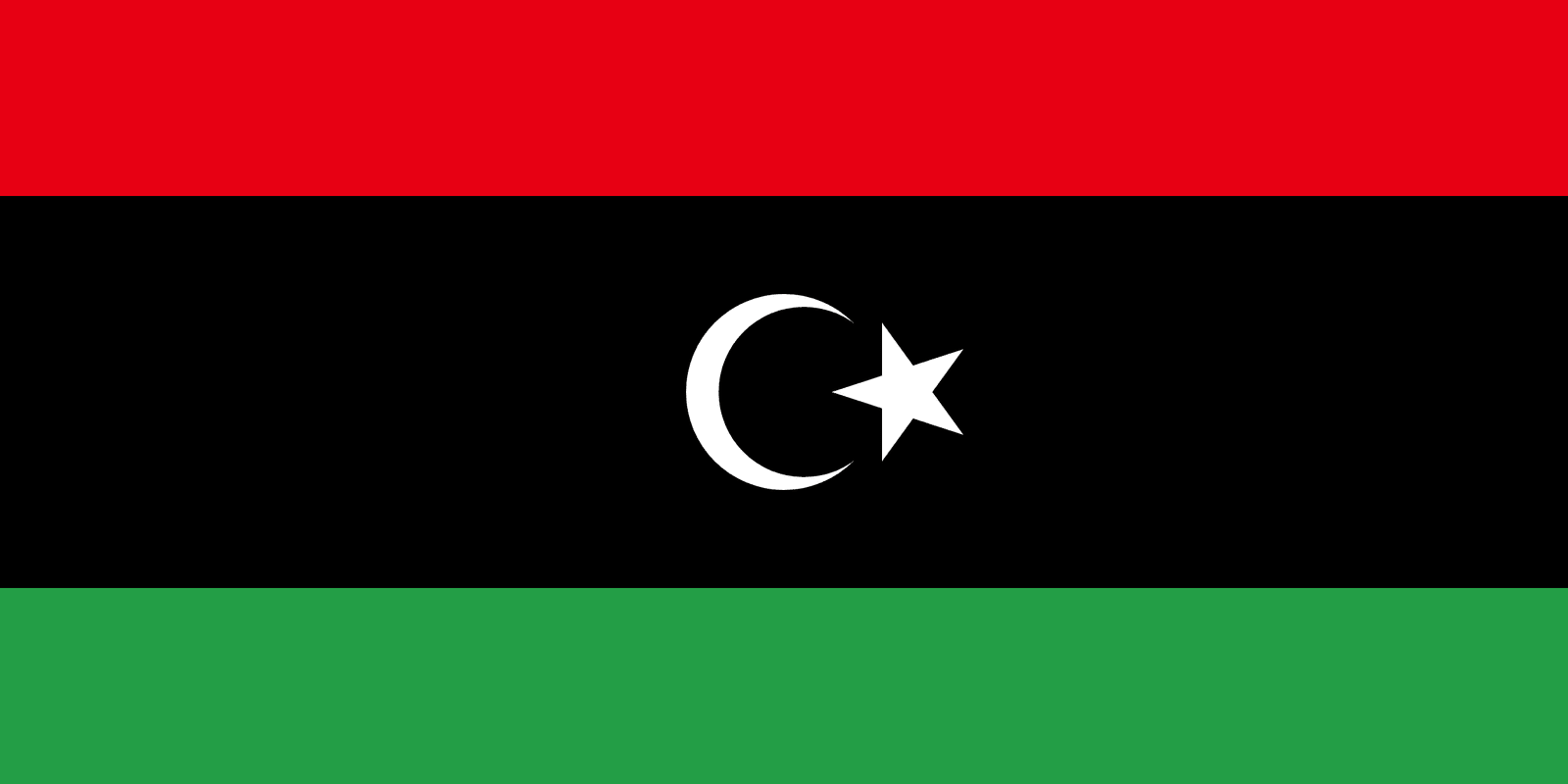
Flag: Red, black, and green horizontal stripes with a white crescent and star, symbolizing the blood of martyrs, the dark period under colonial rule, and the country’s fertile future.
Coat of Arms: Features a crescent, star, and traditional emblem reflecting national sovereignty.
National Anthem: Libya, Libya, Libya, emphasizing independence and national unity.
National Animals/Plants: Arabian oryx and date palm as cultural and ecological symbols.
National Flag (Detailed Section)
The Libyan flag consists of red, black, and green horizontal stripes with a central white crescent and five-pointed star in the black band. The black represents the liberation struggles, red the blood of martyrs, and green symbolizes prosperity and Islam. The crescent and star signify Islamic heritage. It was adopted after independence and restored following the 2011 revolution. Protocol dictates full-mast for national celebrations and half-mast for mourning.
Realted Flags
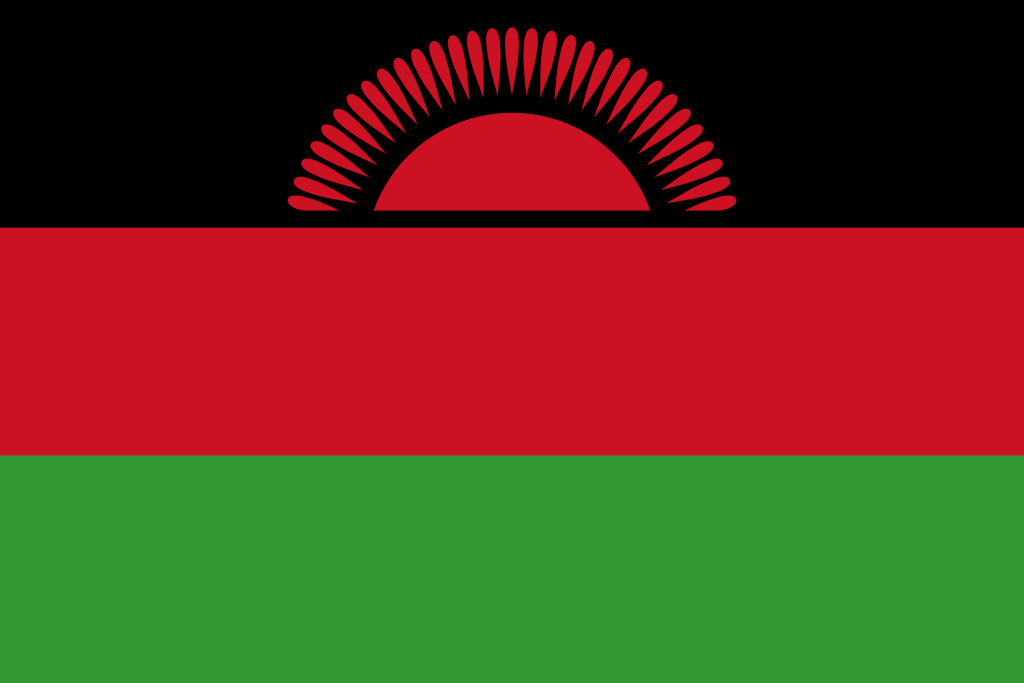
Flag flying days
| Date | Flag Position | Occasion or Reason |
|---|---|---|
| December 24 | Full-mast | Independence Day |
| February 17 | Full-mast | Revolution Day |
| National mourning | Half-mast | Death of leaders or national tragedies |