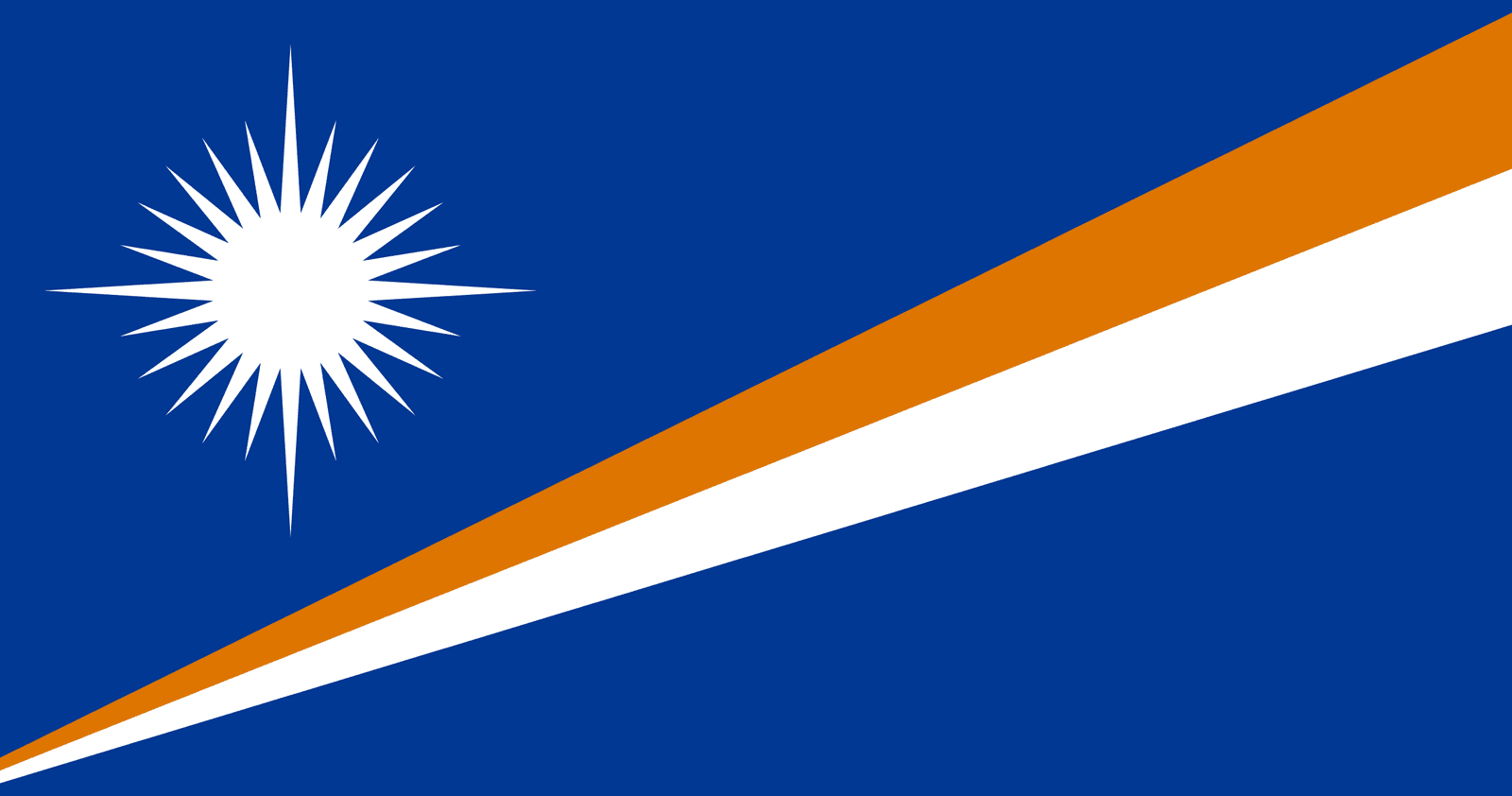
Flag of Marshall Islands
| Legal Name | Republic of the Marshall Islands |
|---|---|
| Flag |
|
| Capital City |
Majuro |
| Total Area | 181 km² |
| Land Area | 181 km² |
| Water Area | Negligible inland water |
| Population | Approximately 59,000 |
| Major Cities | Majuro (27,000), Ebeye (15,000), Jaluit (5,000), Wotje (2,500) |
| Currency | United States Dollar (USD) |
| GDP | Approximately USD 220 million |
| GDP Per Capita | Approximately USD 3,800 |
About of Marshall Islands
The Marshall Islands is an island nation located in the central Pacific Ocean, forming part of the Micronesia region. It consists of 29 atolls and 5 single islands, scattered across an ocean area of over 2 million km². Despite its small land area, it has a vast Exclusive Economic Zone rich in marine resources.
The country has no land borders and is surrounded by the Pacific Ocean. Its capital, Majuro, is both the political and economic center, hosting government offices, commercial enterprises, and the main international airport. Ebeye, on Kwajalein Atoll, is the second-largest settlement and a hub of dense population and local trade.
The Marshall Islands is recognized internationally as a sovereign state and maintains diplomatic relations with over 100 countries. Its strategic location has historically made it important for maritime navigation, U.S. military access, and nuclear testing during the mid-20th century. The country’s security and economy are closely linked to agreements with the United States under the Compact of Free Association.
Etymology
The name “Marshall Islands” is derived from British explorer John Marshall, who charted several of the islands in 1788. The indigenous Marshallese term for the islands is Aolepān Aorōkin M̧ajeļ, meaning “the islands in the expanse of the sea,” reflecting the maritime culture and vast oceanic expanse surrounding the atolls. The name evolved through European exploration and became the internationally recognized designation.
History
Prehistoric and Ancient Civilizations
The Marshall Islands were first settled by Micronesian peoples around the 2nd millennium BCE. These early settlers developed maritime navigation skills, constructing outrigger canoes and establishing subsistence communities based on fishing and coconut cultivation.
Classical and Medieval Periods
Oral traditions and archaeological evidence show sophisticated social structures and navigation practices long before European contact. Chiefs governed local atolls, and inter-island trade flourished.
Colonial Rule
Spanish explorers first sighted the islands in the 16th century, though they were not colonized. Germany claimed the islands in 1885, incorporating them into German New Guinea. During World War I, Japan occupied the islands under a League of Nations mandate, administering them until World War II.
Independence Movement
After World War II, the United Nations placed the islands under U.S. administration as part of the Trust Territory of the Pacific Islands. The islands gained self-governance in 1979 and full sovereignty in 1986 under the Compact of Free Association with the United States, which provides defense and financial assistance.
Key Post-Independence Events
Post-independence, the Marshall Islands has focused on nation-building, environmental resilience, and economic development. Issues of climate change and rising sea levels are particularly critical, threatening low-lying atolls.
Government and Politics
The Marshall Islands operates as a mixed parliamentary-presidential system. The Nitijela (parliament) has 33 members elected for four-year terms. The President is both head of state and government, elected by parliament. The judiciary is independent, with a Supreme Court and lower courts overseeing civil and criminal law.
The country is divided into 24 electoral districts corresponding largely to the inhabited atolls. It maintains diplomatic relations globally and is a member of the United Nations, Pacific Islands Forum, and other regional organizations. Defense is the responsibility of the United States under the Compact of Free Association.
Economy
The Marshall Islands is classified as a developing nation. The economy is dominated by government services, foreign aid, fishing, and copra production. Shipping and offshore finance are also emerging sectors. Natural resources are limited, with marine resources forming the backbone of subsistence and trade.
Economic challenges include vulnerability to climate change, limited arable land, and dependence on foreign aid and imports. Trade partners include the United States, Japan, Australia, and neighboring Pacific nations.
Demographics
The population is predominantly Marshallese, with small communities of other Micronesians and expatriates. Marshallese is the official language alongside English. Christianity, mainly Protestantism and Roman Catholicism, is the dominant religion. About 70% of the population resides in urbanized atolls such as Majuro and Ebeye, while the remaining population lives in smaller, more remote atolls. Population growth is moderate, affected by migration to the United States and other Pacific islands.
Culture and Society
Marshallese culture is deeply connected to the sea, with traditions in canoe-building, navigation, and fishing. Family and clan ties are central to social organization. Arts include weaving, carving, and tattooing, while music and dance are key elements of ceremonies and celebrations. Cuisine emphasizes fish, coconut, breadfruit, and pandanus. Public holidays include Constitution Day (May 1) and Independence Day (November 17). Sports such as volleyball, canoe racing, and football are popular.
Education and Healthcare
Education is compulsory through primary and secondary levels, with English as a primary medium of instruction. Literacy rates are relatively high, and higher education is accessible locally and abroad. Healthcare infrastructure is limited, focused in urban centers, with public health challenges including non-communicable diseases, waterborne illnesses, and disaster preparedness. International assistance supports healthcare services and climate resilience initiatives.
Geography and Climate
The Marshall Islands are low-lying coral atolls with sandy soil, lagoons, and narrow landmasses. There are no mountains, and freshwater resources are limited. The climate is tropical, hot, humid, and influenced by monsoons. Cyclones occasionally impact the islands, while rising sea levels pose a long-term threat. Environmental concerns include coastal erosion, coral reef degradation, and water scarcity.
Flora and Fauna
Vegetation consists of coconut palms, pandanus, breadfruit trees, and native shrubs. The islands support seabirds, fish, and marine life essential for food security and biodiversity. Coral reefs are critical habitats, while conservation efforts focus on protecting fisheries, endangered turtles, and migratory birds.
Map of Marshall Islands
Flag: Blue field with diagonal orange and white stripes, white 24-point star symbolizing the 24 municipalities and the four cardinal directions.
Coat of Arms: Features a shield, traditional canoe, and motto emphasizing national identity.
National Anthem: Forever Marshall Islands, celebrating freedom, sovereignty, and the oceanic heritage.
National Animals/Plants: Coconut tree and frigatebird are iconic symbols of cultural and ecological significance.
National Flag (Detailed Section)
The Marshallese flag features a blue field representing the Pacific Ocean. Two diagonal stripes radiate from the lower hoist corner: orange for courage and leadership, white for peace. A white star with 24 points symbolizes the atolls and islands, while the four elongated points indicate the principal cultural centers. Adopted in 1979, the flag reflects independence and maritime heritage. Flag protocol includes raising it at government buildings and national events, with half-mast for mourning.
Flag flying days
| Date | Flag Position | Occasion or Reason |
|---|
| November 17 | Full-mast | Independence Day |
| May 1 | Full-mast | Constitution Day |
| National mourning | Half-mast | Death of prominent leaders or national tragedies |