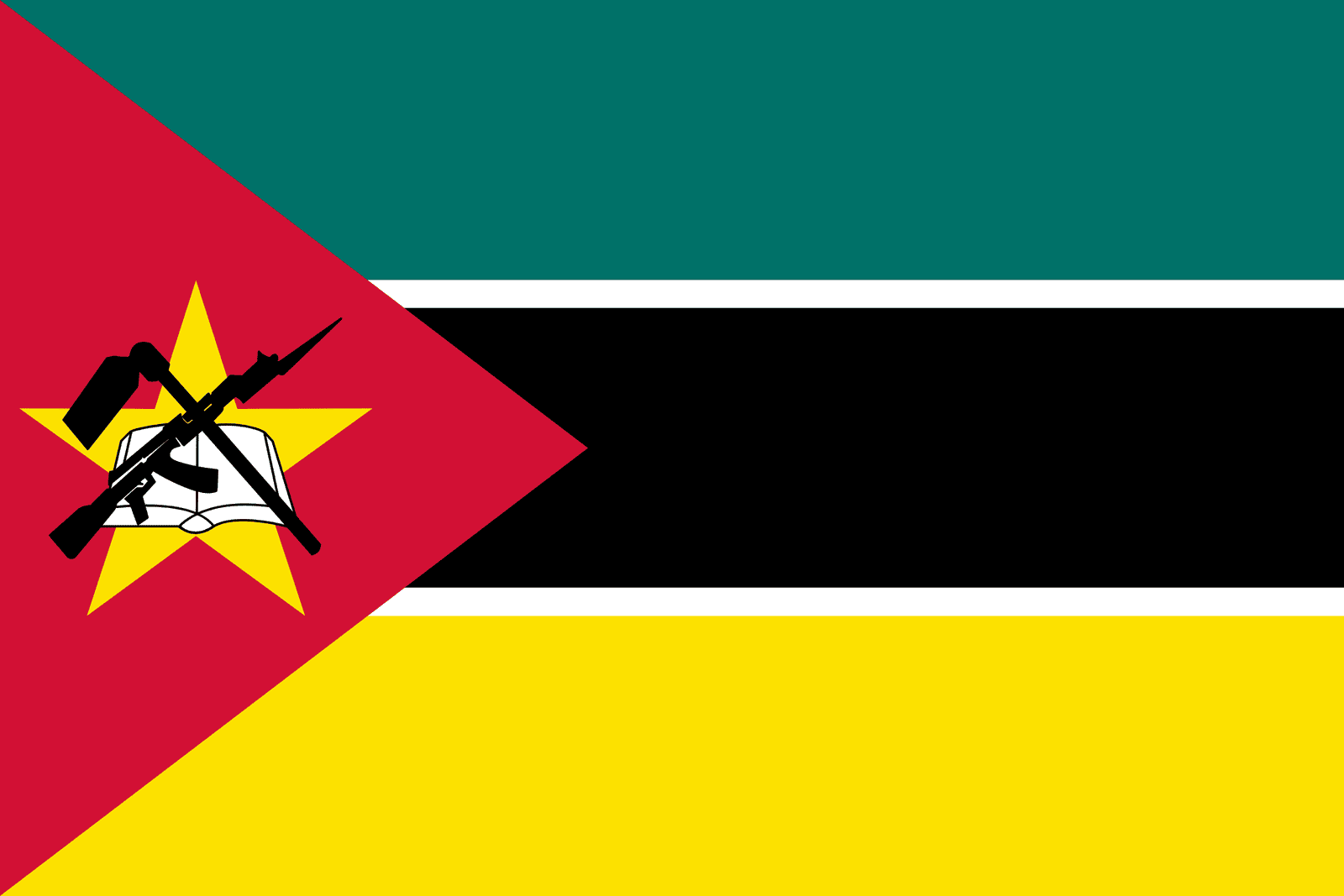
Flag of Mozambique
| Legal Name | Republic of Mozambique |
|---|---|
| Flag |
|
| Capital City |
Maputo |
| Total Area | 801,590 km² |
| Land Area | Approximately 786,380 km² |
| Water Area | Approximately 15,210 km² |
| Population | Approximately 33 million |
| Major Cities | Maputo (1.1 million), Matola (1.2 million), Beira (530,000), Nampula (750,000), Chimoio (325,000) |
| Currency | Mozambican Metical (MZN) |
| GDP | Approximately USD 18–20 billion |
| GDP Per Capita | Approximately USD 550–600 (nominal) |
About of Mozambique
Mozambique is a southeastern African nation located along the Indian Ocean coast, stretching more than 2,400 kilometers from north to south. It occupies a strategic position linking the African interior to maritime trade routes across the Indian Ocean. The country’s long coastline, fertile river valleys, and varied landscapes make it one of the most geographically diverse nations in the region.
Mozambique shares land borders with Tanzania to the north; Malawi and Zambia to the northwest; Zimbabwe to the west; and Eswatini and South Africa to the southwest. Its eastern boundary is entirely maritime, facing the Indian Ocean. The capital, Maputo, is also the largest city and serves as the country’s political, economic, and cultural center, while other major cities such as Beira and Nampula act as regional commercial hubs.
The population of Mozambique is predominantly young and rural, with strong ethnic and linguistic diversity rooted in Bantu-speaking communities. Internationally, Mozambique is recognized as a sovereign republic and a member of major global and regional organizations. Its geopolitical importance lies in its natural resource potential, deep-water ports, and role as a gateway for landlocked southern African countries.
Etymology
The name “Mozambique” is believed to derive from Musa bin Bique (or Mussa Al-Biq), an Arab trader or ruler associated with a coastal settlement on Mozambique Island. Portuguese explorers adapted the name in the late 15th century, and it gradually came to represent the entire coastal region and, later, the modern state. The name reflects the country’s deep historical ties to Indian Ocean trade networks and Arab-Swahili culture.
History
Prehistoric and Ancient Civilizations
Mozambique has been inhabited since prehistoric times, with early hunter-gatherer communities later joined by Bantu-speaking agriculturalists who migrated southward over a thousand years ago. These groups established farming, ironworking, and trade-based societies.
Classical and Medieval Periods
From the early medieval period, Mozambique’s coast became part of the Swahili cultural and commercial world. Arab and Persian traders established settlements and trading posts, integrating the region into Indian Ocean trade routes linking Africa, the Middle East, and Asia.
Major Empires, Kingdoms, or Dynasties
Inland areas were influenced by regional powers such as the Great Zimbabwe civilization and later the Mutapa Empire, which controlled gold trade routes that extended into present-day Mozambique.
Colonial or Imperial Rule
The Portuguese arrived in the late 15th century and gradually established colonial control. Mozambique became a Portuguese colony for nearly five centuries, marked by plantation agriculture, forced labor, and limited economic development for the local population.
Independence Movement
Nationalist resistance intensified in the mid-20th century, led by the Mozambique Liberation Front (FRELIMO). After a prolonged armed struggle, Mozambique achieved independence from Portugal on June 25, 1975.
Key Post-Independence Events
Following independence, the country adopted a socialist-oriented system. A devastating civil war between FRELIMO and RENAMO lasted from 1977 to 1992, causing widespread destruction. The Rome Peace Accords ended the conflict and initiated democratic reforms.
Modern Political Developments
Mozambique transitioned to a multiparty democracy in the 1990s. While political tensions have persisted, the country continues to pursue stability, reconstruction, and economic development amid evolving security and governance challenges.
Government and Politics
Mozambique is a presidential republic governed under a constitution adopted in 1990 and subsequently amended. The President serves as both head of state and government, elected by popular vote. Executive authority is exercised through the Council of Ministers.
The legislative branch consists of a unicameral Assembly of the Republic. The judiciary is independent, with the Supreme Court serving as the highest judicial authority. Administratively, Mozambique is divided into ten provinces and the capital city, Maputo, which has provincial status.
Mozambique maintains active foreign relations and is a member of the United Nations, African Union, Southern African Development Community, Commonwealth of Nations, and Community of Portuguese Language Countries. The country maintains a national defense force responsible for territorial defense and internal security.
Economy
Mozambique is classified as a developing economy with significant growth potential. Agriculture employs the majority of the population and remains central to livelihoods, producing crops such as cassava, maize, rice, sugarcane, and cashew nuts.
Industry has expanded in recent decades, particularly in mining, energy, and aluminum smelting. The discovery of large offshore natural gas reserves has positioned Mozambique as a future major energy exporter. The services sector, including transport, trade, and tourism, is growing steadily.
Mozambique’s natural resources include coal, natural gas, graphite, gemstones, and hydropower potential. Major exports include aluminum, coal, natural gas, agricultural products, and electricity. Economic challenges include poverty, infrastructure gaps, debt management, and vulnerability to climate shocks, while future prospects depend on responsible resource management and inclusive growth.
Demographics
Mozambique’s population is composed primarily of Bantu ethnic groups, including Makhuwa, Sena, Tsonga, Shona, and Makonde communities. Portuguese is the official language, while numerous indigenous languages are widely spoken.
Christianity is the largest religion, followed by Islam, particularly along the northern coast, and traditional belief systems. The population is predominantly rural, though urbanization is increasing. Mozambique has a high population growth rate and a young demographic profile.
Culture and Society
Mozambican culture reflects a blend of African traditions and Portuguese influences. Music and dance play a central role in social life, with styles such as marrabenta and traditional drumming widely celebrated.
Cuisine emphasizes maize, cassava, seafood, and spices, often influenced by Indian Ocean flavors. Social customs place strong value on family, community, and respect for elders. National holidays commemorate independence, peace, and cultural heritage. Football is the most popular sport, alongside athletics and basketball.
Education and Healthcare
The education system includes primary, secondary, and tertiary levels, with compulsory primary education. Literacy rates have improved but remain a development challenge, particularly in rural areas.
Healthcare is provided primarily through a public system supported by international partners. Mozambique has made progress in combating infectious diseases and improving maternal and child health, though challenges such as malaria, HIV/AIDS, and limited healthcare access persist.
Geography and Climate
Mozambique features coastal plains, inland plateaus, river valleys, and highlands. Major rivers include the Zambezi, Limpopo, and Rovuma. The country has an extensive coastline with beaches, estuaries, and coral reefs.
The climate is tropical, with a rainy season from November to March and a cooler, drier season from April to October. Natural hazards include cyclones, floods, droughts, and earthquakes. Environmental concerns focus on deforestation, coastal erosion, and climate change impacts.
Flora and Fauna
Mozambique is rich in biodiversity, with ecosystems ranging from mangroves and coral reefs to savannas and forests. Native plant species include baobabs, acacias, and miombo woodlands.
Wildlife includes elephants, lions, hippos, crocodiles, antelope, and diverse bird species. Conservation efforts are concentrated in national parks and reserves such as Gorongosa National Park, which has become a symbol of ecological restoration.
Map of Mozambique
National Flag: A multicolored flag symbolizing agriculture, peace, mineral wealth, and vigilance
Coat of Arms: Features agricultural and industrial symbols representing labor and progress
National Anthem: Pátria Amada
National Symbols: The book and hoe as symbols of education and agriculture
National Flag (Detailed Section)
The flag of Mozambique consists of horizontal green, black, and yellow stripes separated by thin white lines, with a red triangle at the hoist. Inside the triangle is a yellow star bearing a book, a hoe, and an AK-style rifle. Adopted after independence, the flag symbolizes agriculture, Africa, mineral wealth, peace, education, and defense of sovereignty. It is one of the few national flags to feature a modern firearm. The flag is flown on public buildings and during national ceremonies according to official protocol.
Flag flying days
| Date | Flag Position | Occasion or Reason |
|---|
| June 25 | Full-mast | Independence Day |
| September 7 | Full-mast | Victory Day |
| February 3 | Full-mast | Heroes’ Day |
| April 7 | Full-mast | Women’s Day |
| National Mourning Periods | Half-mast | Death of national leaders or national tragedies |