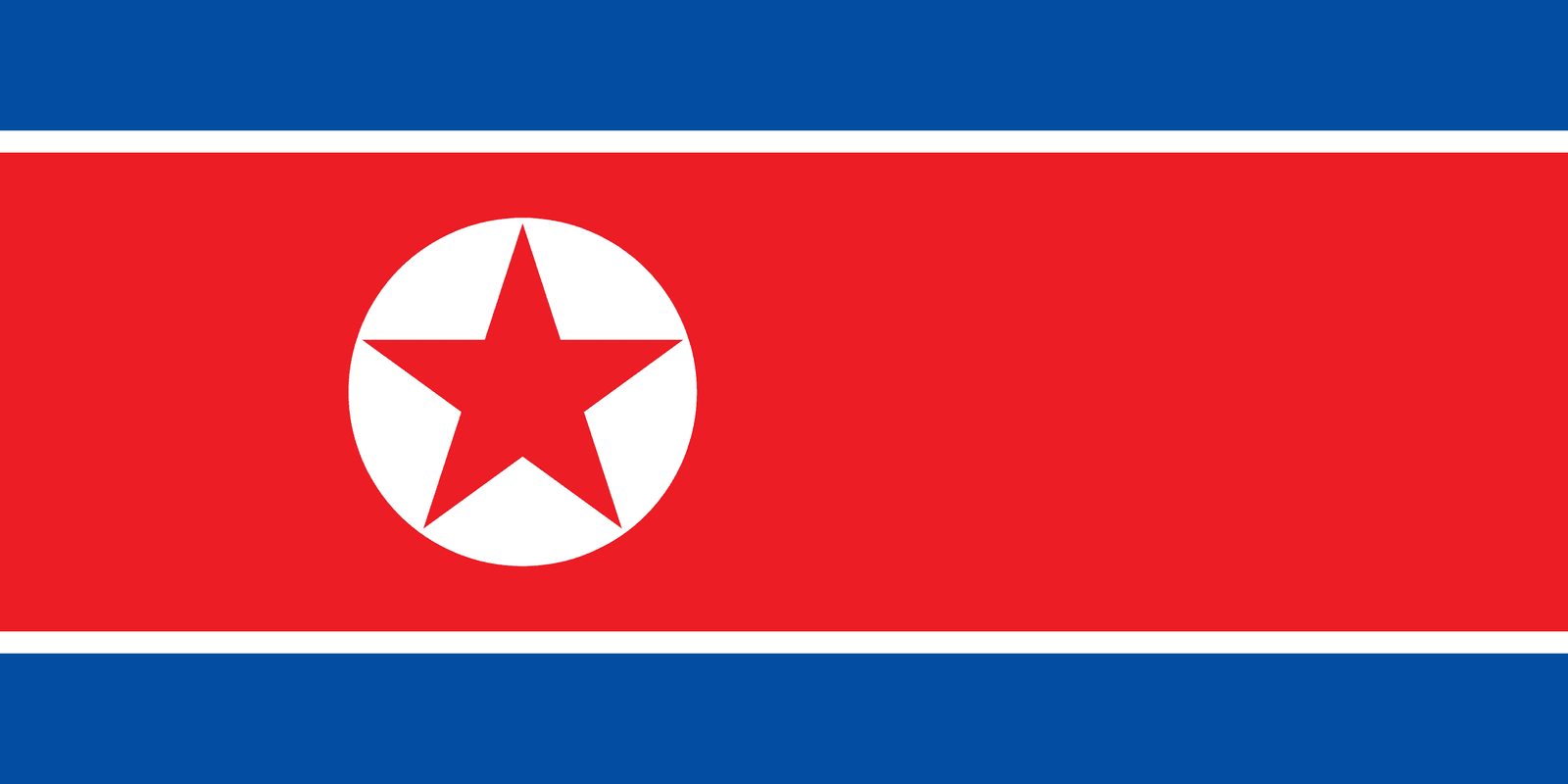
Flag of North Korea
| Legal Name | Democratic People's Republic of Korea |
|---|---|
| Flag |
|
| Capital City |
Approximately 120,540 km² |
| Total Area | Approximately 120,410 km² |
| Land Area | Approximately 120,410 km² |
| Water Area | Approximately 130 km² |
| Population | About 25.8 million |
| Major Cities | Pyongyang (3.0M), Hamhung (768K), Chongjin (662K), Nampo (366K), Wonsan (322K) |
| Currency | North Korean Won (KPW) |
| GDP | Approximately USD 28 billion |
| GDP Per Capita | Approximately USD 1,100 (nominal) |
About of North Korea
The Democratic People’s Republic of Korea, widely known as North Korea, occupies the northern portion of the Korean Peninsula in East Asia. It is bordered by China to the north and northwest, Russia to the northeast, and South Korea to the south, with maritime boundaries along the Yellow Sea to the west and the Sea of Japan (East Sea) to the east. The country’s terrain is predominantly mountainous, particularly in the northeast, with fertile plains along the west coast and major rivers such as the Taedong, Yalu, and Tumen flowing through its valleys.
North Korea’s capital and largest urban center is Pyongyang, an industrial and political hub that reflects the state’s post‑war reconstruction and centralized planning. While Pyongyang is the most prominent city, other significant urban centers include Chongjin, Hamhung, Namp’o, and Sunch’on, each with populations in the hundreds of thousands.
With an estimated population of around 26.5 million, North Korea has a relatively homogeneous demographic profile, with ethnic Koreans constituting the vast majority. Life expectancy and population growth trends are modest, shaped by historical factors including war, famine, and strict state control.
Internationally, North Korea is known for its reclusive political posture, governed under a single‑party system dominated by the Workers’ Party of Korea (WPK). It maintains a unique position in global affairs, with strategic importance rooted in its nuclear weapons program, military capabilities, and role in regional geopolitics involving China, Russia, and the United States.
Etymology
The name “Korea” derives from Goryeo, a medieval kingdom (918–1392) that unified much of the Korean Peninsula. The term evolved through interaction with foreign languages and was later adopted into Western vocabularies. The prefix “Democratic People’s Republic” reflects the state’s official ideological positioning upon its establishment in 1948 as a socialist republic in the northern half of the peninsula. Over time, “North Korea” has become the common shorthand in international usage.
History
Early and Medieval Periods
The Korean Peninsula’s history stretches back thousands of years with ancient states like Gojoseon, which laid early cultural foundations. Subsequent dynasties, including Goguryeo, Baekje, and Silla, shaped the region’s political and cultural development throughout the classical and medieval eras.
Colonial Rule and Division
In the early 20th century, Korea was colonized by Japan (1910–1945), a period marked by resistance and hardship. Following Japan’s defeat in World War II, the peninsula was divided along the 38th parallel with Soviet forces administering the north and American forces the south.
Formation of the DPRK
In 1948, the Democratic People’s Republic of Korea was proclaimed in the north under Kim Il Sung. This was followed by the Korean War (1950–1953), a devastating conflict that ended in an armistice and the creation of the heavily fortified Demilitarized Zone (DMZ).
Post‑War to Modern Era
Post‑war reconstruction under a centrally planned economy emphasized heavy industry and self‑reliance (Juche). The state endured severe economic challenges, including famine in the 1990s. Leadership passed from Kim Il Sung to Kim Jong Il, then to Kim Jong Un in 2011, under whose rule the country has intensified its nuclear and missile programs, while cautiously engaging in diplomatic exchanges and limited economic initiatives.
Government and Politics
North Korea is a unitary single‑party state dominated by the Workers’ Party of Korea. The Supreme Leader serves as both head of state and government, supported by institutions such as the Supreme People’s Assembly. The legal framework is guided by a constitution that enshrines socialist principles and the leadership’s authority.
The executive branch is centralized, with nominal legislative functions exercised by the Assembly. The judiciary nominally exists, though in practice the party exerts pervasive influence across all branches. Administratively, the country is divided into provinces and special cities.
In foreign relations, North Korea holds formal diplomatic ties with certain states, participates in limited multilateral forums, and maintains strategic alliances, especially with China and Russia. Its military, one of the largest in the world by personnel, is central to national policy under the Songun (military‑first) doctrine.
Economy
North Korea’s economy is classified as centrally planned and low‑income, with the state maintaining control over production and distribution. Heavy industry, mining (coal, iron ore, magnesite), and manufacturing are key sectors, while agriculture struggles due to terrain, limited arable land, and climatic constraints. Despite efforts at economic planning and special economic zones, the economy is constrained by international sanctions, infrastructure shortcomings, and isolation. Exports are limited, with China as a principal trading partner. Economic diversification and growth prospects remain modest, though reports suggest periodic fluctuations in output.
Demographics
The population is largely ethnically Korean, with the Korean language universally dominant. Religious practice exists but is limited by state policy; traditional beliefs and folk practices persist alongside restricted formal religious observance. Most of the population is urban, concentrated around industrial centers and the capital region, while rural areas are less densely populated.
Culture and Society
North Korean culture reflects Korean heritage blended with state ideology. Traditional music, arts, and cuisine coexist with state‑produced cultural expressions that promote national narratives. Social norms emphasize collective identity, respect for hierarchy, and adherence to official ideology. Public festivals often commemorate revolutionary history and the leadership, while sports and education are state organized.
Education and Healthcare
The education system is state‑run, with literacy rates officially high. Higher education institutions, including universities in Pyongyang, focus on scientific and ideological training. Healthcare is publicly administered, though quality and access vary significantly between urban centers and rural regions, challenged by resource constraints.
Geography and Climate
North Korea’s landscape is predominantly mountainous, with significant uplands in the northeast and coastal plains along the west. The climate is temperate, with cold winters and warm, wet summers. Natural hazards include typhoons and flooding, while environmental issues such as deforestation and soil erosion pose challenges.
Flora and Fauna
The country’s biodiversity includes temperate forests, grasslands, and coastal ecosystems, supporting species adapted to these environments. Conservation efforts are limited, with protected areas and national parks focusing on preserving native species amid development pressures.
Map of North Korea
The national flag features elements symbolizing socialism and national identity. The coat of arms and national anthem (“Aegukka”) reflect patriotic themes. Other symbols include monuments honoring historical figures and sites associated with cultural heritage.
National Flag (Detailed Section)
The flag’s red field symbolizes revolutionary spirit, flanked by white and blue stripes representing purity and peace. The central red star signifies the ruling party and socialist orientation. The flag’s design dates to the establishment of the DPRK in 1948 and is displayed according to protocols that emphasize national pride and respect.
All Flags of North Korea
| Date | Flag Position | Occasion |
|---|---|---|
| April 15 | Full‑mast | Birthday of Kim Il Sung |
| September 9 | Full‑mast | National Day (Founding of DPRK) |
| Other State Holidays | Full‑mast | National observances |