
Flag of Thailand
| Legal Name | Kingdom of Thailand |
|---|---|
| Flag |
|
| Capital City |
Bangkok |
| Total Area | 796,095.00 km2 |
| Land Area | 513,120 km² |
| Water Area | 510,890 km² |
| Population | Approximately 71 million |
| Major Cities | Bangkok (10.5 million), Chiang Mai (1.0 million), Nonthaburi (1.2 million), Nakhon Ratchasima (0.3 million), Hat Yai (0.2 million) |
| Currency | Thai Baht (THB) |
| GDP | USD 610 billion |
| GDP Per Capita | USD 8,600 (nominal) |
About of Thailand
Thailand is a Southeast Asian nation strategically located at the center of the Indochinese Peninsula, bordering Myanmar to the northwest, Laos to the northeast, Cambodia to the southeast, and Malaysia to the south. Its eastern and southern coastlines provide access to the Gulf of Thailand and the Andaman Sea, which have historically facilitated trade and maritime commerce. Thailand is renowned for its cultural richness, tropical landscapes, and historical significance as a regional hub.
Bangkok, the capital and largest city, is a vibrant metropolis known for its bustling economy, historic landmarks, and role as the country’s political, cultural, and financial center. Other major urban centers include Chiang Mai, Nonthaburi, and Hat Yai. The country has experienced steady urbanization, though a significant portion of its population remains engaged in agriculture and rural livelihoods.
Thailand is internationally recognized as a constitutional monarchy with deep-rooted traditions and political stability relative to the region. Its geopolitical significance stems from its central location in Southeast Asia, serving as a crossroads for trade, tourism, and regional diplomacy. The country is a member of ASEAN, the UN, and maintains strong bilateral relations with neighboring states and global powers.
Etymology
The name “Thailand” originates from the Thai word Prathet Thai, meaning “Land of the Free.” The term “Thai” itself is derived from Tai, an ethnic designation for the central Tai peoples who form the dominant cultural and linguistic group. The name reflects Thailand’s historical status as the only Southeast Asian country never formally colonized by European powers.
History
Prehistoric and Ancient Civilizations
Archaeological evidence suggests human settlement in present-day Thailand dating back to at least 40,000 years, including hunter-gatherer communities and later agricultural societies along the Chao Phraya River.
Classical and Medieval Periods
From the 1st millennium CE, the region hosted early kingdoms such as Dvaravati, Srivijaya, and Khmer-influenced states, which contributed to art, religion, and urban development. Buddhism was introduced and became a dominant cultural force.
Major Kingdoms and Dynasties
The Sukhothai Kingdom (13th–15th centuries) is considered the first Thai state, followed by the Ayutthaya Kingdom (1351–1767), which expanded Thai influence regionally. After Ayutthaya fell to Burmese invaders, the Thonburi Kingdom briefly governed until the establishment of the Rattanakosin Kingdom in 1782 under King Rama I.
Colonial Era
Unlike neighboring countries, Thailand (then Siam) successfully avoided colonization through diplomacy, modernizing reforms, and strategic treaties with European powers.
Modern Political Developments
The 1932 revolution transitioned Thailand from absolute monarchy to constitutional monarchy. Subsequent decades saw military coups, political reforms, and fluctuating governance. Thailand continues to balance democratic institutions with monarchical traditions and military influence in politics.
Government and Politics
Thailand is a constitutional monarchy with a parliamentary democracy:
Executive: The King serves as the ceremonial head of state, while the Prime Minister leads government administration.
Legislature: Bicameral National Assembly consisting of the House of Representatives (elected) and the Senate (appointed and elected).
Judiciary: Independent courts with a Supreme Court and specialized administrative courts.
Administrative Divisions: 77 provinces (changwat), each governed by provincial governors.
Foreign Relations: Active ASEAN member, engages with global trade partners, maintains neutrality in major international conflicts, and promotes regional cooperation.
Defense: Royal Thai Armed Forces ensure territorial security and contribute to regional peacekeeping and humanitarian missions.
Economy
Thailand has a developing, export-oriented economy:
Economic Classification: Emerging market and upper-middle-income country.
Major Industries: Automotive, electronics, petrochemicals, food processing, and tourism.
Agriculture: Rice, rubber, sugarcane, and seafood; still significant in rural employment.
Natural Resources: Tin, natural gas, gypsum, limestone, and timber.
Trade Partners: United States, China, Japan, EU, and ASEAN countries.
Economic Challenges: Income inequality, aging population, reliance on tourism, and political uncertainty.
Outlook: Moderate growth, industrial diversification, and expansion in renewable energy, technology, and service sectors.
Demographics
Thailand is ethnically diverse with a population concentrated in central and northeastern regions:
Ethnic Groups: Predominantly Thai, with Chinese, Malay, Khmer, and indigenous hill tribes.
Languages: Thai (official), regional languages include Northern Thai, Isan, and Malay dialects.
Religions: Predominantly Theravada Buddhism (approx. 94%), with minorities of Islam, Christianity, and Hinduism.
Urbanization: Approximately 51% urban population, concentrated in Bangkok and provincial capitals.
Population Trends: Moderate growth, declining fertility rates, increasing urban migration.
Culture and Society
Thai culture is rooted in Buddhism, monarchy, and respect for social hierarchy. Traditional arts include classical dance, music, mural painting, and craftsmanship. Thai cuisine emphasizes rice, noodles, spices, and herbs, globally celebrated for its balance of flavors. Festivals include Songkran (New Year), Loy Krathong, and Royal Ceremonies. Sports such as Muay Thai, football, and badminton are popular, while recreational tourism plays a central role in society.
Education and Healthcare
Thailand provides free primary and secondary education, with growing tertiary education opportunities in universities like Chulalongkorn and Mahidol. Literacy rates exceed 93%. The healthcare system combines public universal coverage and private facilities, offering high accessibility in urban centers. Public health initiatives target infectious diseases, maternal and child health, and nutrition.
Geography and Climate
Thailand’s terrain ranges from mountains and plateaus in the north, fertile central plains, to coastal lowlands in the south:
Physical Geography: Chao Phraya River basin, Mekong River in the northeast, Andaman coast, and Gulf of Thailand.
Climate: Tropical, with three main seasons—hot (March–June), rainy (May–October), and cool (November–February).
Natural Hazards: Flooding, droughts, tropical storms, and occasional earthquakes.
Environmental Concerns: Deforestation, air and water pollution, and habitat loss.
Flora and Fauna
Thailand hosts rich biodiversity:
Flora: Tropical rainforests, mangroves, orchids, teak, and bamboo species.
Wildlife: Elephants, tigers, leopards, gibbons, hornbills, and freshwater species.
Conservation: National parks, wildlife sanctuaries, and government initiatives protect endangered species and ecosystems.
Map of Thailand
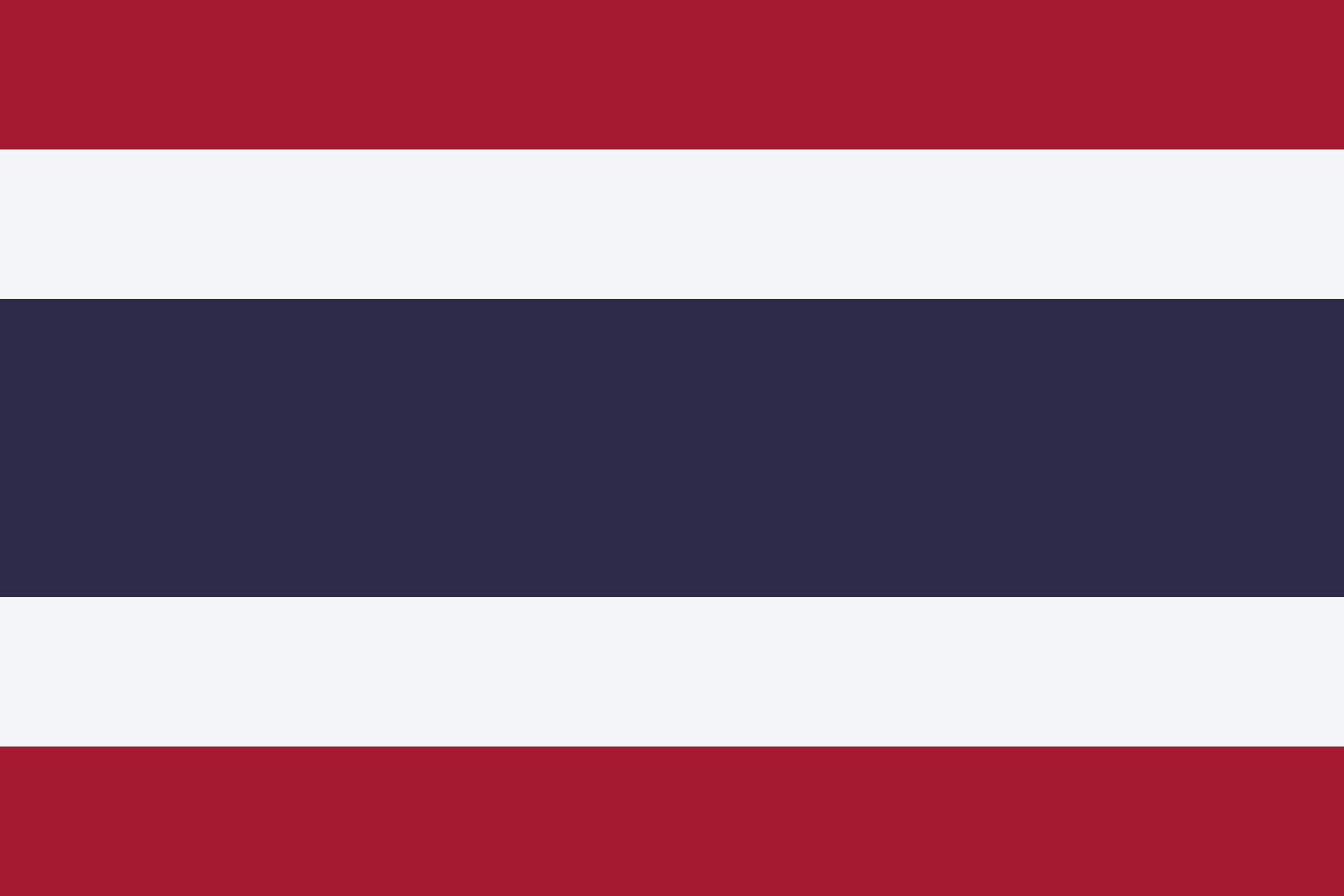
Flag: Five horizontal stripes of red, white, blue (double width), white, and red.
Coat of Arms: Features the Garuda, symbolizing royal authority.
National Anthem: Phleng Chat Thai
National Animals/Plants: Thai elephant, Siamese fighting fish, ratchaphruek (golden shower tree) symbolize national heritage.
National Flag (Detailed Section)
The Thai flag consists of five horizontal stripes in red, white, and blue, with the central blue stripe twice as wide. Red symbolizes the nation and land, white represents religion (Buddhism), and blue signifies monarchy. Adopted in 1917, it reflects unity of nation, religion, and monarchy. Protocol dictates display on government buildings, national holidays, and official events. Half-mast is observed during periods of mourning.
Realted Flags
Flag flying days
| Date | Flag Position | Occasion or Reason |
|---|
| December 5 | Full-mast | King’s Birthday |
| May 5 | Full-mast | Coronation Day |
| July 28 | Full-mast | Constitution Day |
| As Declared | Half-mast | National mourning or royal funerals |
| April 13–15 | Full-mast | Songkran Festival (Thai New Year) |