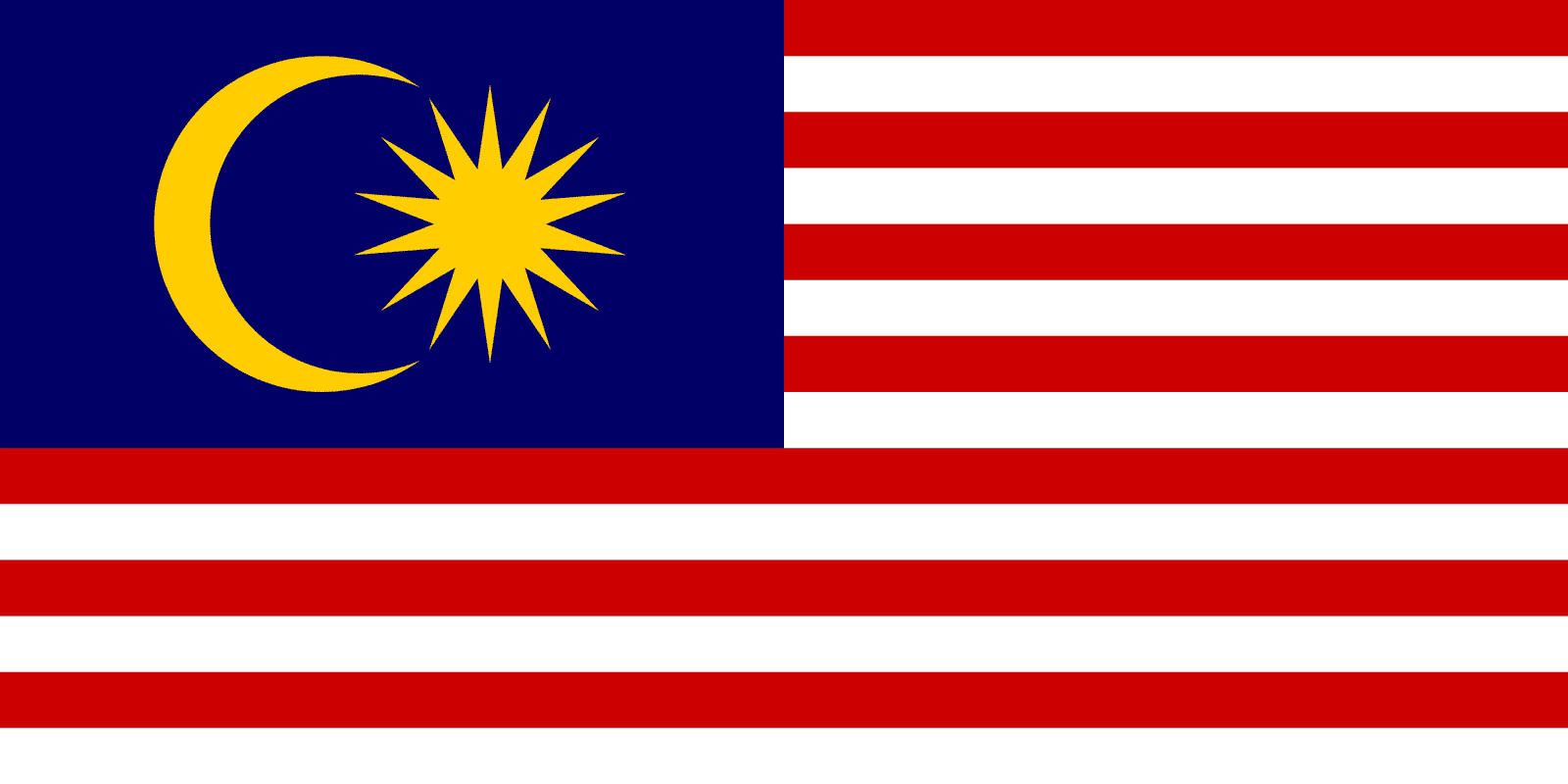
Flag of Malaysia
| Legal Name | Federation of Malaysia |
|---|---|
| Flag |
|
| Capital City |
Kuala Lumpur |
| Total Area | Approximately 330,803 km² |
| Land Area | Approximately 329,847 km² |
| Water Area | Approximately 956 km² |
| Population | Approximately 33 million |
| Major Cities | Kuala Lumpur (1.8 million), George Town (0.7 million), Johor Bahru (0.9 million), Kota Kinabalu (0.5 million), Shah Alam (0.7 million) |
| Currency | Malaysian Ringgit (MYR) |
| GDP | Approximately USD 430 billion |
| GDP Per Capita | Approximately USD 13,000 (Nominal) |
About of Malaysia
Malaysia is a Southeast Asian nation spanning two distinct regions: Peninsular Malaysia, bordering Thailand and Singapore, and East Malaysia on the island of Borneo, bordering Indonesia and Brunei. It occupies a strategic position along the Strait of Malacca, one of the busiest maritime trade routes in the world, giving it considerable geopolitical significance.
The country is politically stable, with Kuala Lumpur serving as the economic and cultural hub, while Putrajaya functions as the administrative capital. Urban centers such as George Town and Johor Bahru are also major economic and cultural nodes. Malaysia has a diverse population comprising Malay, Chinese, Indian, and indigenous groups, fostering a unique multicultural society.
Internationally, Malaysia is recognized as a member of the United Nations, ASEAN, the Commonwealth, and the Organization of Islamic Cooperation. Its economy, cultural heritage, and strategic location make it a significant player in regional and global affairs.
Etymology
The name “Malaysia” derives from the term “Malay,” referring to the dominant ethnic group, and the Latin/Greek suffix “-sia,” meaning “land of.” The term was formalized during the mid-20th century to unify various Malay states and territories, highlighting a shared national identity amidst ethnic diversity. Historically, the Malay Peninsula was known to traders and historians as part of the broader “Malay world,” a cultural and maritime region.
History
Prehistoric and Ancient Civilizations
Archaeological evidence indicates human settlement dating back over 40,000 years, with early communities relying on hunting, gathering, and later agriculture.
Classical and Medieval Periods
From the 1st century CE, the region was influenced by Indianized kingdoms, such as Langkasuka and Srivijaya, which established trade networks and cultural exchange with India, China, and the Middle East. Islam was introduced by traders in the 12th century and became the dominant religion in many states by the 15th century.
Sultanates and Local Kingdoms
The Malacca Sultanate (1400–1511) emerged as a powerful maritime kingdom and facilitated the spread of Islam and Malay culture. Other sultanates, including Johor, Kedah, and Perak, shaped regional politics.
Colonial Rule
The Portuguese captured Malacca in 1511, followed by Dutch and British colonial administrations. Britain consolidated control over Peninsular Malaysia through the Straits Settlements, Federated Malay States, and protectorates, while North Borneo (Sabah) and Sarawak were administered separately.
Independence Movement
Nationalist movements emerged in the 20th century, culminating in the Federation of Malaya gaining independence from Britain on August 31, 1957. Malaysia was formed on September 16, 1963, by merging Malaya with Sabah, Sarawak, and Singapore (which left in 1965).
Key Post-Independence Events
Malaysia has undergone rapid industrialization and urbanization since the 1970s, implementing policies to promote economic growth and ethnic integration, such as the New Economic Policy (NEP). Political developments have included peaceful democratic transitions, with the monarchy serving as a constitutional safeguard.
Government and Politics
Malaysia is a federal constitutional monarchy. The Yang di-Pertuan Agong, elected among the nine Malay state rulers, serves as the ceremonial head of state. The Prime Minister is the head of government, supported by a Cabinet. The legislative branch is bicameral, comprising the Dewan Rakyat (House of Representatives) and Dewan Negara (Senate). The judiciary is independent and upholds civil, criminal, and Sharia law for Muslims.
The country is divided into 13 states and three federal territories, each with administrative autonomy. Malaysia maintains active diplomacy and is a member of ASEAN, the United Nations, and the Organization of Islamic Cooperation. Defense forces include the Malaysian Armed Forces, which focus on territorial security and regional cooperation.
Economy
Malaysia has a newly industrialized economy characterized by high-income sectors, including manufacturing, services, and technology. Key industries include electronics, petroleum, palm oil, rubber, and tourism. The service sector dominates GDP, followed by manufacturing and agriculture.
Natural resources include petroleum, natural gas, tin, and timber. Major trade partners include China, Singapore, the United States, Japan, and the European Union. Challenges include economic inequality, reliance on exports, and environmental sustainability. Future growth focuses on digitalization, green technology, and economic diversification.
Demographics
Malaysia is ethnically diverse, with approximately 69% Malay and Bumiputera, 23% Chinese, 7% Indian, and small indigenous and expatriate communities. Malay is the official language, while English, Mandarin, and Tamil are widely used. Islam is the state religion, with Buddhism, Christianity, Hinduism, and traditional beliefs also practiced. Urban populations dominate major cities, with steady population growth driven by migration and urbanization.
Culture and Society
Malaysia’s culture is a vibrant mix of Malay, Chinese, Indian, and indigenous traditions. Islamic influences shape social norms, festivals, and laws. Arts include traditional dance, music, and crafts such as batik and songket. Cuisine is diverse, with flavors drawn from Malay, Chinese, Indian, and indigenous culinary traditions.
Major public holidays include Hari Raya Aidilfitri, Chinese New Year, Deepavali, and National Day. Football, badminton, and martial arts are popular recreational activities.
Education and Healthcare
The education system consists of primary, secondary, and tertiary levels, with public and private institutions providing instruction in Malay, English, and vernacular languages. Literacy rates are high, and Malaysia hosts multiple universities attracting regional and international students.
Healthcare services are provided through public hospitals, clinics, and private facilities. The system focuses on universal access, disease prevention, and maternal and child health, though rural areas face accessibility challenges.
Geography and Climate
Malaysia’s terrain includes mountains, rainforests, coastal plains, and islands. The central mountain range, the Titiwangsa, divides Peninsular Malaysia, while Borneo’s Sabah and Sarawak feature dense tropical forests. Rivers such as the Rajang and Klang support agriculture and transportation.
Malaysia has a tropical climate, with high humidity, year-round temperatures averaging 25–32°C, and monsoon seasons affecting rainfall distribution. Natural hazards include floods, landslides, and occasional haze from regional forest fires. Environmental concerns include deforestation, urbanization, and marine ecosystem preservation.
Flora and Fauna
Malaysia hosts exceptional biodiversity with tropical rainforests home to thousands of plant species, including dipterocarps, orchids, and rattan palms. Wildlife includes tigers, elephants, orangutans, hornbills, and countless amphibians and reptiles. Conservation efforts include national parks such as Taman Negara and Bako National Park, wildlife reserves, and sustainable forestry programs.
Map of Malaysia
Flag: The Jalur Gemilang features 14 red and white stripes representing the federal states, a blue canton symbolizing unity, and a yellow crescent and 14-point star representing Islam and federal harmony.
Coat of Arms: Features a shield supported by tigers, with symbols representing states, the national flower, and the crescent and star.
National Anthem: “Negaraku” reflects loyalty to the monarchy and nation.
National Animals/Plants: Malayan tiger, hibiscus flower, and various endemic species symbolize heritage and natural wealth.
National Flag (Detailed Section)
The Malaysian flag, adopted in 1963, combines stripes and symbols reflecting federal unity and Islamic heritage. Red and white stripes signify courage and purity, the blue canton represents unity, and the yellow crescent and 14-point star represent Islam and the federation’s 13 states plus federal territories. Flag protocol mandates display on national holidays, government buildings, and ceremonial events, with specific guidelines for half-mast during mourning.
Flag flying days
| Date | Flag Position | Occasion or Reason |
|---|
| August 31 | Full-mast | Independence Day |
| September 16 | Full-mast | Malaysia Day |
| Official mourning days | Half-mast | National mourning or death of dignitaries |
| Royal birthdays | Full-mast | Yang di-Pertuan Agong’s birthday |