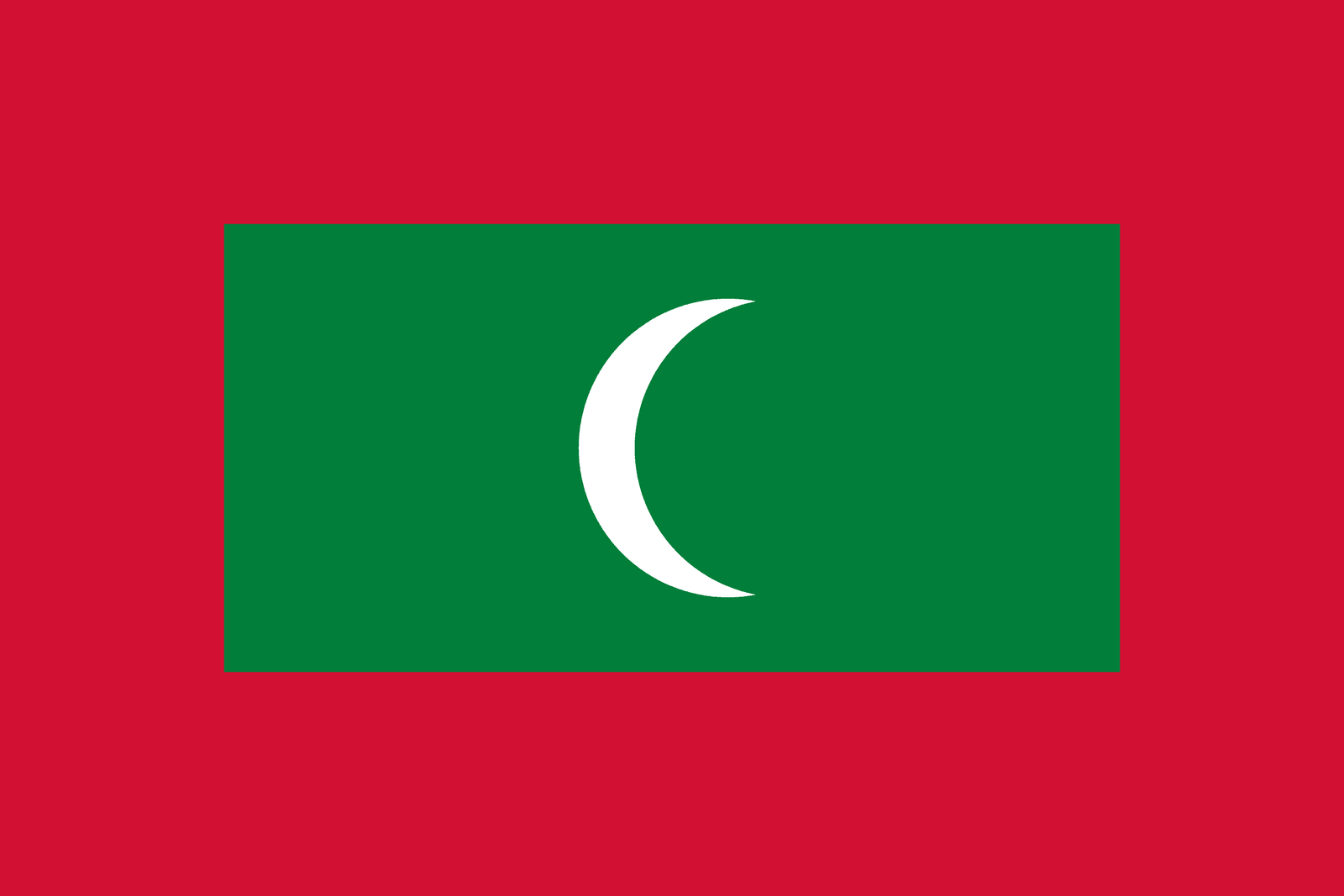
Flag of Maldives
| Legal Name | Republic of Maldives |
|---|---|
| Flag |
|
| Capital City |
Malé |
| Total Area | Approximately 298 km² |
| Land Area | Approximately 298 km² |
| Water Area | Over 90,000 km² of surrounding territorial waters |
| Population | Approximately 525,000–540,000 |
| Major Cities | Malé (150,000+), Hulhumalé (100,000+), Addu City (35,000), Fuvahmulah (12,000) |
| Currency | Maldivian Rufiyaa (MVR) |
| GDP | Approximately USD 6–7 billion |
| GDP Per Capita | Approximately USD 11,000–13,000 (Nominal) |
About of Maldives
The Maldives is a small island nation located in the Indian Ocean, southwest of Sri Lanka and India. It consists of a chain of nearly 1,200 coral islands grouped into 26 natural atolls, stretching across the equator. The country is renowned for its turquoise lagoons, coral reefs, and low-lying geography, making it one of the world’s most geographically unique nations.
Malé, the capital and largest city, serves as the political, economic, and cultural heart of the Maldives. Despite its small size, Malé is one of the most densely populated cities in the world. Other urban centers, such as Hulhumalé and Addu City, play growing roles in housing, administration, and regional development.
The population is relatively small but highly urbanized, with a strong sense of national identity shaped by Islam, maritime traditions, and island life. The Maldives is a fully sovereign and internationally recognized state, active in regional and global organizations. Its strategic importance lies in its location along key Indian Ocean sea lanes and its global prominence in tourism, climate change advocacy, and marine conservation.
Etymology
The name “Maldives” is believed to derive from ancient Sanskrit and Arabic terms. One widely accepted interpretation traces it to Maladvipa, meaning “garland of islands,” reflecting the chain-like formation of the atolls. Over centuries, Arabic, Persian, and South Asian traders adapted the name, eventually giving rise to the modern English form “Maldives.” The name has consistently emphasized the country’s identity as a nation of islands.
History
Prehistoric and Ancient Periods
Archaeological evidence suggests that the Maldives was settled over 2,000 years ago by seafarers from South Asia and possibly Southeast Asia. Early inhabitants relied on fishing, coconut cultivation, and maritime trade.
Classical and Medieval Periods
The islands became an important stop on Indian Ocean trade routes, connecting East Africa, the Middle East, South Asia, and Southeast Asia. Buddhism was the dominant religion until the 12th century, leaving behind archaeological remains and cultural influences.
Islamic Sultanate
In 1153, the Maldives converted to Islam, establishing a long-lasting Islamic sultanate. Islamic law, culture, and governance deeply shaped Maldivian society, with sultans ruling for centuries and maintaining relative autonomy despite foreign influence.
Colonial Influence
The Maldives came under Portuguese control briefly in the 16th century, followed by influence from the Dutch and later the British. Under British protection, the Maldives retained internal self-rule while Britain managed its external defense.
Independence and Republican Era
The Maldives gained full independence in 1965 and became a republic in 1968, abolishing the sultanate. Post-independence history has included periods of centralized rule, political reform, and democratic experimentation.
Modern Political Developments
In the 21st century, the Maldives has experienced significant political change, including the introduction of a multi-party system, constitutional reforms, and peaceful transfers of power. Political stability, governance, and climate resilience remain central national concerns.
Government and Politics
The Maldives is a presidential republic governed under a written constitution. The President serves as both head of state and government and is elected by popular vote.
Legislative authority is vested in the People’s Majlis, a unicameral parliament whose members are elected from constituencies across the atolls. The judiciary is independent and includes the Supreme Court as the highest judicial authority, operating within an Islamic legal framework.
Administratively, the country is divided into atolls and island councils, promoting decentralized governance. The Maldives maintains active foreign relations and is a member of the United Nations, the Commonwealth, and regional organizations. National defense is managed by the Maldives National Defence Force, which focuses on maritime security, disaster response, and internal stability.
Economy
The Maldives has a developing but relatively high-income economy compared to many small island states, driven primarily by tourism. Tourism accounts for a large share of GDP, employment, and foreign exchange earnings, making the economy highly service-oriented.
Fishing, particularly tuna fishing, is the most important traditional industry and remains a key export sector. Limited manufacturing includes food processing, boat building, and handicrafts. Agriculture is minimal due to limited land and soil resources.
Natural resources are largely marine-based, including fisheries and coral ecosystems. Major trade partners include countries in Asia, the Middle East, and Europe. Economic challenges include vulnerability to external shocks, climate change, rising sea levels, and dependence on tourism. Future prospects focus on economic diversification, renewable energy, and sustainable development.
Demographics
The Maldivian population is ethnically homogeneous, with the majority identifying as Maldivian. Dhivehi is the official language and is widely spoken across the islands, with English commonly used in education and business.
Islam is the state religion and is practiced by the entire citizen population, playing a central role in law, culture, and daily life. The population is highly urbanized, particularly in Malé and nearby islands, with internal migration driven by education and employment opportunities. Population growth is moderate, with improving health and education indicators.
Culture and Society
Maldivian culture reflects a blend of South Asian, Arab, and African influences shaped by centuries of maritime exchange. Island communities traditionally emphasize cooperation, hospitality, and respect for elders.
Music and dance forms such as Bodu Beru are integral to cultural expression, while oral storytelling preserves historical memory. Maldivian cuisine is centered on fish, coconut, rice, and spices, reflecting the island environment.
Public life is guided by Islamic values, influencing dress, social norms, and holidays. Major celebrations include Islamic festivals such as Eid al-Fitr and Eid al-Adha, as well as National Day. Sports and recreation include football, water sports, and traditional island games.
Education and Healthcare
Education in the Maldives is universal at the primary level, with expanding access to secondary and tertiary education. Literacy rates are high, and English-medium instruction supports international engagement.
Healthcare services are provided through a network of public hospitals, island health centers, and private clinics. Significant progress has been made in maternal and child health, though challenges remain in specialized care and access for remote islands.
Geography and Climate
The Maldives is the world’s lowest-lying country, with an average elevation of just over one meter above sea level. It has no mountains, rivers, or large plains, consisting instead of coral islands and sandy beaches.
The climate is tropical, with warm temperatures year-round and two main seasons influenced by monsoon winds. Natural hazards include storms, coastal erosion, and flooding. Climate change and sea-level rise pose existential environmental challenges, making sustainability a national priority.
Flora and Fauna
Despite limited land biodiversity, the Maldives boasts rich marine ecosystems. Native vegetation includes coconut palms, breadfruit trees, and coastal shrubs adapted to sandy soils.
Marine wildlife is exceptionally diverse, featuring coral reefs, reef fish, sea turtles, rays, and whale sharks. Conservation efforts focus on marine protected areas, reef restoration, and sustainable fishing practices.
Map of Maldives
The Maldives’ national symbols reflect its Islamic identity, independence, and maritime heritage. They emphasize unity, peace, and faith.
National Flag (Detailed Section)
The national flag of the Maldives consists of a red background symbolizing the blood shed in defense of the nation, a green rectangle representing peace and prosperity, and a white crescent symbolizing Islam. The current design was officially adopted in the mid-20th century and reflects the country’s religious and national identity. The flag is flown on government buildings, schools, and during national celebrations in accordance with official protocol.
Flag flying days
| Date | Flag Position | Occasion or Reason |
|---|---|---|
| July 26 | Full-mast | Independence Day |
| November 11 | Full-mast | Republic Day |
| National Day (variable) | Full-mast | Commemoration of victory over foreign rule |
| Official mourning days | Half-mast | Declared periods of national mourning |