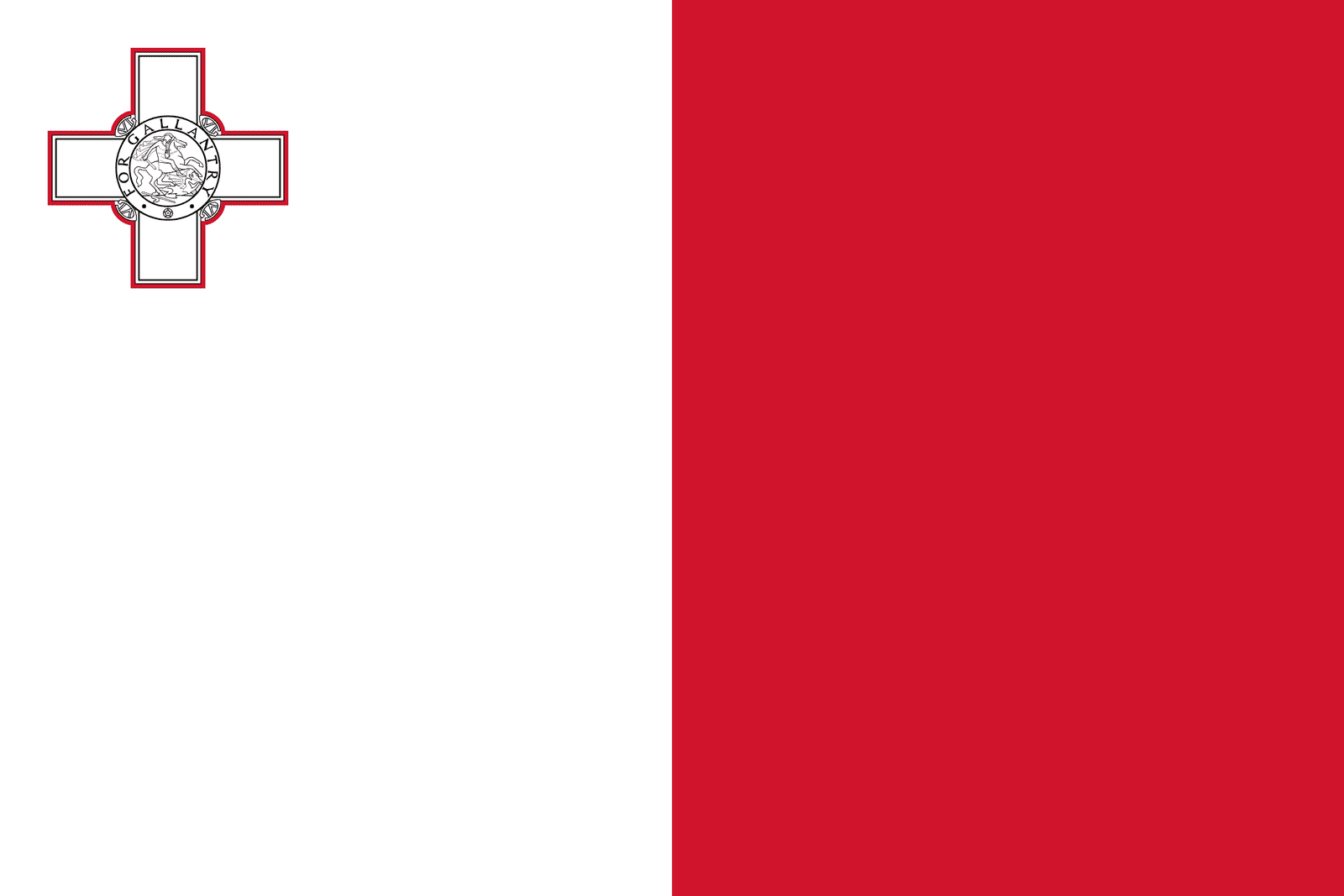
Flag of Malta
| Legal Name | Republic of Malta |
|---|---|
| Flag |
|
| Capital City |
Valletta |
| Total Area | 316 km² |
| Land Area | 316 km² |
| Water Area | Negligible inland water |
| Population | Approximately 525,000 |
| Major Cities | Birkirkara (24,000), Sliema (19,000), St. Julian's (13,000), Mosta (20,000) |
| Currency | Euro (EUR) |
| GDP | Approximately USD 22 billion |
| GDP Per Capita | Approximately USD 41,500 |
About of Malta
Malta is a small archipelago nation in the central Mediterranean Sea, south of Italy and north of Libya. Its strategic location has historically made it a vital hub for maritime trade, military defense, and cultural exchange. The country consists of three main inhabited islands—Malta, Gozo, and Comino—alongside several smaller uninhabited islets.
Malta has no land borders and is surrounded entirely by the Mediterranean. Valletta, the capital, is both the political and cultural heart of the nation, with historical fortifications and modern administrative functions. Birkirkara is the largest city by population and serves as a commercial and residential center. The islands collectively form one of the world’s most densely populated sovereign nations.
Internationally recognized as a sovereign republic, Malta is a member of the European Union, the United Nations, the Commonwealth of Nations, and the Eurozone. Its geopolitical importance stems from its central Mediterranean location, which historically made it a naval and military stronghold.
Etymology
The name “Malta” is believed to derive from the Greek word Melite, meaning “honey,” a reference to the island’s historical abundance of honey production. Linguistic roots also suggest Phoenician influence, with Maleth meaning “refuge” or “safe haven.” Over centuries, the name evolved into its modern form, reflecting Malta’s identity as both a sanctuary and a hub for trade and culture in the Mediterranean.
History
Prehistoric and Ancient Civilizations
Evidence of human habitation dates back to around 5900 BCE, with Neolithic temple complexes such as Ħaġar Qim and Mnajdra. These prehistoric sites demonstrate advanced architectural skills and rich ceremonial traditions.
Classical and Medieval Periods
The Phoenicians, Carthaginians, and Romans successively controlled Malta, integrating it into broader Mediterranean trade and culture. Christianity was introduced during Roman rule, becoming a defining feature of Maltese society. During the medieval period, the islands came under Arab control, introducing irrigation, new crops, and linguistic influences.
Major Empires, Kingdoms, and Colonial Rule
Malta was conquered by the Normans in 1091, later passing to the Kingdom of Sicily. In 1530, Emperor Charles V granted Malta to the Knights Hospitaller, who fortified the islands and repelled the Ottoman siege in 1565. The French briefly occupied Malta under Napoleon in 1798, followed by British rule beginning in 1814.
Independence Movement
Malta gained full independence from Britain on September 21, 1964, becoming a constitutional monarchy. It became a republic on December 13, 1974, maintaining membership in the Commonwealth. Malta joined the European Union in 2004 and adopted the euro in 2008.
Modern Political Developments
Malta has transitioned from a colonial outpost to a stable, democratic republic with a robust service-oriented economy. Its EU membership and strategic maritime position have enhanced political influence and economic development.
Government and Politics
Malta is a parliamentary republic with a multi-party system. The President serves as the ceremonial head of state, while executive power is vested in the Prime Minister and Cabinet. The unicameral House of Representatives legislates national law. Judicial authority is independent, with the Constitutional Court ensuring adherence to constitutional principles.
The nation is divided into local councils, each administering local services. Malta maintains strong international relations through EU and UN membership, Mediterranean partnerships, and Commonwealth ties. Defense responsibilities include a small Armed Forces of Malta, focusing on maritime security and civil protection, often collaborating with EU and NATO operations.
Economy
Malta has a high-income, diversified economy. The largest sectors are tourism, financial services, information technology, and manufacturing, particularly electronics and pharmaceuticals. Agriculture is limited due to scarce arable land, but local production includes vegetables, wine, and dairy products.
Malta’s strategic position supports shipping and maritime services. Key trade partners include Italy, Germany, the United Kingdom, and the European Union at large. Challenges include reliance on imports, housing pressures due to high population density, and climate vulnerability. The economy’s outlook remains positive due to EU integration, tourism growth, and technological innovation.
Demographics
The population is predominantly ethnic Maltese, with minorities including European expatriates and North African immigrants. Maltese and English are official languages; Italian is also widely spoken. Roman Catholicism is the dominant religion, shaping social customs, festivals, and holidays. About 95% of the population resides in urban areas, with steady population growth moderated by migration and limited land availability.
Culture and Society
Maltese culture reflects a blend of Mediterranean, Arab, and European influences. Family, religion, and community play central roles. Arts and literature thrive in traditional crafts, painting, music, and modern creative industries. Maltese cuisine emphasizes fish, rabbit, pasta, and pastries, blending Sicilian and North African flavors. Festivals such as Carnival, Festa Titulari, and Independence Day celebrate historical and religious traditions. Popular sports include football, water polo, and sailing.
Education and Healthcare
Education is compulsory until age 16, with high literacy rates and strong participation in tertiary education. Malta hosts a national university and several vocational institutions. The healthcare system is publicly funded, supplemented by private providers. Public health achievements include high vaccination coverage and life expectancy, although challenges include non-communicable diseases and health service accessibility.
Geography and Climate
Malta is characterized by low, rocky hills, limited freshwater sources, and a rugged coastline with bays and harbors. The islands experience a Mediterranean climate, with hot, dry summers and mild, wet winters. Natural hazards include occasional droughts and coastal erosion. Environmental concerns focus on urban expansion, water scarcity, and marine conservation.
Flora and Fauna
Native flora includes carob, olive, and citrus trees, while endemic plants like the Maltese centaury are culturally significant. Wildlife is limited, with seabirds, lizards, and introduced mammals. Marine biodiversity is rich, supporting fisheries and coral ecosystems. National parks and protected areas safeguard endangered species and coastal habitats
Map of Malta
Flag: Vertical bands of white and red with the George Cross outlined in red.
Coat of Arms: Features a shield with heraldic symbols representing Malta’s history, supported by a mural crown.
National Anthem: L-Innu Malti, expressing national pride and cultural heritage.
National Animals/Plants: Maltese Falcon (historical symbol), Maltese Cross, and endemic plant species like Maltese centaury.
National Flag (Detailed Section)
The Maltese flag features two vertical bands: white (hoist side) and red, symbolizing peace and courage. The George Cross, awarded by King George VI in 1942 for Malta’s bravery in World War II, occupies the upper hoist corner. Adopted in 1964, the flag reflects Malta’s historical resilience, sovereignty, and Mediterranean identity. Flag protocol includes display at government buildings, schools, and during national celebrations, with half-mast for mourning or national tragedies.
Flag flying days
| Date | Flag Position | Occasion or Reason |
|---|
| September 21 | Full-mast | Independence Day |
| December 13 | Full-mast | Republic Day |
| April 25 | Full-mast | Freedom Day |
| National mourning | Half-mast | Death of notable figures or national tragedies |